What Are RTD Sensors and How Do RTD Sensors Work?
Introduction to RTD Sensors
Accurate temperature measurement plays a critical role in modern industries. From chemical processing and power generation to food, pharmaceutical, and glass manufacturing, even small temperature variations can impact product quality, safety, and efficiency. This is why industries rely on precise and stable temperature sensors.
Among the various temperature measurement devices available today, RTD sensors are widely trusted for their accuracy, repeatability, and long-term stability. An RTD Sensor is specifically designed to deliver reliable temperature readings in demanding industrial environments.
In this blog, we will explore what are RTD sensors, how do RTD sensors work, the types of RTD sensors, their advantages, comparisons with other sensors, and how to choose the right RTD sensor for your application.
What Are RTD Sensors?
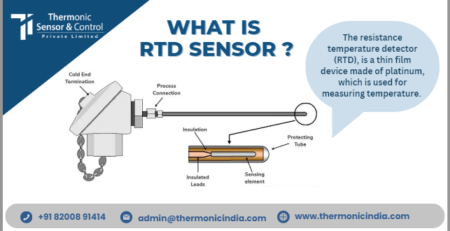
RTD sensors, also known as Resistance Temperature Detectors, are temperature sensors used to measure temperature by correlating the resistance of a metal element with temperature.
Definition of RTD Sensors
RTD sensors are precision temperature sensors that operate on the principle that the electrical resistance of certain metals increases predictably as temperature rises.
Full Form of RTD
RTD stands for Resistance Temperature Detector.
Basic Principle Behind RTD Sensors
The working principle of RTD sensors is simple:
- When temperature changes, the resistance of the RTD element changes.
- This resistance change is measured and converted into a temperature value.
Because the resistance-temperature relationship is stable and repeatable, RTD sensors are ideal for accurate temperature measurement.
Why RTDs Are Preferred Over Other Temperature Sensors
RTD sensors are preferred because they offer:
- High measurement accuracy
- Excellent repeatability
- Long-term stability
- Good linearity across a wide temperature range
This makes RTD sensors used to measure temperature in critical industrial processes where precision is essential.
Also Read : Types of Pressure Transmitter Used in Industry
Types of RTD Sensors
There are different types of RTD sensors, classified based on material and wiring configuration.
Types of RTD Sensors Based on Material
1. Platinum RTD (Pt100, Pt1000)
Platinum RTDs are the most commonly used RTD sensors.
- Pt100 RTD sensors have 100 ohms resistance at 0°C
- Pt1000 RTD sensors have 1000 ohms resistance at 0°C
- Extremely stable and accurate
- Suitable for wide industrial applications
2. Nickel RTD
- Less expensive than platinum
- Limited temperature range
- Lower stability over time
3. Copper RTD
- Good linearity
- Lower cost
- Limited to low-temperature applications
Types of RTD Sensors Based on Wiring Configuration
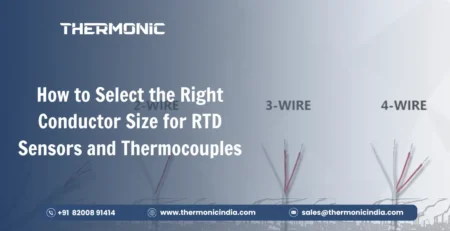
1. 2-Wire RTD
- Simplest configuration
- Affected by lead wire resistance
- Suitable for short distances
2. 3-Wire RTD
- Most commonly used in industries
- Compensates for lead wire resistance
- Good balance between cost and accuracy
3. 4-Wire RTD
- Highest accuracy
- Eliminates lead wire resistance completely
- Used in laboratories and precision applications
Understanding RTD sensors types helps in selecting the right sensor for your specific measurement needs.
How Do RTD Sensors Work?
Many people ask, how do RTD sensors work? The answer lies in the predictable behavior of metal resistance with temperature.
Principle of Resistance Change with Temperature
As temperature increases, the resistance of the RTD element increases. This relationship is nearly linear, especially for platinum RTDs.
Relationship Between Resistance and Temperature
RTD sensors use standardized resistance-temperature curves to convert resistance values into accurate temperature readings.
Role of Electrical Current in RTD Measurement
A small electrical current flows through the RTD element; as a result, the sensor responds predictably to temperature changes.
- First, the system measures the resulting voltage drop across the RTD element.
- Next, it calculates the electrical resistance using the measured voltage and known current.
- Finally, the system derives the temperature value directly from the calculated resistance.
Step-by-Step Working Process
- Temperature changes around the RTD sensor
- RTD element resistance varies accordingly
- Measuring instrument detects resistance change
- Signal is processed and converted into temperature value
This precise mechanism explains how RTD sensors work in industrial systems.
Advantages of RTD Sensors
RTD sensors offer several benefits that make them ideal for industrial temperature measurement.
High Accuracy and Repeatability
RTD sensors provide highly accurate readings with excellent repeatability, even over long periods.
Excellent Long-Term Stability
Unlike some sensors, RTDs maintain calibration stability for years with minimal drift.
Wide Temperature Measurement Range
RTDs can measure temperatures from cryogenic levels up to high industrial ranges. As a result, engineers develop high-temperature RTD sensors to withstand harsh conditions while maintaining accurate performance.
Better Linearity Compared to Thermocouples
RTD sensors offer a more linear response, simplifying signal processing and improving accuracy.
RTD Sensors vs Other Temperature Sensors
Understanding the difference between RTDs and other sensors helps in selecting the right solution.
1. RTD vs Thermocouple
Accuracy
- RTD sensors: Higher accuracy
- Thermocouples: Moderate accuracy
Temperature Range
- RTDs: Medium to high range
- Thermocouples: Very high temperatures
Cost Comparison
- RTDs: Higher initial cost
- Thermocouples: Lower cost
RTDs are preferred where precision is more important than extreme temperature range.
2. RTD vs Thermistor
Sensitivity
- Thermistors: Very sensitive at narrow ranges
- RTDs: Consistent sensitivity across wide ranges
Stability
- RTDs: Superior long-term stability
- Thermistors: Prone to drift
Typical Applications
- Thermistors: Consumer electronics
- RTDs: Industrial and process control applications
Also Read : Best Temperature Sensors for High Accuracy Applications
How to Choose the Right RTD Sensor
Choosing the right RTD sensor ensures accurate and reliable temperature measurement.
Required Temperature Range
Select RTD sensors suitable for your operating temperature, especially if high temperature RTD sensors are needed.
Accuracy and Tolerance Needs
Choose the appropriate class (Class A, Class B) based on accuracy requirements.
Environmental Conditions
Consider vibration, moisture, chemicals, and pressure exposure.
Mounting Type and Probe Length
Select proper probe length and mounting style for effective heat transfer.
Output and Connection Type
Choose suitable wiring configuration and output signals compatible with your system.
Selecting the right RTD sensor improves performance, safety, and process efficiency.
Looking for Reliable RTD Sensors? Talk to the Experts
RTD sensors are among the most reliable and accurate temperature sensors available today. Moreover, their high stability, repeatability, and precision actively enable industries to perform accurate temperature measurement in highly demanding and safety-critical applications.
Whether you need Pt100 RTD sensors, customized designs, or solutions for demanding industrial environments, choosing the right RTD sensor makes a significant difference in process control and product quality.
Contact Thermonic India today for high-quality, customized RTD sensor solutions designed to meet your exact industrial requirements.