RTD vs Thermocouple for Industrial Applications
Introduction
Temperature measurement plays a critical role in modern industrial processes. From chemical reactors and power plants to plastic extrusion lines and pharmaceutical production, accurate temperature control ensures safety, efficiency, and product quality. When selecting a temperature sensor, engineers often face one common question: RTD vs Thermocouple – which one is better for industrial applications?According to the National Institute of Standards and Technology (NIST), precise temperature measurement is essential for industrial calibration and process reliability.
At Thermonic India, a leading manufacturer of industrial temperature sensors, we regularly help customers understand the difference between RTD and thermocouple and choose the right solution for their plant conditions. Whether you are selecting a PT100 RTD sensor or a K-type thermocouple, understanding their working principles and performance differences is essential.
In this guide, we will clearly explain:
- What is difference between RTD and thermocouple
- RTD vs thermocouple comparison
- Thermocouple vs RTD sensor advantages
- Which sensor is suitable for your industrial application
What is an RTD?
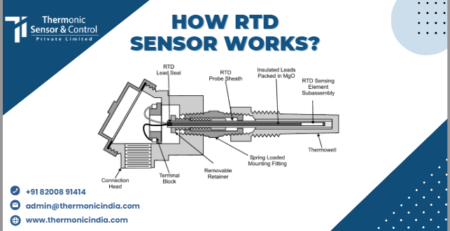
An RTD (Resistance Temperature Detector) is a temperature sensor that measures temperature based on changes in electrical resistance. The most common type used in industry is the PT100 RTD, made of platinum.
How RTD Works
As temperature increases, the resistance of platinum increases in a predictable and linear manner. This resistance change is measured and converted into temperature readings.
Common RTD Types
- PT100
- PT1000
- 2-wire, 3-wire, 4-wire configurations
Temperature Range
Typically: -200°C to 600°C
Advantages of RTD
- High accuracy
- Excellent long-term stability
- Linear output
- Reliable for moderate temperatures
Industrial Applications in India
At Thermonic India, RTDs are widely used in:
- Pharmaceutical plants
- Food processing industries
- HVAC systems
- Chemical manufacturing
- Plastic processing
RTDs are ideal where precision and repeatability are more important than extreme temperature tolerance.
Also Read : What Are RTD Sensors and How Do RTD Sensors Work?
What is a Thermocouple?
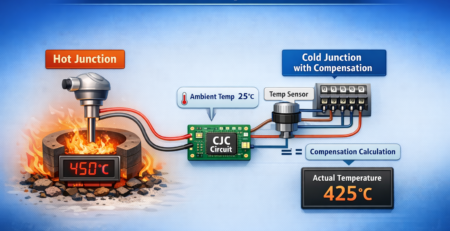
A thermocouple is a temperature sensing device formed by connecting two different metal wires together. It works on the Seebeck effect, where voltage is generated when two different metals are exposed to temperature differences.
Common Thermocouple Types
- Type K
- Type J
- Type T
- Type N
- Type R & S (high temperature)
Temperature Range
Typically: -200°C to 1800°C (depending on type)
Advantages of Thermocouple
- Handles extremely high temperatures
- Faster response time
- Durable in harsh environments
- Lower initial cost
Industrial Applications
Thermocouples from Thermonic India are commonly used in:
- Furnaces and kilns
- Power plants
- Boiler systems
- Metal processing industries
- Heat treatment plants
Difference Between RTD and Thermocouple
Many engineers search for:
- difference between RTD and thermocouple
- what is difference between RTD and thermocouple
- what is the difference between RTD and thermocouple
Let’s simplify it.
Thermocouple vs RTD – Key Comparison
1️⃣ Accuracy
RTD sensors provide higher accuracy and maintain consistent performance over time.
Thermocouples are slightly less accurate but acceptable for high-temperature applications.
👉 Winner: RTD
2️⃣ Temperature Range
RTDs are limited to moderate temperatures.
Thermocouples can measure extremely high temperatures (up to 1800°C).
👉 Winner: Thermocouple
3️⃣ Response Time
Thermocouples respond faster due to smaller mass and direct junction.
RTDs are slightly slower.
👉 Winner: Thermocouple
4️⃣ Durability
Thermocouples withstand vibration, shock, and harsh industrial conditions better.
RTDs are more delicate.
👉 Winner: Thermocouple
5️⃣ Cost
Thermocouples are generally cheaper.
RTDs cost more due to platinum element.
👉 Winner: Thermocouple (initial cost)
6️⃣ Stability & Long-Term Performance
RTDs offer better long-term stability and less drift.
Thermocouples may drift over time at high temperatures.
👉 Winner: RTD
RTD vs Thermocouple for Industrial Applications
The choice depends on application needs.
When to Choose RTD
Choose RTD if:
- You require high accuracy
- Temperature is below 600°C
- Stable process control is important
- Used in pharma, food, or laboratory settings
For example, pharmaceutical plants in Ahmedabad prefer PT100 RTDs for precise process monitoring.
When to Choose Thermocouple
Choose Thermocouple if:
- Temperature exceeds 600°C
- You need fast response
- Environment is harsh or vibrating
- Used in furnaces, boilers, and heat treatment
For high-temperature industrial environments across Gujarat and India, thermocouples are widely preferred.
Also Read : Best Temperature Sensors for High Accuracy Applications
Common Mistakes in Sensor Selection
- Ignoring maximum temperature range
- Not considering vibration
- Selecting wrong sheath material
- Overlooking calibration requirements
- Choosing cost over application suitability
At Thermonic India, we help customers avoid these mistakes by offering customised sensor solutions based on industrial needs.
Why Choose Thermonic India for Temperature Sensors?
As a trusted manufacturer of industrial temperature sensors in Ahmedabad, Thermonic India provides:
- PT100 RTD sensors
- Thermocouples (K, J, T types)
- Custom industrial probes
- High-temperature assemblies
- Industrial temperature monitoring solutions
Our sensors are used in manufacturing plants, chemical industries, power plants, and OEM machinery across India.
Conclusion: RTD vs Thermocouple – Which is Better?
There is no universal “best” sensor. The answer depends on your application requirements.
If accuracy and stability matter most, choose an RTD sensor.
If extreme temperature and durability are required, choose a thermocouple sensor.
Understanding the difference between RTD and thermocouple helps engineers make the right decision for process safety and efficiency.
If you are still unsure about RTD vs thermocouple for industrial applications, contact Thermonic India for expert guidance and customised temperature sensing solutions. Explore our range of PT100 RTD sensors and industrial thermocouples to find the perfect match for your process requirements.