

Best Temperature Sensors for High Accuracy Applications
Introduction
Accurate temperature measurement is a critical requirement across modern industries. From pharmaceutical manufacturing and food processing to chemical plants and glass production, temperature directly affects product quality, safety, and process efficiency. Even minor temperature variations can lead to production losses, compliance issues, or equipment damage.
This is why selecting the best temperature sensors for high accuracy applications is not just a technical decision, but a strategic one. With multiple sensing technologies available today, industries must choose industrial temperature sensors that offer precision, stability, and reliability under real-world operating conditions.
In this blog, we explore the most commonly used high accuracy temperature sensors, explain how they work, compare their performance, and help you identify the right solution for your application.
Importance of Accurate Temperature Measurement
Temperature plays a key role in controlling industrial processes and maintaining consistent output quality. Accurate temperature measurement ensures that processes operate within defined limits and meet regulatory standards.
Impact of Temperature Accuracy on Industrial Processes
- Product Quality Control: Precise temperature control ensures uniformity and reduces defects.
- Process Efficiency: Accurate readings prevent overheating or underheating, saving energy and reducing waste.
- Operational Safety: Monitoring high temperatures helps prevent equipment failure and workplace hazards.
- Regulatory Compliance: Industries such as pharmaceuticals, food & beverage, and chemicals require strict temperature validation.
Overview of High-Accuracy Temperature Sensing Technologies
High-accuracy temperature measurement is achieved using technologies such as RTDs, thermocouples, thermistors, platinum sensors, semiconductor sensors, and infrared sensors. Each sensor type offers different advantages depending on accuracy requirements, temperature range, and environmental conditions.
What Is a High-Accuracy Temperature Sensor?
Definition and Accuracy Standards
A high-accuracy temperature sensor is designed to measure temperature with minimal deviation from the true value over a specified operating range. Accuracy is defined by international standards such as IEC 60751 for RTDs and ASTM specifications for thermocouples.
Key Parameters Affecting Accuracy
1. Tolerance
Tolerance defines the maximum allowable deviation from the actual temperature. Sensors with tighter tolerances provide higher accuracy.
2. Stability
Stability refers to the sensor’s ability to maintain accuracy over time without significant drift.
3. Repeatability
Repeatability indicates how consistently a sensor produces the same output when exposed to the same temperature repeatedly.
Difference Between Accuracy and Precision
- Accuracy measures how close the reading is to the actual temperature.
- Precision refers to how repeatable the measurements are.
A sensor may be precise but inaccurate if it consistently reports the wrong value, highlighting the importance of proper calibration.
Also Read : Cold Junction Compensation in Thermocouples
Factors to Consider When Selecting High-Accuracy Temperature Sensors
Selecting the right sensor involves a careful assessment of multiple factors.
1. Temperature Range
Ensure the sensor can accurately measure temperatures within your process limits without degradation.
2. Response Time
Fast response time is essential for processes with rapid temperature changes.
3. Environmental Conditions
Consider vibration, pressure, moisture, chemicals, and corrosive environments.
4. Long-Term Stability and Drift
High-accuracy applications demand sensors with minimal drift over long periods.
5. Calibration Requirements
Sensors should support easy calibration and traceability to international standards.
6. Output Signal Compatibility
The sensor’s output must be compatible with control systems, transmitters, or data loggers.
Best Temperature Sensors for High Accuracy Applications
1. RTD (Resistance Temperature Detector)
➯ Working Principle
RTDs measure temperature by detecting changes in electrical resistance of a metal element, typically platinum. As temperature increases, the resistance of the element increases in a predictable manner.
➯ Accuracy Levels (Class A, Class AA, Class B)
- Class AA: Extremely high accuracy for critical applications
- Class A: High accuracy for industrial use
- Class B: Standard industrial accuracy
➯ Advantages
- Excellent accuracy and repeatability
- Long-term stability
- Suitable for wide industrial use
➯ Typical Applications
- Process industries such as chemical and petrochemical plants
- Laboratories and calibration systems
- Glass industry temperature sensors for controlled heating processes
RTDs are among the most widely used high accuracy temperature sensors in industrial environments.
2. Thermistor Temperature Sensors
➯ Operating Principle
Thermistors are temperature-sensitive resistors that exhibit large resistance changes with small temperature variations. They are available as NTC (Negative Temperature Coefficient) and PTC (Positive Temperature Coefficient).
➯ High Sensitivity in Narrow Temperature Ranges
Thermistors offer extremely high sensitivity, making them ideal for applications requiring precise measurement over limited temperature ranges.
➯ Advantages
- High sensitivity
- Fast response time
- Compact and cost-effective
➯ Limitations
- Narrow temperature range
- Non-linear response compared to RTDs
➯ Common Applications
- Medical equipment
- HVAC systems
- Electronics and appliances
Thermistors are best suited for controlled environments where temperature ranges are limited.
3. Thermocouple Temperature Sensors
➯ Working Principle
Thermocouple sensors operate on the Seebeck effect, where a voltage is generated when two dissimilar metals are joined and exposed to temperature differences. This voltage corresponds to temperature.
➯ Common Thermocouple Types
- K-Type Thermocouple: Most widely used, suitable for high temperatures
- J-Type Thermocouple: Used for lower temperature industrial applications
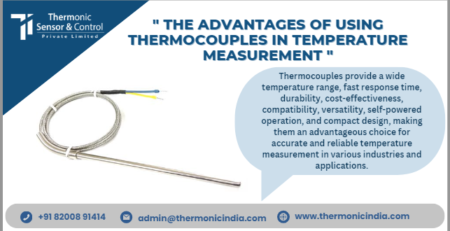
Thermocouples are widely used industrial temperature sensors due to their ruggedness.
➯ Accuracy Considerations
Thermocouples generally provide slightly lower accuracy than RTDs but perform exceptionally well at very high temperatures.
➯ Advantages
- Wide operating temperature range
- Fast response time
- Durable and vibration-resistant
- Cost-effective
➯ Limitations
- Lower accuracy compared to RTDs
- Requires cold junction compensation
- Potential long-term drift
➯ Typical Applications
- Glass furnaces and kilns
- Metal processing and heat treatment
- Boilers and reactors
Thermocouples are ideal for extreme temperature environments where other sensors may fail.
4. Platinum Temperature Sensors (Pt100 / Pt1000)
➯ Why Platinum Offers High Accuracy
Platinum has a stable and repeatable resistance-temperature relationship, making it ideal for precision temperature measurement.
➯ Stability and Repeatability Benefits
- Minimal drift
- Excellent repeatability
- Long service life
➯ Industrial and Scientific Applications
- Pharmaceutical manufacturing
- Food and beverage processing
- Power plants
- Research laboratories
Pt100 and Pt1000 sensors are among the most reliable industrial temperature sensors for high-accuracy applications.
5. Semiconductor (IC-Based) Temperature Sensors
➯ Digital and Analog IC Sensors
These sensors convert temperature directly into electrical signals and are available with digital or analog outputs.
➯ Accuracy and Resolution
Modern IC sensors offer good accuracy and resolution in controlled environments.
➯ Best Use Cases
- Electronics and PCB temperature monitoring
- Data centers
- Embedded systems
They are ideal for low to moderate temperature ranges.
6. Infrared (Non-Contact) Temperature Sensors
➯ Measurement Principle
Infrared sensors measure temperature by detecting thermal radiation emitted from an object’s surface.
➯ Accuracy Considerations
Accuracy depends on emissivity, distance, and environmental conditions.
➯ Advantages for Moving or Hazardous Targets
- No physical contact required
- Suitable for moving or inaccessible objects
- Extremely fast response
➯ Typical Applications
- Glass manufacturing
- High-temperature metal processing
- Hazardous environments
Applications Requiring High Accuracy Temperature Measurement
- Pharmaceutical manufacturing – process validation and compliance
- Food & beverage processing – quality and safety control
- Chemical & petrochemical industries – reaction control
- Power plants – equipment protection and efficiency
- Research laboratories – testing and calibration
Also Read : Advanced Industrial Sensors for Process Stability
How to Choose the Best Temperature Sensor for Your Application
1. Matching Sensor Type to Application Needs
Select sensors based on required accuracy, temperature range, and process conditions.
2. Environmental and Process Conditions
Consider pressure, vibration, chemical exposure, and mounting requirements.
3. Compliance with Industry Standards
Ensure sensors meet applicable industrial and safety standards.
Looking for Reliable High-Accuracy Temperature Sensors? Let’s Get You the Right Solution
Choosing the right temperature sensor is essential for process control, safety, and product quality. Whether you need high accuracy temperature sensors for pharmaceuticals, rugged industrial temperature sensors for harsh environments, or specialized glass industry temperature sensors, the right choice can significantly improve your operations.
Thermonic India offers a complete range of RTDs, thermocouples, platinum sensors, thermistors, and infrared temperature solutions designed for accuracy, durability, and long-term performance.
👉 Explore Thermonic India’s temperature sensor solutions today and get expert support tailored to your application.



Comment (1)
[…] Also Read : Best Temperature Sensors for High Accuracy Applications […]
Comments are closed.