Top Industrial Applications of Thermocouples Sensors in 2026
Summarize this blog post with:


Introduction to Thermocouple Sensors
Temperature monitoring is essential in nearly every manufacturing process. Whether you operate a steel plant or a food processing facility, maintaining the exact temperature guarantees product quality and workplace safety. This is why understanding the applications of thermocouples is so important in modern industries. Thermocouple sensors stand out as the standard tool for this job. A thermocouple sensor is a highly reliable device that measures temperature by reading the voltage created across two different metals.
Why do these devices remain so popular in 2026? Simply put, they offer unmatched durability and precision. Modern industries push equipment to the limits with extreme heat and high pressure. Thermocouples handle these conditions easily. From automotive production lines to massive oil refineries, the need for accurate temperature tracking only grows stronger. Finding a reputable thermocouple manufacturer in india, or thermocouple suppliers near me, ensures you get high-quality sensors tailored to these demanding environments.
Throughout this guide, we will explore exactly what are the common applications of thermocouples and why they dominate the temperature measurement market. We will also look at the top industrial applications of thermocouples that drive modern manufacturing forward.
What Are Thermocouple Sensors and How Do They Work?
Basic Working Principle
To understand any industrial application of thermocouple technology, you first need to know how these devices operate. They rely on a scientific concept called the Seebeck effect. Discovered in the 1800s, this principle states that a temperature difference between two dissimilar electrical conductors produces a voltage.
Two Dissimilar Metals Generating Voltage When Heated
A standard thermocouple consists of two different metal wires joined together at one end. We call this junction the measuring end. When you heat or cool this junction, it creates a small electrical voltage. The sensor sends this voltage reading back to a controller, which translates the electrical signal into a readable temperature. This simple, elegant design is exactly what makes the application of thermocouple sensors so highly dependable across various fields.
Key Features of Thermocouple Sensors
Wide Temperature Range
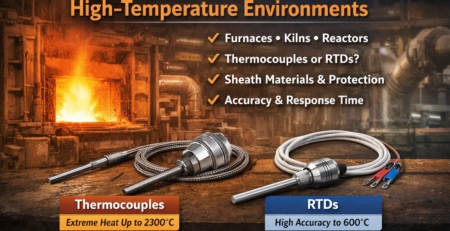
One of the main reasons the application of thermocouple technology is so widespread is the incredible temperature range these sensors can handle. Certain thermocouple types can measure temperatures as low as -200°C and as high as 2300°C.
Fast Response Time
When processes change rapidly, you need a sensor that keeps up. Because they feature a simple, exposed or thinly protected junction, thermocouples react to temperature changes in fractions of a second. This rapid feedback is crucial for any application of thermocouple in industry where sudden temperature spikes cause safety hazards.
Durability in Harsh Environments
Factories are tough environments. Sensors face constant vibration, high pressure, and corrosive chemicals. Thermocouples feature rugged outer sheaths made from stainless steel or specialized alloys. This protection ensures long-lasting performance, expanding the applications of thermocouple sensors into the most brutal manufacturing settings.
Cost-Effective Compared to Other Sensors
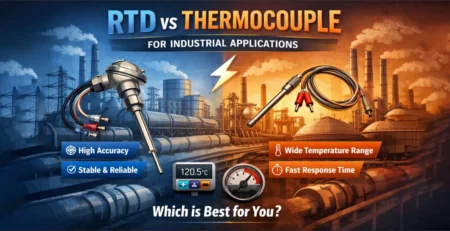
When you compare them to Resistance Temperature Detectors (RTDs) or thermistors, thermocouples offer a massive cost advantage. They deliver high-tier performance without the high-tier price tag. This cost-effectiveness makes them the go-to choice when a facility requires hundreds of temperature measurement points.
Why Thermocouple Sensors Are Widely Used in Industrial Applications
Ability to Measure Extremely High Temperatures
No other sensor handles extreme heat quite like a thermocouple. In metalworking and glass production, temperatures routinely exceed 1000°C. Other measuring devices simply melt or fail. The applications of thermocouples shine here because specific metal pairings (like platinum and rhodium) thrive in this intense heat.
Reliable Performance in Demanding Environments
Whether submerged in liquid, exposed to vacuum environments, or buried under high-pressure steam, these sensors keep working. This incredible reliability forms the backbone of process safety management.
Suitable for Continuous Industrial Processes
Many industrial plants operate 24 hours a day, 7 days a week. Shutting down a process to replace a faulty sensor costs thousands of dollars in lost production. Because thermocouples last a long time and provide consistent readings, they perfectly support continuous industrial processes.
Compatible with Automation and Control Systems
As factories upgrade to smart automation, sensors must communicate seamlessly with central control systems. Thermocouple signals easily integrate with modern Programmable Logic Controllers (PLCs) and digital monitoring software. This compatibility ensures that the industrial applications of thermocouples will continue to grow as factories become more automated.
Also Read : Types of Temperature Sensors Used in Industrial Applications
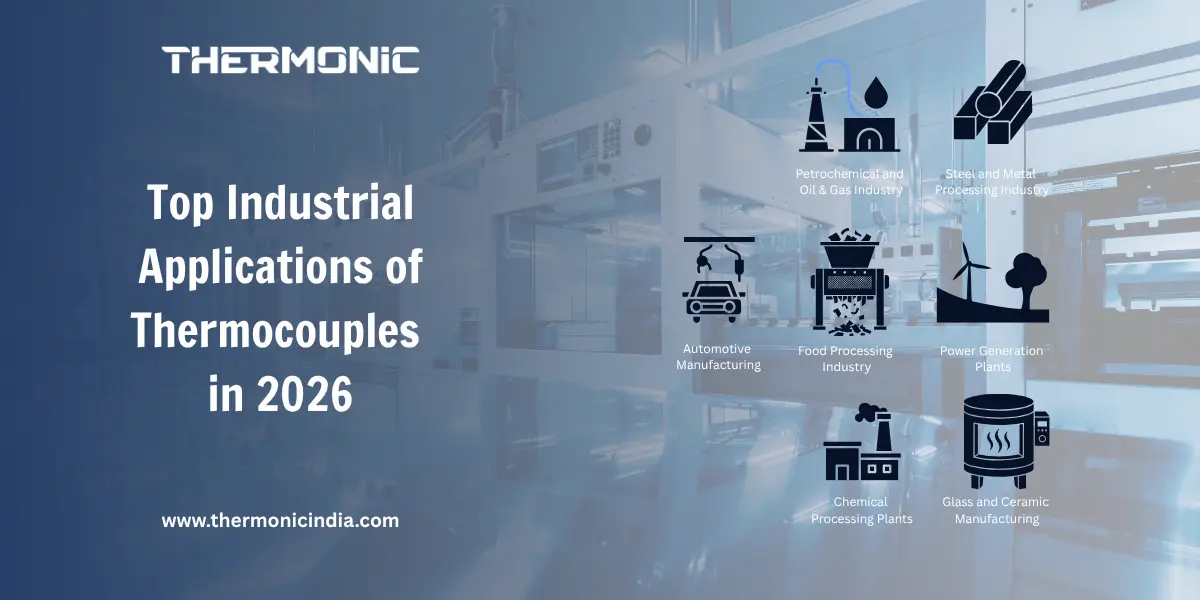
Top Industrial Applications of Thermocouples in 2026
The diverse applications of thermocouple technology touch almost every sector. Let us break down the top industrial use cases in 2026.
1. Steel and Metal Processing Industry
The steel industry relies heavily on extreme heat to melt, forge, and shape metal.
- Furnace temperature monitoring: Blast furnaces operate at staggering temperatures. Thermocouples ensure the furnace stays within safe and optimal limits.
- Molten metal measurement: Technicians use specialized sensors dipped directly into molten metal to check its exact temperature before pouring.
- Heat treatment processes: Hardening and tempering steel requires precise temperature control to achieve the right metal structure.
- Casting and forging operations: Monitoring the cooling rate of metal prevents structural weaknesses.
2. Petrochemical and Oil & Gas Industry
The petrochemical sector presents unique challenges, primarily involving highly combustible materials and harsh chemicals.
- Refinery process temperature monitoring: Crude oil separation requires highly specific temperature zones.
- Reactor temperature control: Chemical reactions often generate their own heat. Sensors monitor these reactors to prevent dangerous thermal runaways.
- Pipeline temperature measurement: Keeping fluids moving through pipelines often requires heat tracing. Sensors ensure the pipes stay warm enough to prevent clogs.
- Hazardous environment monitoring: Explosion-proof thermocouple casings allow for safe temperature monitoring in highly volatile zones.
3. Power Generation Plants
Whether using fossil fuels, nuclear energy, or renewable sources, power plants need exact temperature data to generate electricity efficiently.
- Boiler temperature monitoring: Sensors track the water and steam temperatures inside massive boilers to prevent pressure explosions.
- Turbine exhaust temperature measurement: Monitoring exhaust gas helps engineers assess the health and efficiency of the turbine.
- Heat recovery systems: Capturing and reusing waste heat is a massive trend in 2026. Sensors track this transferred energy.
- Energy efficiency optimization: Accurate temperature data allows power plants to burn less fuel while producing more electricity.
4. Glass and Ceramic Manufacturing
Making glass and ceramics requires heating materials until they melt or fuse together.
- Kiln temperature monitoring: Firing ceramics requires a slow, controlled rise in heat. Thermocouples track this exact curve.
- Glass melting furnaces: Glass flows properly only at specific high temperatures.
- Ceramic firing processes: Proper heat ensures the final ceramic product has no cracks or weak points.
- High-temperature production environments: The ambient heat in these factories requires sensors that can withstand constant thermal stress.
5. Food Processing Industry
While we often think of heavy industry, the food sector relies on these sensors just as much. Interestingly, the application of thermocouple in daily life often starts here, ensuring the food you eat is safe.
- Oven and cooking temperature control: Industrial bakeries use sensors to ensure thousands of loaves of bread bake perfectly at once.
- Sterilization and pasteurization processes: Milk and juice must reach exact temperatures to kill bacteria without ruining the taste.
- Packaging temperature monitoring: Sealing plastic packaging requires precise heat. Too cool, and the package leaks; too hot, and the plastic melts.
- Safety and quality control: Maintaining an unbroken cold chain or hot chain is a primary application of thermocouple sensors in the food sector.
6. Chemical Processing Plants
Chemical plants handle aggressive acids, bases, and solvents.
- Reactor temperature control: Similar to petrochemicals, chemical reactors need strict monitoring to ensure reactions happen safely and efficiently.
- Distillation column monitoring: Separating chemicals based on their boiling points relies entirely on accurate temperature tracking.
- Process safety management: Alarms triggered by thermocouples can automatically shut down systems if temperatures rise too quickly.
- Corrosion-resistant temperature sensing: By using Teflon or other special coatings, thermocouples can survive inside vats of corrosive acid.
7. Automotive Manufacturing
Car manufacturing blends heavy industry with precise technology.
- Engine testing and development: Engineers use thermocouples to track cylinder temperatures during prototype engine testing.
- Exhaust gas temperature measurement: Monitoring exhaust helps automakers tune engines to meet strict 2026 emissions standards.
- Paint curing ovens: Car bodies move through massive ovens to bake the paint. Sensors ensure an even cure.
- Component heat treatment: Making strong gears and axles requires precise heat treatment tracked by specialized sensors.
Factors to Consider When Selecting Thermocouple Sensors
Choosing the right sensor determines the success of your temperature monitoring strategy.
Temperature range required
Always match the sensor to your maximum and minimum expected temperatures.
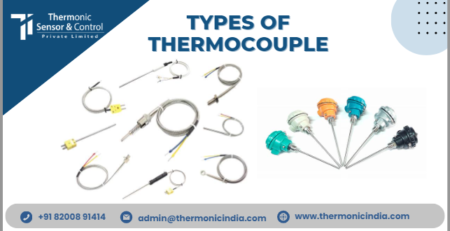
Sensor type (K, J, T, etc.)
Type K is the most common for general use, while Type S or R works best for extreme heat.
Environmental conditions
Consider if the sensor will face moisture, vibration, or corrosive chemicals. Choose the appropriate protective sheath.
Accuracy requirements
Determine how much temperature variance your process can tolerate.
Response time
If you need instant readings, choose an exposed junction. If you need durability, choose a grounded or ungrounded junction.
Also Read : Best Temperature Sensors for High Accuracy Applications
Future Trends of Thermocouple Sensors in 2026 and Beyond
Integration with Industrial IoT (IIoT)
The applications of thermocouples now involves wireless transmitters that send data directly to cloud-based dashboards.
Smart temperature monitoring systems
AI now analyzes temperature trends in real-time, adjusting burners and valves automatically.
Improved materials for extreme environments
New ceramic and exotic metal sheaths allow sensors to survive even longer in brutal conditions.
Predictive maintenance using sensor data
Instead of waiting for a machine to break, plants use temperature data to predict when a bearing or motor is about to fail.
Conclusion: Ready to Upgrade Your Industrial Applications of Thermocouples Sensors in 2026?
From massive steel blast furnaces to industrial baking ovens, the application of thermocouple technology remains essential. We have explored the diverse applications of thermocouple sensors across multiple sectors, highlighting their durability, speed, and wide temperature range. Selecting the correct sensor ensures your machinery runs smoothly, your products maintain high quality, and your workers stay safe.
Working with a reliable thermocouple manufacturer in india guarantees that you receive sensors built exactly to your unique process specifications. As automation and IIoT continue to evolve, we encourage you to invest in high-quality temperature measurement solutions. A small investment in the right sensor prevents massive losses in production downtime.