Types of Temperature Sensors Used in Industrial Applications
Introduction
Temperature control plays a critical role in almost every industrial process from manufacturing and pharmaceuticals to oil & gas and food processing. Accurate monitoring ensures product quality, equipment safety, and energy efficiency. That is why understanding types of temperature sensors and their industrial applications is essential for engineers and plant managers.
If you want to understand the fundamentals first, you can also read our detailed guide on what are temperature sensors and how they work in industrial environments. Additionally, explore our in-depth comparison on industrial temperature sensors to help you choose the right solution for your plant.
In this blog, we will explore:
- What are temperature sensors
- Different types of temperature sensors
- Types of temperature sensors used in industries
- Applications of temperature sensors
- How to select the right sensor
What Are Temperature Sensors?
Before discussing the different types of temperature sensors, let’s understand the basics.
Temperature sensors are devices that detect heat energy and convert it into a measurable signal (electrical resistance, voltage, or digital output). This signal is then displayed, recorded, or used by a control system for process automation.
In simple words, temperature sensors help machines “understand” how hot or cold something is.
In industrial environments, temperature sensors are used for:
- Process control
- Safety monitoring
- Quality assurance
- Energy management
Also Read : RTD vs Thermocouple for Industrial Applications
Types of Temperature Sensors
There are several types of temperature sensors, each designed for specific operating conditions. The main categories include:
- Thermocouples
- RTDs (Resistance Temperature Detectors)
- Thermistors
- Infrared (Non-Contact) Sensors
- Semiconductor-Based Sensors
Let’s explore them in detail.
1. Thermocouples
Thermocouples are among the most widely used industrial temperature sensors due to their wide temperature range and durability.
Working Principle
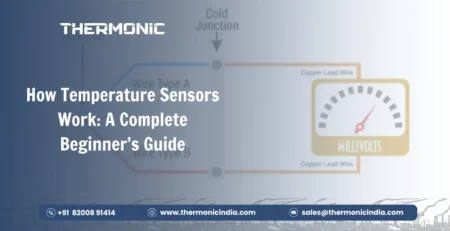
They operate on the Seebeck Effect — when two different metals are joined together, they generate a small voltage proportional to temperature.
Common Types
- Type K
- Type J
- Type T
- Type E
- Type N
- Type R, S, and B (high-temperature applications)
Advantages
- Wide temperature range (-200°C to 1700°C)
- Fast response time
- Suitable for harsh environments
- Cost-effective
Applications
- Furnaces
- Boilers
- Heat treatment plants
- Steel and glass industries
2. RTDs (Resistance Temperature Detectors)
RTDs are highly accurate and stable sensors commonly used where precision is critical.
Working Principle
RTDs measure temperature based on the change in electrical resistance of a metal (usually platinum).
Common Types
- PT100
- PT1000
Advantages
- High accuracy
- Excellent repeatability
- Long-term stability
Applications
- Pharmaceutical industries
- Food processing plants
- Chemical reactors
- Laboratory measurements
3. Thermistors
Thermistors are temperature-sensitive resistors that provide high sensitivity within a limited range.
Types
- NTC (Negative Temperature Coefficient)
- PTC (Positive Temperature Coefficient)
Advantages
- High sensitivity
- Quick response
- Compact size
Limitations
- Limited temperature range
- Less suitable for extreme industrial environments
Applications
- HVAC systems
- Electronic devices
- Battery monitoring systems
4. Infrared (Non-Contact) Temperature Sensors
Infrared sensors measure temperature without touching the object.
Working Principle
They detect thermal radiation emitted by an object and convert it into a temperature reading.
Advantages
- No physical contact
- Ideal for moving objects
- Suitable for hazardous areas
Applications
- Steel manufacturing
- Glass production
- High-speed conveyor systems
5. Semiconductor-Based Temperature Sensors
These sensors use integrated circuits to measure temperature.
Advantages
- High precision in limited ranges
- Easy integration with electronic systems
- Digital output compatibility
Applications
- Control panels
- Embedded systems
- Automation equipment
Industrial Temperature Sensors: Key Selection Factors
When choosing among the different types of temperature sensors, consider the following:
- Required temperature range
- Accuracy level
- Environmental conditions
- Response time
- Chemical exposure
- Budget
Selecting the wrong sensor can lead to measurement errors, product rejection, and increased downtime.
Applications of Temperature Sensors in Industry
The applications of temperature sensors vary widely across industries.
1. Manufacturing Industry
- Injection molding
- CNC machining
- Heat treatment processes
2. Oil & Gas Industry
- Pipeline monitoring
- Refinery process control
- Tank storage systems
3. Chemical & Pharmaceutical Industry
- Reactor monitoring
- Sterilization systems
- Batch processing
4. Food & Beverage Industry
- Pasteurization
- Cold storage monitoring
- Cooking and baking systems
5. Power Plants
- Boiler monitoring
- Turbine supervision
- Steam temperature control
Without reliable temperature measurement, maintaining quality and safety in these industries would be nearly impossible.
Comparison of Different Types of Temperature Sensors
| Sensor Type | Temperature Range | Accuracy | Cost | Best For |
| Thermocouple | Very Wide | Moderate | Low | High-temperature applications |
| RTD | Moderate | High | Medium | Precision industries |
| Thermistor | Limited | Very High (within range) | Low | Electronics |
| Infrared | Wide | High | High | Non-contact measurement |
| Semiconductor | Limited | Good | Low | Automation panels |
Why Industrial Temperature Sensors Matter
Modern industries rely heavily on automation and data-driven control systems. Reliable industrial temperature sensors help:
- Improve product quality
- Reduce energy consumption
- Prevent equipment damage
- Increase plant safety
- Ensure regulatory compliance
Even small temperature deviations can lead to major financial losses in large-scale production.
Also Read : Best Temperature Sensors for High Accuracy Applications
Your Trusted Partner for Temperature Sensors Used in Industrial Applications
Choosing the right types of temperature sensors used in industrial applications is not just a technical decision — it’s a strategic investment in your plant’s performance and reliability. Whether you need thermocouples for extreme heat or RTDs for high-precision measurement, the right solution can dramatically improve efficiency and reduce downtime.
If you’re still exploring what are temperature sensors, comparing the different types of temperature sensors, or evaluating the best industrial temperature sensors for your process, our team is here to guide you every step of the way.
With the right temperature sensor, you can achieve:
- Accurate monitoring
- Stable process control
- Improved production efficiency
- Long-term operational reliability
Don’t leave critical process measurements to guesswork. Let industry experts help you select the most suitable solution based on your application, environment, and compliance needs.
Connect with us today to discuss your requirements and find the ideal temperature sensor solution for your industry.