

How to Choose the Right Temperature Sensor for Electric Vehicle Battery Management
Summarize this blog post with:


Introduction
Electric vehicle manufacturers need accurate, reliable temperature measurements to develop battery systems that perform consistently under different operating conditions. From battery cell monitoring to cooling system control, selecting the right temperature sensor is an important part of designing an effective Battery Management System (BMS).
The right temperature sensor for electric vehicle battery management helps engineers monitor temperature changes, identify abnormal heating and support appropriate charging and thermal management strategies. However, not every sensor technology is suitable for every measurement point. Factors such as accuracy, response time, installation space, electrical compatibility and overall cost must be considered before making a purchase.
In this guide, we explain how NTC thermistors, RTD sensors and thermocouples compare, what EV manufacturers should evaluate before selecting a sensor, and how to identify a suitable solution for their battery application.
For background on electric vehicle technologies, explore the U.S. Department of Energy’s Vehicle Technologies Office.
Why Is Temperature Monitoring Important in EV Battery Management?
An EV battery operates under changing electrical loads, charging conditions and environmental temperatures. Monitoring these changes allows the BMS to make informed decisions and helps the vehicle’s thermal management system maintain suitable operating conditions.
Preventing Battery Overheating
Battery cells generate heat during charging and discharging. Uneven cooling, high electrical loads or faults can cause certain areas of a battery pack to become hotter than others.
An appropriately positioned EV battery temperature sensor helps the BMS identify abnormal temperature changes. The system can then trigger suitable responses, such as reducing charging current, adjusting cooling or activating protective measures according to its control strategy.
Temperature sensors support this process, but their effectiveness depends on correct placement, calibration and integration with the BMS.
Improving Battery Performance and Lifespan
Battery performance is affected by operating temperature. Conditions outside the battery manufacturer’s recommended limits can reduce efficiency and accelerate degradation.
Electric vehicle battery temperature monitoring helps engineers understand temperature distribution across battery cells and modules. This information supports thermal management decisions, helps identify uneven heating and can contribute to more consistent battery operation over time.
Supporting Safe and Efficient Charging
Fast charging increases the importance of accurate temperature measurements. The BMS uses sensor readings alongside other battery parameters to determine whether charging conditions remain within approved limits.
Reliable readings help the system adjust charging current or activate protective measures when necessary. However, temperature monitoring must work with suitable control logic and other safety mechanisms to provide effective protection.
Types of Temperature Sensors Used in EV Battery Management
Choosing the right sensor starts with understanding how different technologies measure temperature and where each performs best.
NTC Thermistors for EV Battery Monitoring
Best suited for consideration in compact, cost-sensitive battery monitoring applications.
An NTC (Negative Temperature Coefficient) thermistor is a resistance-based sensor whose electrical resistance decreases as temperature increases.
NTC thermistors are widely used in electronic temperature measurement because they offer high sensitivity over a selected temperature range, compact dimensions and economical implementation.
Key advantages for EV manufacturers:
- Compact construction for battery modules with limited installation space.
- High sensitivity to temperature changes within the intended operating range.
- Cost-effective implementation across multiple measurement points.
- Compatibility with suitable BMS measurement circuits.
What should you consider?
NTC thermistors have a nonlinear resistance-temperature relationship. The BMS therefore requires an appropriate conversion method, calibration and signal-processing design. Engineers should also verify the sensor’s tolerance, response time, operating range and mounting method.
For manufacturers seeking a practical NTC thermistor for EV battery monitoring, the final specification should match the battery design and the requirements of the measurement electronics.
RTD Sensors for Stable Temperature Measurement
Worth evaluating when measurement stability and repeatability are important.
Resistance Temperature Detectors (RTDs) measure temperature through a predictable change in electrical resistance. Common types include PT100 and PT1000 sensors, which have nominal resistances of 100 ohms and 1,000 ohms, respectively, at 0°C.
RTDs are valued for their stability, repeatability and accuracy when appropriately specified and installed.
Potential advantages for EV applications:
- Stable resistance-based measurements.
- Good repeatability for applications requiring consistent temperature readings.
- Availability in different probe designs and configurations.
- Potential use in battery cooling circuits, thermal management equipment and selected battery monitoring points.
What should you consider?
RTD selection requires attention to probe size, thermal contact, wiring configuration, excitation current and measurement circuit compatibility. Self-heating and installation constraints must also be assessed.
An RTD sensor for electric vehicles may be suitable for selected applications, but its response time and physical dimensions should be evaluated before using it for compact battery cell monitoring.
Thermocouples for Battery Testing and Thermal Applications
Useful for evaluating temperature across a broad range of testing conditions.
A thermocouple consists of two dissimilar metal conductors joined to produce a temperature-dependent voltage. The measurement system interprets this voltage to determine temperature, using suitable reference-junction compensation.
Thermocouples are available in different types, constructions and temperature ranges, making them useful for engineering tests and selected industrial applications.
Key advantages:
- Broad temperature measurement capability, depending on the thermocouple type.
- Availability in rugged probe and customised assembly designs.
- Potential suitability for battery development, thermal testing and monitoring selected components.
- Flexible installation options for different test setups.
What should you consider?
Thermocouple measurements require appropriate signal conditioning and cold-junction compensation. Wiring, electrical noise, probe attachment and measurement accuracy must also be evaluated.
A thermocouple for battery temperature measurement can be valuable in development and validation work, particularly where engineers need to study thermal behaviour under different test conditions. Its suitability for continuous vehicle battery monitoring depends on the application and system design.

How Do NTC, RTD and Thermocouple Sensors Compare?
| Selection factor | NTC thermistor | RTD sensor | Thermocouple |
| Main advantage | High sensitivity | Stability and repeatability | Wide temperature range |
| Output | Resistance | Resistance | Voltage |
| Typical strength | Compact and economical | Consistent measurements | Rugged construction |
| Main consideration | Nonlinear response | Wiring and measurement circuit | Cold-junction compensation |
| Potential EV application | Cell and module monitoring | Cooling circuits and selected thermal systems | Testing and thermal validation |
The best choice depends on the measurement point, required accuracy, response time and BMS design. For many EV manufacturers, using different sensor technologies at different points may be more appropriate than relying on one type throughout the vehicle.
Also Read : Best Temperature Sensors Used in Electric Vehicles: Types, Applications and Benefits
Key Factors to Consider When Choosing an EV Battery Temperature Sensor
Before requesting a quotation, evaluate these technical requirements to avoid integration problems and unnecessary costs.
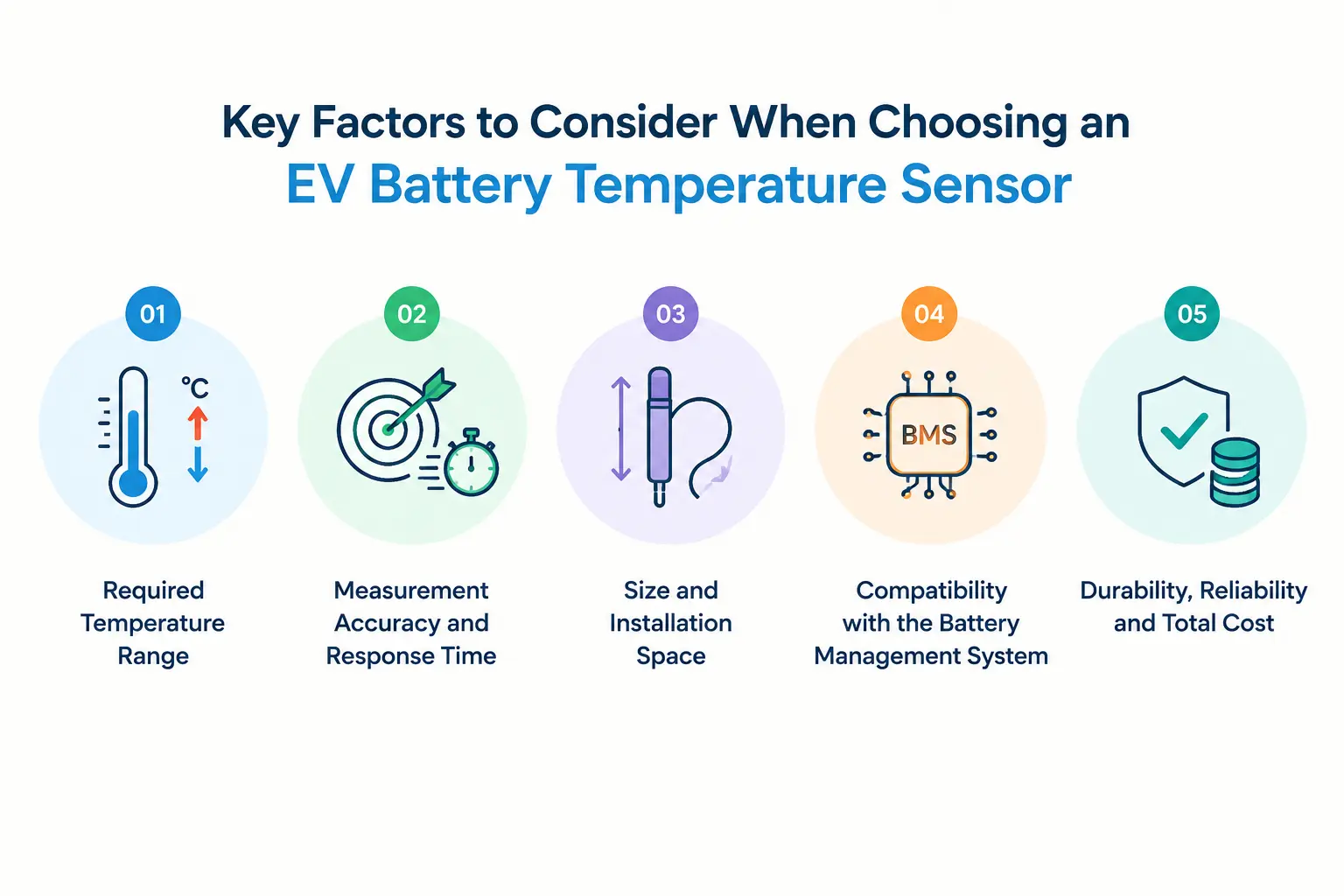
Required Temperature Range
Identify the minimum and maximum temperatures expected during charging, discharging, storage and environmental exposure. Check the sensor’s rated operating range and measurement accuracy across that range.
Do not select a sensor based only on its maximum temperature rating. Its performance within the actual operating range is equally important.
Measurement Accuracy and Response Time
Accuracy determines how closely a reading represents the temperature being measured. Response time determines how quickly the sensor reacts to a temperature change.
Consider both the sensor specification and its installation. A sensor with a fast rated response may react more slowly when mounted with poor thermal contact or inside an insulating enclosure.
Size and Installation Space
Battery packs have limited space, so sensor dimensions and mounting arrangements matter.
Check the following before finalising your design:
- Probe dimensions and mounting requirements.
- Cable routing and connector clearance.
- Thermal contact with the intended measurement surface.
- Compatibility with battery packaging, insulation and enclosure design.
Compatibility with the Battery Management System
The sensor must work with the BMS measurement electronics. Confirm its resistance characteristics or voltage output, wiring requirements, measurement range and signal-conditioning needs.
Also evaluate calibration methods, measurement resolution, open-circuit and short-circuit detection, and the system’s response to sensor faults.
Durability, Reliability and Total Cost
EV sensors may experience vibration, thermal cycling, moisture and demanding installation conditions. Check the suitability of the sensor construction, insulation, connectors and cable materials.
Compare the total installed cost rather than the purchase price alone. Calibration, integration, replacement access and long-term reliability can all influence the overall cost of ownership.
Where Should Temperature Sensors Be Installed in an EV Battery System?
Sensor placement affects how effectively the system detects temperature differences.
- Battery cells and modules: Select measurement points based on cell chemistry, pack layout and thermal behaviour. One sensor may not represent the temperature of an entire module.
- Battery cooling system: Monitor coolant inlet and outlet temperatures where required to evaluate cooling performance.
- Battery pack: Place sensors at suitable locations to understand temperature distribution and identify localised heating.
- Busbars, connectors and power electronics: Consider additional monitoring where electrical loading and component design create relevant thermal risks.
The number and location of sensors should be established through battery design analysis and validation testing. Incorrect placement can result in readings that do not represent the temperature of the critical component.
How to Match the Right Sensor to Your EV Battery Application
Use the following practical guidance when shortlisting temperature sensing options.
- Compact battery modules: Evaluate NTC thermistors for their size, sensitivity and cost-effectiveness.
- Stable temperature measurement: Consider PT100 or PT1000 RTD sensors where their accuracy, response time and physical dimensions meet the application requirements.
- Battery development and thermal testing: Evaluate thermocouples for test points requiring suitable temperature range and rugged construction.
- Cooling circuit monitoring: Consider RTDs or other compatible technologies according to fluid conditions, installation requirements and measurement electronics.
For EV manufacturers developing new battery packs, the decision should be based on the complete measurement system, including the sensor, mounting method, wiring, electronics and control strategy.
Common Mistakes to Avoid When Selecting EV Battery Temperature Sensors
Avoid these common errors during sensor procurement and system integration:
- Selecting a sensor solely because it has a low purchase price.
- Ignoring response time and thermal contact.
- Choosing an unsuitable operating range.
- Overlooking BMS compatibility and calibration requirements.
- Neglecting electrical noise, isolation and cable routing.
- Using too few measurement points to understand the battery’s thermal behaviour.
- Skipping validation under representative operating conditions.
Addressing these factors early can help reduce redesign work, integration delays and avoidable procurement costs.
Also Read :Best Temperature Sensors for Semiconductor Manufacturing Environments
How to Validate a Temperature Sensor Before Integration
Before approving a sensor for production, verify its specifications and performance.
Check Technical Specifications
Review the accuracy, tolerance, operating range, response time, dimensions, wiring and connector details. Request relevant technical documentation from the supplier.
Conduct Performance Testing
Compare sensor readings against a calibrated reference across the expected operating range. Evaluate response during changing thermal conditions and verify that the mounting method provides suitable thermal contact.
Verify BMS Compatibility
Test the sensor with the intended measurement electronics. Confirm fault detection, calibration and temperature-limit responses under representative operating conditions.
For vehicle applications, testing should form part of the manufacturer’s broader battery validation and safety process.

Choose the Right Temperature Sensor for Reliable EV Battery Monitoring
Selecting the right temperature sensor for electric vehicle battery management requires more than comparing product prices. EV manufacturers must balance accuracy, response time, size, durability, BMS compatibility and overall system cost.
NTC thermistors are worth considering for compact, cost-sensitive battery monitoring. RTD sensors can suit applications that prioritise stable and repeatable measurements, while thermocouples offer flexibility for selected testing and thermal measurement requirements.
Thermonic Sensor & Control Pvt. Ltd., based in Ahmedabad, India, manufactures industrial temperature measurement solutions, including thermocouples, RTD sensors and customised temperature sensor assemblies. We work with industrial temperature sensing requirements and can discuss potential sensor configurations based on your application’s specifications.
If you are developing an EV battery pack, upgrading a thermal management system or sourcing sensors for production, defining your technical requirements early can help you identify a suitable solution.
Frequently Asked Questions
Which temperature sensor is best for an EV battery management system?
There is no single best sensor for every EV battery. NTC thermistors are suitable for many compact monitoring applications, RTDs may suit selected stable measurement applications, and thermocouples can support thermal testing. The right option depends on the design and BMS requirements.
Why are NTC thermistors commonly used in EV battery packs?
NTC thermistors offer high sensitivity over a selected temperature range, compact dimensions and cost-effective implementation. They require appropriate calibration and signal processing because their resistance-temperature relationship is nonlinear.
Can PT100 or PT1000 sensors be used for EV battery monitoring?
Yes, they may be suitable for selected battery and thermal management applications. Engineers should verify their physical dimensions, response time, measurement accuracy and compatibility with the BMS electronics before selection.
How many temperature sensors does an EV battery pack need?
The required number depends on battery chemistry, pack design, thermal characteristics, monitoring strategy and applicable safety requirements. Sensor placement and coverage should be established during system design and validated through testing.
What affects EV battery temperature measurement accuracy?
Important factors include sensor tolerance, calibration, thermal contact, installation location, wiring, measurement electronics, electrical noise and response time.


Leave a Reply