
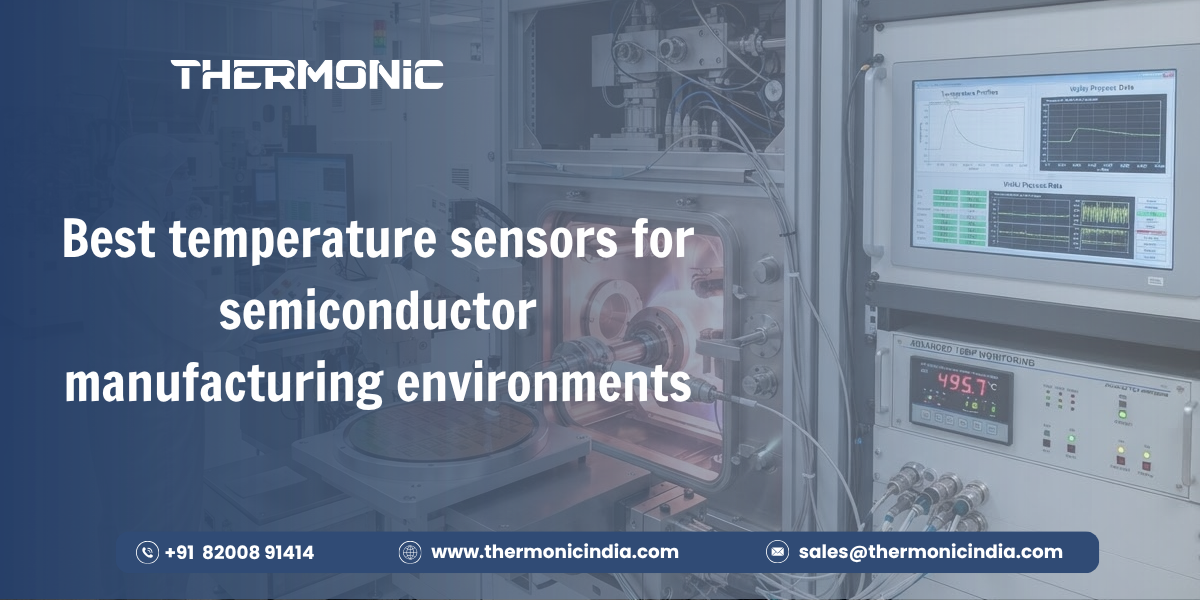
Best Temperature Sensors for Semiconductor Manufacturing Environments
Semiconductor manufacturing requires precise temperature control at every stage of production. Even small temperature variations can affect wafer quality, material properties and the performance of electronic components. According to NIST, accurate measurement and process control are important for maintaining consistency in advanced manufacturing. Therefore, choosing the right semiconductor temperature sensor is essential for reliable process monitoring and product quality.
Different manufacturing processes require different temperature measurement methods. Resistance Temperature Detectors (RTDs) provide stable and repeatable readings, while thermocouples are suitable for many high-temperature applications. NTC thermistors and infrared sensors also support temperature monitoring in specific environments.
As a provider of industrial temperature measurement solutions, Thermonic India offers a range of RTD sensors and other temperature measurement products for industrial applications. Understanding the capabilities of each sensor type helps manufacturers choose a suitable solution for their operating conditions.
Why Is Temperature Monitoring Important in Semiconductor Manufacturing?
Temperature affects several stages of semiconductor production, including wafer processing, chemical vapour deposition (CVD), etching and thermal treatment. Accurate monitoring helps manufacturers maintain the required process conditions.
Key requirements include:
- Measurement accuracy: Reliable readings help maintain consistent production conditions.
- Fast response time: Sensors must detect temperature changes quickly when processes require rapid control.
- Chemical compatibility: Sensor materials must suit the chemicals, gases and environmental conditions involved.
- Contamination control: Sensor construction and installation should support cleanroom requirements.
- Long-term stability: Consistent performance reduces measurement errors and unexpected process variations.
Selecting the correct sensor helps manufacturers improve process control and reduce the risk of temperature-related production issues.
Best Temperature Sensors for Semiconductor Manufacturing Environments
1. RTD Sensors for High-Precision Temperature Measurement
Resistance Temperature Detectors (RTDs) measure temperature by detecting changes in the electrical resistance of a sensing element. Platinum RTDs, such as Pt100 and Pt1000, are widely used where stable and repeatable temperature readings are required.
Key benefits of RTD sensors:
- Good measurement accuracy and long-term stability.
- Repeatable readings for controlled temperature environments.
- Availability in different probe designs and wiring configurations.
- Suitability for monitoring process equipment, cooling systems and temperature-controlled fluids.
RTDs are useful when consistent measurement is more important than measuring extremely high temperatures. However, their operating range, response time and installation requirements must match the application.

2. Thermocouple Sensors for High-Temperature Processes
Thermocouples measure temperature using the voltage generated between two different metal conductors. They are available in different types, including K, J, N, R and S, each offering different temperature ranges and performance characteristics.
Key benefits of thermocouple sensors:
- Suitable for a wide range of operating temperatures.
- Available in compact and rugged constructions.
- Useful for furnaces and thermal processing equipment.
- Available with protective sheaths for suitable operating environments.
Thermocouples can be a practical choice for semiconductor equipment that operates at elevated temperatures. The correct type depends on the process temperature, atmosphere, required accuracy and expected sensor life.
3. NTC Thermistors for Sensitive Temperature Detection
Negative Temperature Coefficient (NTC) thermistors work by changing their electrical resistance as temperature changes. Their resistance generally decreases when temperature increases.
These sensors offer high sensitivity over a comparatively limited temperature range.
Common applications include equipment cooling, electronic assemblies and auxiliary temperature monitoring systems. They can help detect local temperature changes in systems that need sensitive measurements.
However, NTC thermistors are not suitable for every high-temperature process. Their operating limits, calibration requirements and stability should be checked before selection.
4. Infrared Temperature Sensors for Non-Contact Measurement
Infrared temperature sensors measure thermal radiation emitted by an object. Since they do not require direct contact, they can be useful for measuring moving or inaccessible surfaces.
Their advantages include:
- Non-contact temperature measurement.
- Fast response in suitable applications.
- Reduced need for physical contact with the measured surface.
- Potential use in selected wafer-handling and thermal processing applications.
However, infrared measurement depends on factors such as surface emissivity, viewing angle, optical access and the sensor’s measurement range. These factors must be considered when measuring semiconductor materials and equipment.
5. Thin-Film RTDs and Specialised Temperature Sensors
Some semiconductor equipment requires compact sensors or application-specific designs. Thin-film RTDs and specialised sensor assemblies may be suitable where installation space, mounting arrangements or integration requirements limit the available options.
Their performance depends on the sensing element, construction materials, mounting method and operating environment. Manufacturers should evaluate these factors before choosing a specialised sensor.
Also Read : Best Temperature Sensors Used in Electric Vehicles: Types, Applications and Benefits
Comparison of Temperature Sensors for Semiconductor Manufacturing
| Sensor type | Main advantage | Typical application |
| RTD (Pt100/Pt1000) | Stability and precision | Controlled process temperatures and cooling systems |
| Thermocouple | Wide temperature capability | Furnaces and high-temperature equipment |
| NTC thermistor | High sensitivity over a limited range | Cooling and electronic systems |
| Infrared sensor | Non-contact measurement | Moving or inaccessible hot surfaces |
| Thin-film RTD | Compact design options | Integrated and specialised equipment |
The best option depends on the required temperature range, measurement accuracy, installation conditions and process requirements.
Which Sensors Are Suitable for Different Semiconductor Processes?
Wafer Processing and Thermal Treatment
RTDs and thermocouples can monitor temperatures in wafer-processing equipment. The choice depends on the operating range, required accuracy and location of measurement.
Chemical Vapour Deposition and Thin-Film Deposition
Temperature control is important during deposition because process conditions influence the properties of deposited films. RTDs and thermocouples may be used at appropriate measurement points, depending on the equipment design.
Etching and Plasma Processing
Temperature monitoring supports process stability and equipment protection. Sensor placement, electrical compatibility and resistance to the operating environment are important when monitoring chambers, electrodes and associated cooling systems.
Cleanrooms and Cooling Systems
RTDs and NTC thermistors may be used in cooling circuits, fluid monitoring and supporting equipment. The complete sensor assembly should be compatible with the facility’s cleanliness and contamination-control requirements.
Furnaces and High-Temperature Equipment
Thermocouples are often suitable for high-temperature applications. The sensor type, protective sheath and construction materials must be selected according to the temperature range and operating atmosphere.
How to Choose the Right Semiconductor Temperature Sensor
Before purchasing a semiconductor temperature sensor, consider the following factors.
1. Operating temperature range: Identify the minimum, normal and maximum process temperatures, including short-term temperature peaks.
2. Required accuracy: Determine the acceptable measurement tolerance and check calibration requirements.
3. Material compatibility: Evaluate exposure to chemicals, gases and other environmental conditions. Select suitable sheath, insulation and housing materials.
4. Response time and installation: Consider how quickly the temperature changes and whether the sensor can be installed at the correct measurement point.
5. Signal compatibility: Check whether the sensor can work with the existing PLC, temperature controller or data acquisition system. Confirm wiring and signal requirements.
6. Maintenance and reliability: Consider sensor drift, calibration frequency, replacement requirements and the cost of production downtime.
A suitable sensor should meet the actual process requirements rather than being selected on purchase price alone.
Common Temperature Measurement Challenges in Semiconductor Plants
Semiconductor manufacturers may experience measurement problems caused by incorrect sensor placement, temperature gradients, calibration errors or electrical interference.
Chemical exposure can also damage unsuitable sensor materials, while sensor drift may cause readings to become less reliable over time. In cleanroom environments, inappropriate construction or installation can create additional contamination risks.
To reduce these issues, manufacturers should use application-compatible sensors, follow suitable calibration procedures, check wiring and installation, and establish preventive maintenance schedules.
How Thermonic India Supports Industrial Temperature Measurement Requirements
Thermonic India provides industrial temperature measurement and control products, including RTD sensors, thermocouples, temperature controllers and related accessories.
Choosing the right solution requires a clear understanding of the operating temperature, measurement accuracy, installation method and environmental conditions. These details help determine the appropriate sensor design and specifications.
As a semiconductor temperature sensor manufacturer or supplier is evaluated, buyers should check product specifications, material compatibility, calibration requirements and the ability to meet their equipment needs. Manufacturers and suppliers should only be considered suitable for semiconductor applications when their specific product capabilities have been verified.
Thermonic India can discuss industrial temperature measurement requirements and help identify relevant product options based on the application details provided.
Also Read : Best Pressure Transmitter Types for Industrial Automation: Working Principles, Types and Applications
Frequently Asked Questions
1. Which temperature sensor is best for semiconductor manufacturing?
RTDs are suitable for many precision temperature monitoring tasks, while thermocouples are useful for many high-temperature applications. Infrared sensors and thermistors can serve specialised requirements. The right choice depends on the process.
2. Are Pt100 RTD sensors suitable for semiconductor applications?
Yes, Pt100 RTD sensors can be suitable for compatible temperature ranges where stable and repeatable measurements are required. Their construction and installation must match the application.
3. When should thermocouples be used instead of RTDs?
Thermocouples are often preferred when the application requires a wider or higher operating temperature range. RTDs may be preferred when stability and accuracy are key priorities within their suitable operating range.
4. Can infrared sensors measure wafer temperature without contact?
Yes, infrared sensors can measure surface temperature without direct contact. However, emissivity, surface characteristics, optical access and calibration affect the measurement.
5. What should buyers check when selecting a semiconductor temperature sensors manufacturer?
Buyers should evaluate product specifications, accuracy, operating range, material compatibility, calibration support and the manufacturer’s ability to meet the equipment’s technical requirements.

Upgrade Your Process with Reliable Semiconductor Temperature Sensors
Reliable temperature measurement supports better process monitoring, consistent manufacturing conditions and equipment performance. By comparing RTDs, thermocouples, thermistors and infrared sensors, manufacturers can identify the technology that best fits their temperature range, accuracy and installation requirements.
Thermonic India offers industrial temperature measurement and control products, including industrial temperature sensors, RTDs and thermocouples. Explore suitable sensing options based on your process and equipment requirements.



Leave a Reply