Are You Using the Right Angle for Temperature Sensors? A Complete Guide
Summarize this blog post with:


Introduction
Accurate temperature measurement is the backbone of safe and efficient industrial operations. From chemical processing plants to power generation facilities, even a small deviation in temperature readings can lead to product defects, energy losses, or serious safety risks. While most engineers focus on selecting the right sensor type, one critical factor is often overlooked , the installation angle.
Yes, the angle at which a temperature sensor is installed can significantly impact its performance. It directly affects accuracy, response time, and even the lifespan of the sensor. Improper installation can lead to false readings, increased vibration damage, and frequent maintenance issues.
Many industries rely on experienced temperature sensor manufacturers to not only supply high-quality sensors but also guide them on correct installation practices. In this guide, we’ll break down how installation angles work, why they matter, and how to choose the right one for your application.
Why Installation Angle Matters in Temperature Sensors
The installation angle is not just a mechanical choice , it plays a direct role in how effectively the sensor interacts with the process medium.
Direct impact on measurement accuracy
A sensor must be properly immersed in the process fluid to capture accurate temperature readings. Incorrect angles can lead to partial exposure, resulting in inaccurate or fluctuating data.
Influence on heat transfer and response time
The angle determines how well the sensor is exposed to the flow of heat. Better exposure means faster heat transfer, which leads to quicker response times and improved process control.
Effect on sensor exposure to process flow
If the sensor is not aligned properly with the flow, it may not measure the true process temperature. This is especially critical in high-velocity systems.
Role in reducing vibration and mechanical stress
Improper angles like 90° installations in high-flow conditions can increase vibration. Over time, this leads to fatigue failure of the thermowell and sensor assembly.
Common Temperature Sensor Installation Angles
Different industrial setups require different installation approaches. Understanding each angle helps in selecting the most suitable configuration.
90° Installation (Perpendicular Mounting)
This is the most commonly used installation method where the sensor is mounted perpendicular to the pipe or vessel.
Advantages:
- Simple and easy to install
- Suitable for low-flow or stable environments
- Widely used across industries
Limitations:
- Higher vibration in high-flow systems
- Reduced immersion depth in small pipes
- Increased risk of mechanical stress
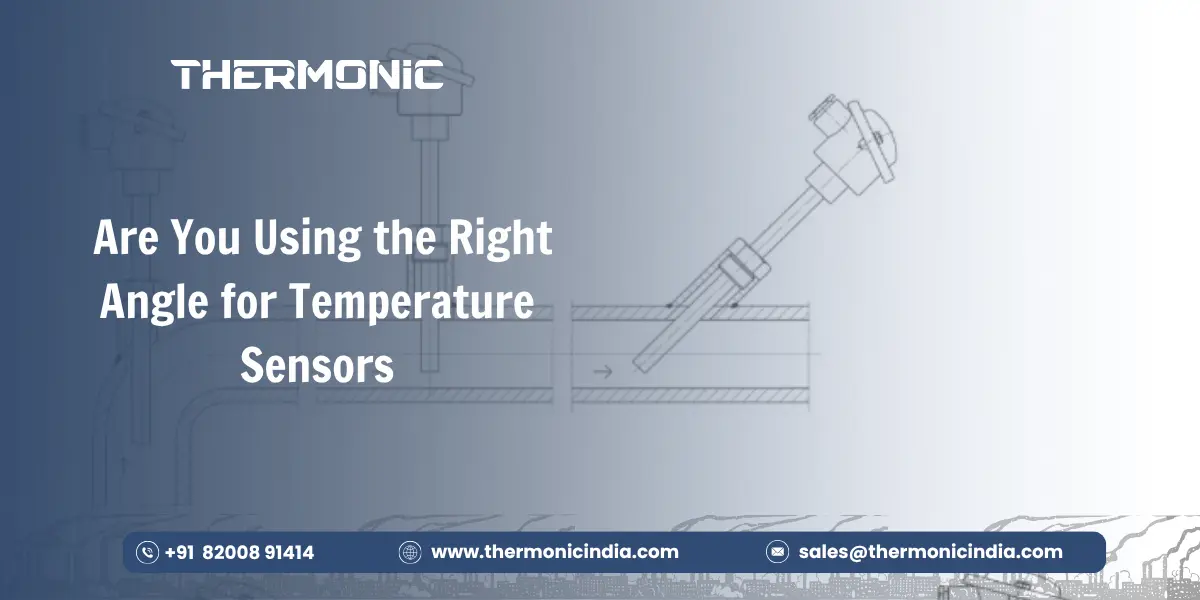
45° Installation (Angled Mounting)
A 45-degree angle is often considered the optimal installation method for many industrial applications.
Benefits:
- Reduced flow-induced vibration
- Improved immersion depth, even in smaller pipelines
- Better contact with process fluid
- More accurate temperature readings
This method is especially effective in high-velocity flow systems where durability and accuracy are critical.
Inline Installation (Parallel to Flow)
In this setup, the sensor is aligned with the direction of the flow.
Key features:
- Minimal disturbance to flow
- Lower mechanical stress
- Suitable for ducts, air systems, and low-pressure applications
However, inline installation may not always provide the best immersion depending on the application.
Other Custom Angles
In complex industrial systems, standard angles may not be sufficient.
Applications include:
- Custom-designed pipelines
- Space-restricted installations
- Specialized process conditions
These installations are typically engineered based on specific operational requirements.
Also Read : How Vibration Affects Temperature Sensors and How to Prevent Failure
How Different Angles Affect Sensor Performance
Choosing the right angle directly influences overall sensor efficiency and reliability.
Accuracy
Proper immersion ensures that the sensor measures the actual process temperature rather than surface or ambient conditions.
Response Time
Better exposure to the process medium allows faster detection of temperature changes, improving system responsiveness.
Durability
Reducing vibration and mechanical stress increases the lifespan of both the sensor and thermowell.
Maintenance
Angled installations often provide easier access for inspection and replacement, reducing downtime.
Factors to Consider When Choosing the Right Angle
There is no one-size-fits-all approach. The correct angle depends on multiple process factors.
- Pipe diameter and flow velocity
Smaller pipes often benefit from angled installation for better immersion - Type of temperature sensor (RTD or Thermocouple)
Different sensors have different response characteristics - Process medium (liquid, gas, steam)
Flow behavior varies depending on the medium - Pressure and temperature conditions
High-pressure systems require more stable configurations - Installation space and accessibility
Practical constraints may influence angle selection
Industry-Wise Best Practices for Installation Angles
Different industries follow specific guidelines based on their operating conditions.
Oil & Gas
- High pressure and flow rates
- 45° installation preferred for durability and accuracy
Power Plants
- Steam lines require stable and vibration-resistant setups
- Angled installations improve performance
Chemical Industry
- Depends on fluid properties and corrosiveness
- Custom angles may be required
Food & Pharma
- Hygiene and cleanability are critical
- Proper immersion with corrosion-resistant materials is essential
Common Installation Mistakes to Avoid
Even minor mistakes can lead to major performance issues.
- Incorrect immersion length
- Choosing the wrong angle for flow conditions
- Ignoring vibration impact
- Poor thermowell design
- Improper sealing and alignment
Avoiding these errors can significantly improve measurement reliability and reduce maintenance costs.
Role of Thermowell in Angle Installation
A thermowell is not just a protective component , it plays a key role in installation effectiveness.
Key functions:
- Protects the sensor from pressure, corrosion, and flow
- Allows sensor removal without process shutdown
- Enhances durability and safety
Design considerations:
- Length: Must ensure proper immersion
- Material: Should match process conditions
- Insertion angle: Must align with optimal flow interaction
Proper thermowell design complements the chosen installation angle for maximum efficiency.
Also Read : How to Select the Right Temperature Sensor Cable for Harsh Industrial Conditions
Key Benefits of Correct Angle Installation
When done right, installation angle can significantly improve system performance.
- Improved measurement accuracy
- Longer sensor lifespan
- Reduced maintenance and replacement costs
- Better process control and efficiency
A small adjustment in angle can lead to substantial operational improvements.
Need Help Selecting the Right Angle? We’ve Got You Covered
Choosing the correct installation angle is not just a technical detail , it’s a strategic decision that impacts your entire operation. Even a slight mistake can lead to inaccurate readings, increased wear, and costly downtime.
That’s why it’s important to evaluate every aspect of your application before making a decision. From flow conditions to environmental factors, every detail matters.
At Thermonic India, we understand these challenges and provide tailored solutions based on real-world industrial needs. As a trusted temperature sensor company, we help you select the right installation angle, sensor type, and materials for maximum performance.
- Small angle changes = big performance impact
- Always evaluate your application conditions carefully
- Consult experts for reliable and long-lasting solutions
Not sure which angle is right for your system?
👉 Get expert guidance from Thermonic India
👉 Optimize your sensor performance
👉 Request a consultation or quote today
Make the right installation choice today and ensure accuracy, durability, and efficiency for the long run.