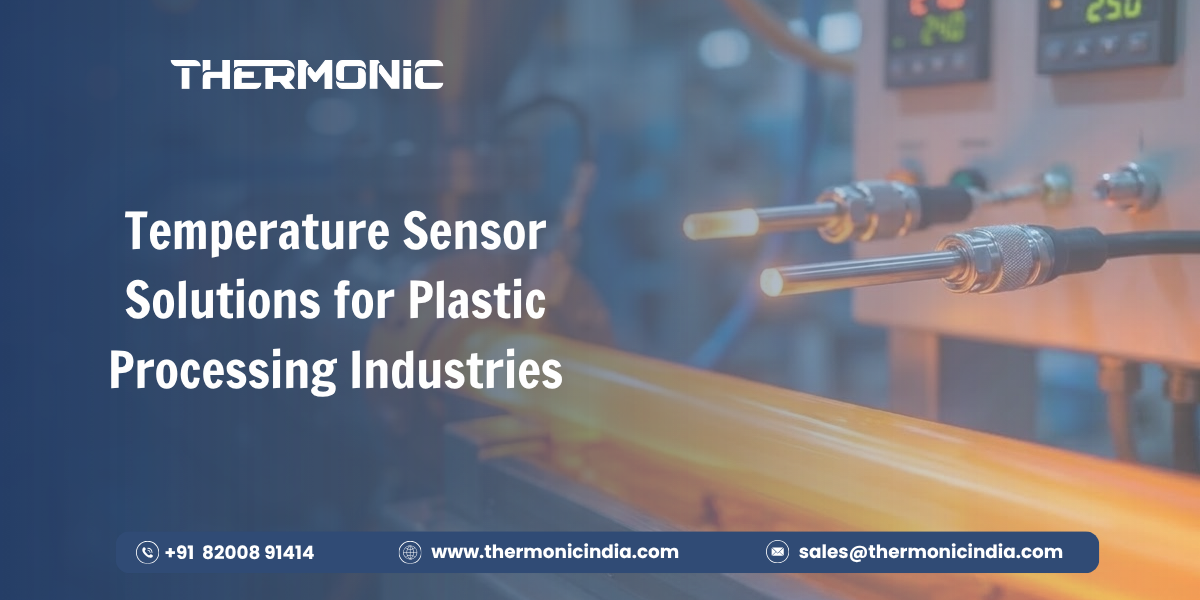
Temperature Sensor Solutions for Plastic Processing Industries
Introduction
Temperature plays a critical role in almost every stage of plastic manufacturing. From melting raw materials to extrusion, injection molding, blow molding, and cooling, precise temperature control helps manufacturers maintain product quality and production efficiency. Even a small temperature variation can affect material flow, dimensional accuracy, surface finish, and the overall performance of plastic products.
For this reason, reliable temperature sensors for plastic processing are essential for modern plastic manufacturing equipment. Industrial temperature sensors manufacturers develop different sensor technologies, including RTDs, PT100 sensors, PT1000 sensors, and thermocouples, to meet the specific requirements of plastic processing machinery.
Choosing the right sensor can help manufacturers achieve stable temperature measurement, reduce material waste, minimize downtime, and improve machine performance.
Understanding Temperature Measurement in Plastic Processing
Plastic materials must be heated and cooled within specific temperature ranges during processing. If the temperature is too low, the material may not melt or flow properly. If it is too high, the material can degrade, burn, or lose its desired properties.
A properly selected temperature sensor for plastic industry applications continuously monitors process temperatures and sends accurate measurements to a temperature controller or automation system.
Why Accurate Temperature Measurement Is Essential
Accurate temperature measurement provides several important advantages in plastic processing:
- Maintains consistent processing temperatures
- Improves the quality and uniformity of finished products
- Reduces material waste and rejected products
- Helps prevent machine overheating
- Supports efficient production
- Improves process stability
- Helps operators identify temperature problems early
In applications such as injection molding and extrusion, temperature sensors are often installed at multiple points. This allows manufacturers to monitor different heating zones and maintain better control over the entire process.
What Happens When Temperature Is Not Controlled Properly?
Poor temperature measurement can create several production problems. Uneven heating may cause inconsistent material flow, while excessive temperatures can damage polymers.
Common problems include:
- Uneven melting of plastic materials
- Material degradation
- Poor surface finish
- Dimensional inconsistencies
- Product defects
- Unexpected machine downtime
- Increased energy consumption
- Higher maintenance and production costs
Therefore, selecting a reliable plastic machinery temperature sensor is an important part of maintaining consistent production.
Common Plastic Processing Applications Requiring Temperature Sensors
Plastic processing includes several manufacturing methods, and each application can have different temperature measurement requirements.
Injection Molding Machines
Injection molding requires precise temperature control because plastic material must be heated, melted, injected, and cooled correctly.
A temperature sensor for injection molding can be used for:
- Barrel temperature monitoring
- Nozzle temperature measurement
- Mold temperature monitoring
- Heating-zone temperature measurement
- Machine and hydraulic temperature monitoring
Accurate sensing helps maintain consistent material viscosity and supports repeatable molding cycles.
Plastic Extrusion Machines
Extrusion processes continuously push melted plastic through a die to produce products such as pipes, sheets, films, profiles, and cables.
Temperature sensor for plastic extrusion applications may include:
- Extruder barrel temperature measurement
- Die temperature measurement
- Melt temperature monitoring
- Multi-zone heating control
- Feed and processing-zone temperature monitoring
Since extrusion machines often use multiple heating zones, dependable sensors are important for maintaining a stable temperature profile throughout the process.
Blow Molding Machines
Blow molding uses heated plastic materials to manufacture hollow products such as bottles, containers, and industrial components.
Temperature sensors can monitor:
- Barrel temperature
- Die temperature
- Mold temperature
- Heating zones
- Process temperatures
Consistent temperature measurement helps improve product uniformity and reduce defects.
Plastic Film and Sheet Production
Film and sheet manufacturing requires accurate control of extrusion, die, and cooling temperatures. Depending on the equipment design, sensors can monitor heating zones, dies, rollers, and other process components.
Surface temperature sensors can also be useful where direct measurement of a machine or roller surface is required.
Plastic Recycling and Compounding
Recycling and compounding processes involve heating, melting, mixing, and forming plastic materials. Temperature monitoring is essential for controlling material conditions during processing.
Sensors can be used for:
- Material melting temperature
- Extruder temperature
- Compounding zones
- Granulation processes
- Heating equipment
Also Read : How Industrial Automation Depends on High-Accuracy Temperature Sensors
Types of Temperature Sensors Used in Plastic Processing
Different plastic processing machines require different temperature measurement technologies. Two of the most widely used options are thermocouples and RTD sensors.
Thermocouple Sensors
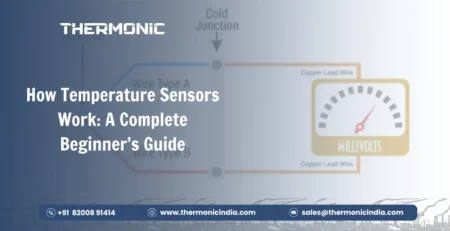
Thermocouples generate a temperature-dependent electrical signal and are widely used in industrial applications.
Common options include:
- K-Type thermocouples
- J-Type thermocouples
- Other thermocouple configurations based on application requirements
A thermocouple for plastic processing can provide fast response and can operate across a wide temperature range. This makes thermocouples suitable for many extrusion, molding, and high-temperature machine applications.
RTD Sensors
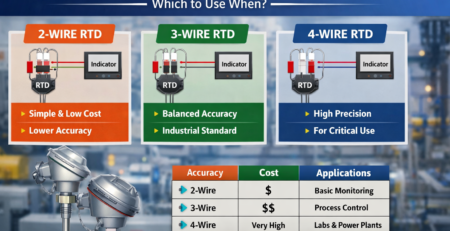
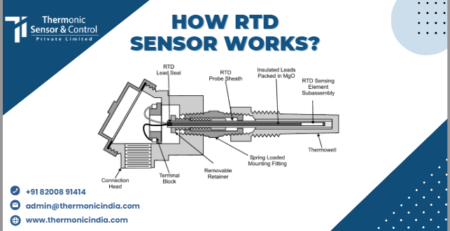
RTD sensors measure temperature through the predictable change in electrical resistance of the sensing element.
Common options include:
- PT100 RTD sensors
- PT1000 RTD sensors
- Simplex and duplex configurations
- Customized probe designs
A PT100 sensor for plastic industry applications is particularly useful where accurate and stable temperature measurement is important.
RTD sensors are commonly selected for applications where measurement accuracy and long-term stability are key priorities.
Surface Temperature Sensors
Some plastic processing applications require temperature measurement without inserting a probe directly into the process.
Surface temperature sensors can be used for:
- Rollers
- Machine surfaces
- Heating plates
- Other industrial surfaces
They provide a practical solution where direct immersion or insertion is not suitable.
Customized Temperature Sensors
Plastic machinery often has specific mounting and dimensional requirements. Standard sensors may not always fit these applications.
Customized sensors can be manufactured with:
- Different probe lengths and diameters
- Customized mounting arrangements
- Specific threads and fittings
- Different cable lengths
- Various connectors
- Application-specific sheath materials
This allows manufacturers to select a sensor that matches their machine design and operating conditions.

Choosing the Right Temperature Sensor for Plastic Machinery
Selecting a temperature sensor should involve more than simply choosing an RTD or thermocouple. The sensor must match the actual operating conditions of the machine.
Important factors include:
- Required temperature range
- Measurement accuracy
- Response time
- Probe diameter and length
- Mounting method
- Thread and fitting requirements
- Sheath material
- Cable insulation
- Operating environment
- Controller compatibility
- Mechanical and vibration conditions
For example, a high-temperature extrusion application may require a thermocouple with suitable sheath construction, while a process requiring highly stable measurement may benefit from a PT100 RTD.
RTD vs Thermocouple for Plastic Processing: Which Is Better?
Both technologies can provide reliable temperature measurement, but their characteristics are different.
RTD Sensors
RTDs are generally preferred when the application requires:
- High measurement accuracy
- Excellent long-term stability
- Repeatable readings
- Precise temperature control
- Moderate industrial temperature ranges
Thermocouples
Thermocouples can be advantageous when the application requires:
- Fast temperature response
- A broad temperature range
- High-temperature measurement
- Robust construction
- Compact sensor designs
How to Select Between Them
There is no single sensor that is best for every plastic processing machine. Consider the required temperature range, accuracy, response time, installation conditions, and controller compatibility before making a selection.
The right sensor should match the process rather than simply being chosen based on price or availability.
Key Features of Reliable Temperature Sensors for Plastic Processing
A reliable sensor should be designed to withstand the operating conditions of plastic processing machinery.
Important features include:
- High measurement accuracy
- Fast response time
- Robust construction
- High-temperature resistance
- Good vibration resistance
- Reliable electrical insulation
- Long service life
- Easy installation and replacement
- Compatibility with industrial temperature controllers
The sensor’s sheath, cable, fitting, and connection should also be selected according to the machine environment.
Benefits of Using High-Quality Temperature Sensors
Investing in dependable temperature measurement solutions can deliver benefits throughout the production process.
These include:
- Better product consistency
- Reduced material waste
- Improved process control
- Lower machine downtime
- Better energy efficiency
- Longer equipment life
- Improved production reliability
- Reduced maintenance requirements
Accurate sensing also gives operators better information for making timely process adjustments.
Common Temperature Sensor Problems in Plastic Processing
Even a high-quality sensor can provide unreliable readings if it is incorrectly installed or exposed to unsuitable conditions.
Incorrect Temperature Readings
Possible causes include:
- Sensor calibration problems
- Incorrect sensor positioning
- Damaged wiring
- Loose electrical connections
- Incorrect sensor selection
Slow Sensor Response
Slow response can result from:
- Incorrect sensor design
- Excessive probe length
- Poor sensor positioning
- Inappropriate installation
Frequent Sensor Failure
Frequent failures may occur because of:
- Excessive temperature exposure
- Mechanical damage
- Continuous vibration
- Chemical exposure
- Incorrect installation
Temperature Fluctuations
Unstable readings may be caused by:
- Sensor degradation
- Loose connections
- Controller problems
- Electrical interference
- Incorrect sensor placement
Regular inspection and proper sensor selection can help reduce these issues.
How Thermonic Provides Temperature Sensor Solutions for Plastic Industries
Thermonic India provides industrial temperature measurement solutions for different manufacturing and process applications. Its product range includes RTD sensors, PT100 and PT1000 sensors, thermocouples, and customized temperature sensor solutions.
For plastic processing applications, sensors can be developed according to specific machine and process requirements, including:
- Customized sensor dimensions
- Different probe lengths and diameters
- Suitable sheath materials
- Customized cables and connectors
- Different mounting arrangements
- Application-specific RTD and thermocouple configurations
Thermonic supports OEMs, machine manufacturers, maintenance teams, and industrial users looking for dependable temperature measurement solutions.
Also Read : Common Temperature Sensor Problems in Factories and Their Solutions
Why Choose Customized Temperature Sensors for Plastic Machinery?
Every plastic processing machine may have different installation conditions and temperature requirements. A customized sensor can provide better compatibility with the equipment.
Key benefits include:
- Exact machine compatibility
- Easier installation
- Appropriate probe dimensions
- Better measurement positioning
- Reduced replacement problems
- Customized cables and connectors
- Application-specific fittings
- Suitable solutions for OEM machinery
Customization can be particularly valuable for machine builders that require consistent sensor specifications across different equipment models.
Maintenance Tips for Plastic Processing Temperature Sensors
Regular maintenance can help extend sensor life and maintain measurement reliability.
Follow these practices:
- Inspect sensors regularly
- Check wiring and electrical connections
- Monitor unusual temperature fluctuations
- Calibrate sensors at appropriate intervals
- Check for mechanical damage
- Inspect sensor fittings and mounting
- Replace damaged or unstable sensors
- Maintain correct sensor positioning
If readings suddenly change or become inconsistent, investigate the sensor, wiring, controller, and installation before assuming the process itself is responsible.

Looking for Reliable Temperature Sensors for Your Plastic Processing Machinery?
Accurate temperature measurement is essential for reliable plastic processing. From injection molding and extrusion to blow molding, film production, recycling, and compounding, the right sensor helps manufacturers maintain stable process conditions and consistent product quality.
RTDs such as PT100 and PT1000 are suitable for applications that prioritize accuracy and stability, while thermocouples can provide fast response and wide temperature capability. The best choice depends on the machine, process temperature, installation conditions, and measurement requirements.
Working with an experienced temperature sensor supplier can also make it easier to select customized solutions for specific plastic processing equipment.
Contact Thermonic India for application-specific RTD, PT100, PT1000, and thermocouple solutions designed for injection molding, extrusion, blow molding, and other plastic processing applications.