Common Temperature Sensor Problems in Factories and Their Solutions
Summarize this blog post with:


Introduction
Accurate temperature measurement is essential for safe, efficient, and consistent factory operations. Temperature sensors help industrial systems monitor process conditions, protect machinery from overheating, maintain product quality, and support automated temperature control. From furnaces and boilers to chemical processing equipment, HVAC systems, food processing lines, and manufacturing machinery, reliable temperature measurement plays a critical role.
The growing importance of industrial sensing is also reflected in recent market data. According to Grand View Research, the global industrial sensors market was valued at USD 27.5 billion in 2025 and is projected to reach USD 53.5 billion by 2033, with temperature sensors accounting for more than 16% of the market in 2025.
However, even a well-designed temperature measurement system can experience failures. Temperature sensor problems can result from calibration errors, damaged wiring, incorrect installation, electrical interference, extreme temperatures, or selecting the wrong sensor for an application.
Understanding these problems and their solutions helps maintenance teams reduce downtime, improve process control, and extend sensor service life. Working with experienced temperature sensors manufacturers can also help factories select sensors that match their operating conditions and measurement requirements.
Why Temperature Sensors Are Important in Industrial Processes
Factories rely on temperature measurement for many critical operations. A small measurement error can affect product quality, process efficiency, and equipment safety.
Temperature sensors help with:
- Maintaining precise process temperatures
- Preventing overheating and equipment damage
- Improving production consistency
- Supporting automated temperature control
- Reducing unplanned downtime
- Improving energy efficiency
- Monitoring boilers, furnaces, ovens, tanks, and machinery
- Maintaining required process conditions
Industrial applications commonly use thermocouples, RTD sensors, PT100 sensors, NTC sensors, PTC sensors, and specialized temperature probes. Each technology has different characteristics, so choosing the correct sensor is essential.

Common Temperature Sensor Problems in Factories
1. Inaccurate Temperature Readings
One of the most common temperature sensor problems is inaccurate measurement. A sensor may display a temperature that is consistently higher or lower than the actual process temperature, or its reading may fluctuate unexpectedly.
Common causes include:
- Sensor aging
- Poor calibration
- Incorrect sensor selection
- Environmental interference
- Damaged sensing elements
- Incorrect installation
- Faulty instrumentation
The solution starts with checking the sensor against a reliable reference. If the sensor has drifted, calibration may restore its accuracy. However, a physically damaged or severely degraded sensor should generally be replaced.
Solutions include:
- Calibrate sensors at suitable intervals
- Check the sensor’s operating range
- Verify the sensor type
- Inspect the sensing element
- Check the controller and measuring instrument
- Replace sensors that no longer meet accuracy requirements
2. Slow Temperature Response
A sensor that takes too long to respond to process changes can create control problems. Slow response may cause a controller to react later than required, particularly in applications where temperature changes quickly.
Common causes include:
- Incorrect probe diameter
- Heavy protective sheath
- Excessive thermal mass
- Poor sensor placement
- Improper thermowell selection
Solutions include:
- Select an appropriately sized probe
- Choose a suitable thermowell
- Improve sensor positioning
- Use a faster-response sensor when required
- Ensure sufficient contact with the process
For fast-changing processes, sensor response time should be considered during the initial design rather than after installation.
3. Sensor Drift Over Time
Temperature sensor drift occurs when the sensor gradually produces readings that differ from its original calibrated value. This can happen after repeated thermal cycling or prolonged exposure to demanding industrial conditions.
Common causes include:
- Repeated heating and cooling cycles
- High operating temperatures
- Material degradation
- Chemical exposure
- Long-term mechanical stress
Solutions include:
- Perform periodic calibration
- Establish preventive maintenance schedules
- Monitor historical sensor readings
- Replace sensors showing excessive drift
- Select durable materials suitable for the application
Regular calibration is especially important where temperature accuracy directly affects product quality or safety.
4. Thermocouple Failure
Thermocouples are widely used because they can operate across broad temperature ranges and are suitable for many industrial applications. Nevertheless, thermocouple failure can cause incorrect readings or complete signal loss.
Common thermocouple problems include:
- Broken wires
- Oxidation
- Contamination
- Incorrect polarity
- Damaged junction
- Poor connections
- Excessive temperature exposure
Solutions include:
- Inspect thermocouple wiring
- Check polarity
- Inspect the sensing junction
- Verify the thermocouple type
- Check terminal connections
- Replace damaged thermocouples
- Select suitable sheath and thermocouple materials
The correct thermocouple type must match the application and connected controller. A K-type thermocouple, for example, should not simply be substituted with another type without verifying system compatibility.
5. RTD or PT100 Sensor Problems
RTD sensors, particularly PT100 sensors, are popular where stable and accurate temperature measurement is required. However, wiring and resistance-related faults can create measurement errors.
Typical RTD or PT100 problems include:
- Open circuit
- Short circuit
- Incorrect resistance
- Wiring errors
- Lead resistance
- Damaged sensing element
- Loose terminals
Solutions include:
- Check sensor resistance with an appropriate multimeter
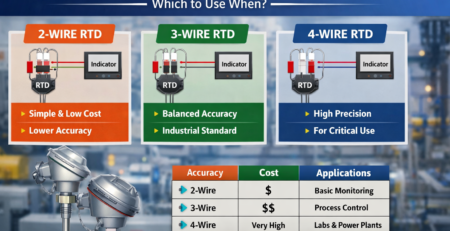
- Verify the 2-wire, 3-wire, or 4-wire configuration
- Inspect terminal connections
- Check cable continuity
- Verify the controller configuration
- Replace damaged RTD elements
Using the correct wiring configuration is important because lead resistance can affect measurement accuracy, particularly with 2-wire RTDs.
Also Read : Why Your Temperature Sensor Is Giving Wrong Readings
6. Electrical Noise and Signal Interference
Industrial factories contain motors, drives, switching equipment, high-voltage cables, and other electrical systems that can interfere with low-level sensor signals.
Electrical interference may appear as:
- Fluctuating temperature readings
- Unstable controller signals
- Sudden temperature changes
- Intermittent sensor faults
Solutions include:
- Use suitable shielded sensor cables
- Separate sensor cables from power cables
- Follow appropriate grounding practices
- Check cable routing
- Use suitable signal conditioning where required
Proper wiring design is just as important as sensor quality when creating a reliable temperature measurement system.
7. Sensor Wiring and Connection Problems
Sometimes the sensor itself is functioning correctly, but its wiring or connection has failed.
Typical issues include:
- Loose terminals
- Broken cables
- Incorrect wiring
- Corroded connectors
- Damaged insulation
- Moisture entering connections
Solutions include:
- Inspect connections regularly
- Tighten loose terminals
- Replace damaged cables
- Check continuity
- Protect connections from moisture and contamination
- Use suitable industrial-grade connectors
A simple wiring inspection should therefore be one of the first steps when troubleshooting a sudden temperature sensor problems.
8. Sensor Damage Due to High Temperature or Harsh Environments
Industrial sensors can operate in demanding environments involving high temperatures, chemicals, vibration, dust, moisture, and corrosion.
Excessive exposure can cause:
- Sheath deterioration
- Corrosion
- Insulation damage
- Sensor drift
- Cable degradation
- Mechanical failure
Solutions include:
- Select suitable sheath materials
- Use protective thermowells
- Choose sensors according to environmental conditions
- Select appropriate cable insulation
- Specify suitable ingress protection where required
For high-temperature applications, factories should work with experienced high temperature industrial sensors suppliers that can recommend suitable sensor construction and materials.
9. Incorrect Sensor Installation or Positioning
Even a high-quality sensor can provide poor results when installed incorrectly.
Common installation mistakes include:
- Positioning the sensor too close to a surface
- Insufficient immersion depth
- Poor contact with the process
- Incorrect thermowell installation
- Installing the sensor in a non-representative location
Solutions include:
- Follow recommended installation practices
- Ensure adequate immersion depth
- Position sensors at representative measurement points
- Check thermowell installation
- Ensure proper process contact
The objective is to measure the actual process temperature rather than the temperature of an unrelated surface or surrounding environment.
10. Temperature Sensor Compatibility Issues
A sensor may be physically suitable but electrically incompatible with the measuring system.
Potential compatibility problems include:
- Incorrect temperature range
- Incorrect output signal
- Incorrect thermocouple type
- Incorrect RTD configuration
- Controller configured for the wrong sensor
Solutions include:
- Verify sensor specifications before installation
- Match the sensor with the controller
- Confirm the required temperature range
- Check wiring configuration
- Verify output and input signal requirements
How to Troubleshoot a Faulty Temperature Sensor
When a sensor suddenly stops working or provides unusual readings, use a systematic troubleshooting process.
Step 1: Check the Sensor Physically
Inspect the probe and sheath for:
- Cracks
- Corrosion
- Deformation
- Discoloration
- Mechanical damage
Also inspect the cable and connector.
Step 2: Check Electrical Connections
Inspect terminals and wiring for loose, broken, or incorrectly connected wires. Look for signs of moisture, corrosion, or insulation damage.
Step 3: Test Sensor Resistance or Output
For RTD sensors, measure resistance and compare it with the expected value.
For thermocouples, check the signal and verify that the sensor type and polarity are correct.
Step 4: Verify Calibration
Compare the sensor’s reading with a reliable reference. If the difference is outside the required tolerance, recalibration or replacement may be necessary.
Step 5: Check the Temperature Controller
Do not assume the sensor is always responsible for the problem. Check:
- Controller configuration
- Input sensor type
- Display behavior
- Wiring
- Signal processing
- Alarm settings
Preventive Maintenance Tips for Industrial Temperature Sensors
Preventive maintenance can reduce unexpected failures and extend sensor service life.
Recommended practices include:
- Schedule regular inspections
- Calibrate sensors periodically
- Check wiring and connectors
- Monitor sensor response time
- Inspect thermowells
- Keep critical spare sensors available
- Record sensor failures and replacement history
- Check for corrosion and mechanical damage
- Replace sensors before repeated failures affect production
Maintenance teams should also document recurring failures. If the same sensor fails repeatedly, the underlying issue may be incorrect sensor selection, installation, process conditions, or wiring rather than sensor quality alone.
How to Choose the Right Temperature Sensor for a Factory
Choosing the correct sensor starts with understanding the process.
Consider the Operating Temperature
Determine the minimum and maximum process temperature before selecting a sensor. The sensor should have an appropriate operating range with enough margin for actual process conditions.
Consider the Process Environment
Evaluate:
- Chemical exposure
- Moisture
- Pressure
- Vibration
- Dust
- Corrosion
- Mechanical impact
Select the Appropriate Sensor Type
Different sensors suit different applications:
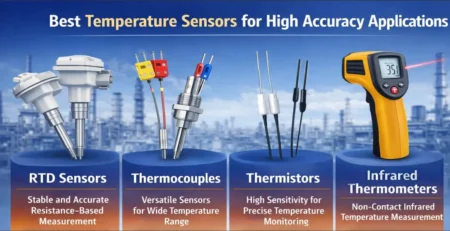
- Thermocouples: Suitable for broad temperature ranges and many high-temperature applications.
- RTD/PT100 sensors: Suitable where accuracy, stability, and repeatability are important.
- NTC/PTC sensors: Useful for specific temperature monitoring, sensing, and control applications.
If you are experiencing ntc temperature sensor problems, first check whether the NTC resistance-temperature characteristics match the controller and application.
Select Suitable Construction Materials
Depending on the application, sensor construction may use:
- Stainless steel
- Inconel
- Specialized alloys
- Application-specific protective materials
Consider Installation Requirements
Check:
- Probe diameter
- Probe length
- Threaded or flanged connection
- Thermowell requirement
- Cable type
- Connector type
- Installation location
Selecting these specifications correctly can prevent many future temperature sensor problems.
Thermocouple vs RTD: Which Is Better for Your Factory?
There is no single sensor that is best for every industrial application.
When comparing thermocouples and RTDs, consider:
- Accuracy
- Temperature range
- Response time
- Durability
- Cost
- Process conditions
- Required stability
- Controller compatibility
Thermocouples are often selected for broad temperature ranges and demanding high-temperature applications, while RTDs such as PT100 are commonly chosen where accuracy and stable measurement are priorities.
The correct choice depends on the process, installation environment, required accuracy, and control system.
Also Read : Temperature Sensor Maintenance Checklist for Reliable Industrial Performance
When Should You Replace an Industrial Temperature Sensor?
A temperature sensor may need replacement when you notice:
- Frequent inaccurate readings
- Visible physical damage
- Repeated calibration failure
- Slow or unstable response
- Corrosion
- Electrical faults
- Excessive sensor drift
- Repeated production interruptions
Replacing a sensor before complete failure can help prevent unexpected production downtime.
Best Practices to Prevent Temperature Sensor Failures
Factories can reduce sensor failures by following a few practical principles:
- Use application-specific sensor selection
- Work with experienced temperature sensor suppliers
- Follow correct installation procedures
- Perform scheduled calibration
- Protect sensors from harsh environments
- Use suitable thermowells
- Inspect cables and connections
- Maintain accurate maintenance records
- Keep critical replacement sensors in stock
- Review recurring sensor failures
For specialized applications, choosing the right temperature sensor supplier can be as important as selecting the sensor technology itself.

Conclusion: Need Reliable Temperature Sensors for Your Factory?
Temperature sensors are essential components of modern industrial monitoring and control systems. Problems such as inaccurate readings, slow response, sensor drift, wiring faults, electrical interference, environmental damage, and incorrect installation can affect process efficiency and equipment reliability.
The best way to minimize these issues is to combine correct sensor selection with proper installation, regular calibration, preventive maintenance, and timely replacement.
For an industrial temperature sensor factory, selecting sensors according to the actual process temperature, environment, mechanical requirements, and controller specifications can significantly improve measurement reliability.
Thermonic India provides industrial temperature measurement solutions including thermocouples, RTD/PT100 sensors, temperature probes, thermowells, NTC/PTC sensors, and customized temperature sensors for demanding industrial applications.
If you are facing recurring temperature sensor problems, selecting the right sensor construction and configuration can help improve measurement accuracy, equipment protection, and process performance.
Explore reliable industrial thermocouples, RTD/PT100 sensors, temperature probes, and thermowells for your application.
Contact Thermonic India for application-specific temperature measurement solutions.