
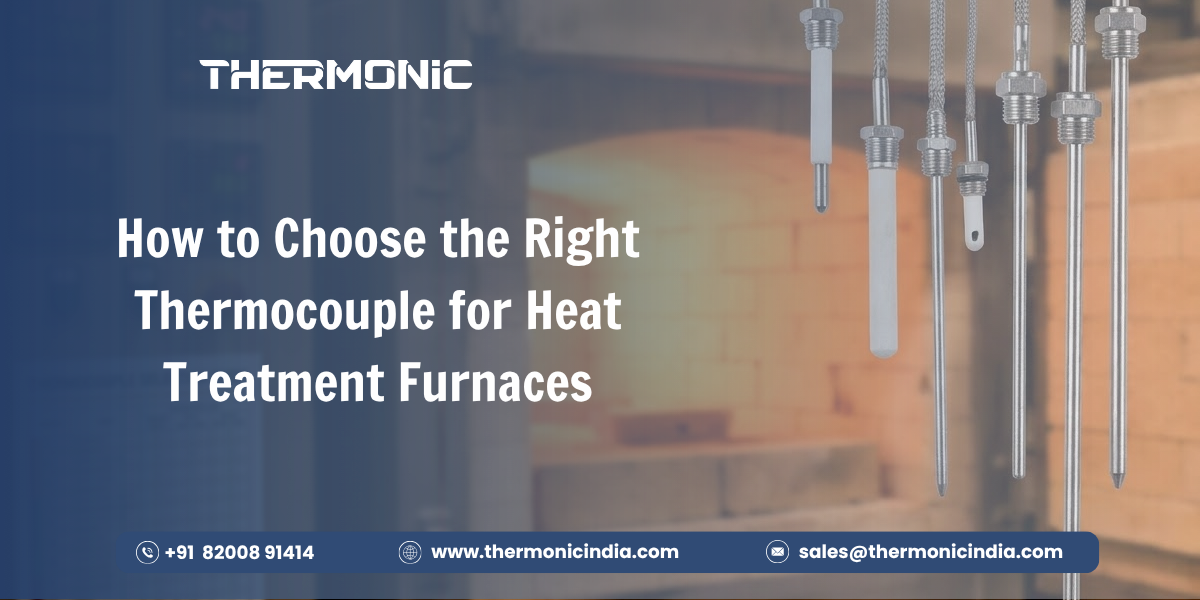
How to Choose the Right Thermocouple for Heat Treatment Furnaces
Summarize this blog post with:


Heat treatment furnaces require accurate temperature measurement to maintain consistent heating conditions and achieve the desired material properties. Whether manufacturers produce annealing, hardening, tempering or carburising furnaces, selecting the right temperature measurement system is essential for reliable furnace performance.
According to the International Energy Agency (IEA), industry accounts for nearly 40% of global energy demand. This highlights the importance of improving industrial process efficiency, including effective temperature monitoring and control. Choosing a suitable furnace temperature sensor helps furnace manufacturers maintain stable operating conditions, minimise measurement errors and support efficient heating operations.
Thermocouples are widely used for industrial furnace temperature measurement because they can operate across different temperature ranges and withstand demanding environments. However, selecting the right type requires careful consideration of operating temperature, furnace atmosphere, accuracy, protection materials and installation requirements.
What Is a Thermocouple and How Does It Work in Heat Treatment Furnaces?
A thermocouple is a temperature sensor made from two dissimilar metal wires joined at one end. When the measuring junction experiences a temperature difference, it generates a small electrical voltage. This phenomenon is known as the Seebeck effect.
The temperature controller receives this voltage signal and converts it into a temperature reading.
In heat treatment furnaces, thermocouples perform several important functions:
- Monitor the temperature inside the furnace chamber.
- Maintain the required heating and soaking temperatures.
- Support controlled heating and cooling cycles.
- Provide feedback to automatic temperature control systems.
- Help prevent overheating and unwanted temperature variations.
For furnace manufacturers, selecting a suitable thermocouple ensures that the temperature measurement system works reliably throughout the operating cycle.

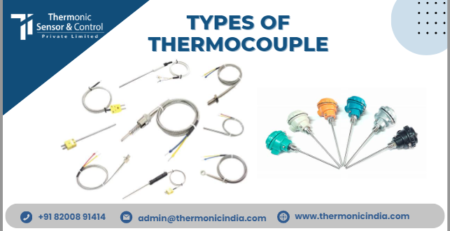
Different Types of Thermocouples Used in Heat Treatment Furnaces
Different thermocouple types offer different temperature ranges, stability and material characteristics. The selection depends on the furnace design and its intended application.
1. Type K Thermocouple
Type K thermocouples use Chromel and Alumel wires. They are widely used in industrial furnaces because of their broad operating range and general-purpose performance.
- Typical temperature range: -200°C to 1,260°C.
- Suitable for general industrial heating applications.
- Commonly used in heat treatment and heat processing equipment.
- Available in different probe and protection tube configurations.
2. Type J Thermocouple
Type J thermocouples consist of Iron and Constantan wires. They are suitable for selected lower-temperature applications.
- Typical temperature range: -210°C to 760°C.
- Used in controlled industrial heating processes.
- Suitable for applications where the operating environment supports iron-based thermoelements.
- Requires consideration of oxidation and moisture exposure.
Also Read : Temperature Sensor for Furnace: Thermocouple Types, Benefits and Uses
3. Type N Thermocouple
Type N thermocouples use Nicrosil and Nisil wires. They offer good stability at elevated temperatures and can provide an alternative to Type K in demanding applications.
- Typical temperature range: -200°C to 1,260°C.
- Suitable for high-temperature industrial processes.
- Offers improved resistance to certain forms of thermoelectric drift.
- Useful for applications requiring stable temperature measurement.
4. Type R and Type S Thermocouples
These thermocouples use platinum-rhodium-based materials and are designed for high-temperature applications.
- Typical upper operating temperature: approximately 1,450°C.
- Suitable for precision high-temperature furnace applications.
- Offer good stability under suitable operating conditions.
- Commonly considered for specialised heat treatment processes.
5. Type B Thermocouple
Type B thermocouples are designed for very high-temperature measurement.
- Typical upper operating temperature: approximately 1,700°C.
- Suitable for specialised high-temperature furnace applications.
- Uses platinum-rhodium alloy combinations.
- Offers good stability at elevated temperatures.
Note: Temperature ranges are approximate and depend on wire diameter, construction, protection materials and operating conditions.
Key Factors to Consider When Choosing a Thermocouple for Heat Treatment Furnaces
Selecting a thermocouple involves more than matching the sensor with the furnace’s maximum temperature. Furnace manufacturers should evaluate the complete operating environment.
1. Required Temperature Range
First, identify the minimum and maximum temperatures required by the furnace. Different heat treatment processes operate at different temperatures.
Consider:
- Maximum operating and peak temperatures.
- Heating and cooling cycles.
- Required soaking temperature.
- Possible temperature fluctuations during operation.
Select a thermocouple that can comfortably handle the intended operating range.
2. Temperature Accuracy and Stability
Temperature accuracy directly affects process consistency. A sensor with unsuitable tolerance or poor long-term stability may produce incorrect readings.
Check the thermocouple’s accuracy class, measurement requirements and expected performance during repeated heating cycles. Regular calibration also helps identify measurement deviations.
3. Furnace Atmosphere and Operating Environment
The furnace atmosphere can affect thermocouple performance and service life.
Consider whether the furnace operates under:
- Oxidising conditions.
- Reducing conditions.
- Inert gas environments.
- Vacuum conditions.
- Carburising or nitriding atmospheres.
Choose suitable thermoelements and protection arrangements to minimise contamination, oxidation and premature sensor failure.
4. Thermocouple Sheath and Protection Tube Material
The protection tube shields the thermocouple from direct exposure to the furnace environment.
Common material options include:
- SS304 and SS316: Suitable for selected industrial applications.
- Inconel: Used in demanding high-temperature environments.
- Ceramic protection tubes: Suitable for very high-temperature applications where the atmosphere is compatible.
- Other heat-resistant alloys: Selected according to temperature and chemical exposure.
The correct material improves sensor protection and helps extend operating life.
5. Sensor Installation and Placement
Even a suitable thermocouple may provide unreliable readings if installed incorrectly.
Furnace manufacturers should consider:
- Required insertion length.
- Mounting arrangement and fitting design.
- Measuring junction position.
- Clearance from furnace walls and heating elements.
- Accessibility for inspection and replacement.
Correct positioning helps obtain representative temperature readings from the intended measurement area.
6. Compatibility with Temperature Controllers
Thermocouples must be compatible with the furnace’s temperature controller.
Check the supported thermocouple type, input configuration, signal requirements and extension cable compatibility. Correct cold-junction compensation is also important for reliable measurement.
Matching Thermocouples with Different Heat Treatment Furnaces
Different furnace designs require different temperature measurement arrangements.
| Furnace type | Important selection considerations |
| Annealing furnace | Long-term stability and consistent temperature monitoring |
| Hardening furnace | High-temperature capability and accurate soaking control |
| Tempering furnace | Suitable measurement range and stable temperature regulation |
| Carburising furnace | Resistance to specialised furnace atmospheres |
| Vacuum furnace | Vacuum-compatible construction and suitable protection arrangements |
Furnace manufacturers should select thermocouples according to the actual process conditions rather than following a single sensor specification for every furnace model.
How Thermocouples Support Furnace Temperature Control Systems
A thermocouple works as part of a complete temperature control system.
The process generally involves three steps:
- Temperature measurement: The thermocouple measures the temperature inside the furnace and generates an electrical signal.
- Controller processing: The temperature controller converts the signal into a reading and compares it with the programmed setpoint.
- Heating adjustment: The controller adjusts the heating output through the control system to maintain the required temperature.
This feedback process helps maintain stable furnace operation and reduces unwanted temperature fluctuations.
For furnace manufacturers, integrating suitable sensors with compatible controllers is important for developing reliable and efficient heating equipment.
Also Read : How to Choose the Right Temperature Sensor for Electric Vehicle Battery Management
Common Thermocouple Selection Mistakes to Avoid
Incorrect sensor selection can increase maintenance requirements and affect furnace performance. Avoid these common mistakes:
- Selecting a thermocouple without checking the maximum operating temperature.
- Ignoring the effect of furnace atmosphere on sensor materials.
- Choosing an unsuitable protection tube.
- Overlooking insertion length and sensor positioning.
- Using incompatible temperature controllers or extension cables.
- Neglecting periodic inspection and calibration.
Evaluating these factors during furnace design can help reduce premature sensor failure and improve long-term reliability.
Why Choose Thermonic India for Industrial Furnace Thermocouples?
Thermocouple selection is an important part of designing reliable industrial heating equipment. Thermonic Sensor & Control Pvt. Ltd. (Thermonic India) manufactures and supplies industrial temperature measurement solutions for different manufacturing and process applications.
Our thermocouple solutions include:
- Type K, J, T, N, R, S and B thermocouples.
- Mineral insulated and ceramic thermocouples.
- Customised thermocouple assemblies.
- Different sheath and protection tube materials.
- Industrial mounting arrangements and connection options.
- Temperature measurement solutions based on application requirements.
With ISO 9001:2015 and CE credentials, Thermonic India supports industrial customers in selecting suitable temperature sensors for their operating requirements.

Need Accurate Furnace Temperature Measurement? Explore Our Solutions
Choosing the right furnace thermocouple is essential for maintaining reliable temperature measurement, consistent heating performance and effective temperature control.
Furnace manufacturers should evaluate operating temperature, sensor accuracy, furnace atmosphere, protection materials and controller compatibility before finalising their selection.
Thermonic India offers industrial thermocouple solutions designed for different temperature ranges and application requirements. Explore our range to identify suitable temperature measurement solutions for your heat treatment furnace designs.






Leave a Reply