
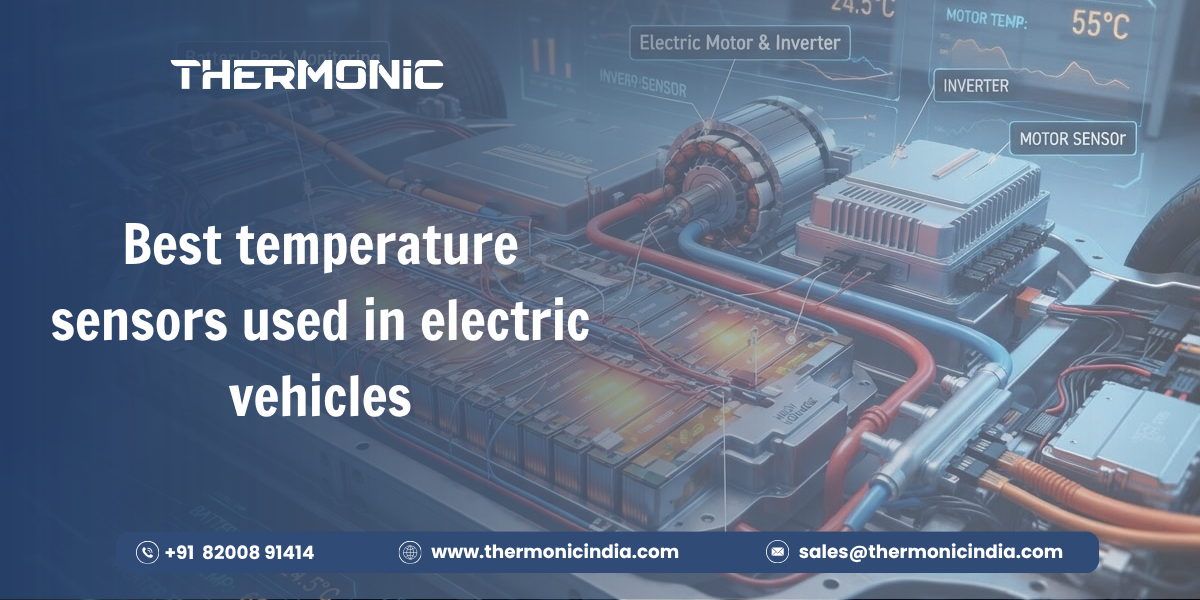
Best Temperature Sensors Used in Electric Vehicles: Types, Applications and Benefits
Introduction
Electric vehicles (EVs) are changing the automotive industry. However, their performance and reliability depend on effective temperature monitoring across batteries, electric motors, charging systems and power electronics.
Temperature plays an important role in EV operation. Excessive heat can affect battery performance, accelerate component ageing and increase the risk of equipment failure. Similarly, operating below the recommended temperature range can reduce battery efficiency and affect charging performance.
This is why selecting the right temperature sensor for electric vehicle applications is essential for manufacturers, battery system developers and automotive component suppliers.
Different sensor technologies, including NTC thermistors, RTD sensors and thermocouples, serve different purposes. Understanding their working principles and applications helps engineers choose suitable temperature measurement solutions.
What Are Temperature Sensors in Electric Vehicles?
Temperature sensors measure the temperature of specific components and convert the measurement into an electrical signal that a monitoring or control system can interpret.
In electric vehicles, these sensors can provide temperature data to the Battery Management System (BMS), Electronic Control Unit (ECU) or other dedicated control systems.
Based on the application, temperature readings can support:
- Battery temperature monitoring and thermal management.
- Motor and power electronics temperature monitoring.
- Charging equipment temperature control.
- Coolant temperature measurement.
- Overtemperature detection and protective actions.
The sensor must match the component, operating conditions and required measurement accuracy to provide reliable readings.
Best Types of Temperature Sensors Used in Electric Vehicles
Different EV applications require different temperature sensing technologies. The following sensor types are useful to understand when evaluating temperature measurement requirements.
1. NTC Thermistor Temperature Sensors
Negative Temperature Coefficient (NTC) thermistors are widely used for electronic temperature measurement. Their electrical resistance decreases as temperature increases.
This resistance change allows electronic circuits to calculate temperature and monitor variations during operation.
Applications of NTC sensors in EVs:
- Battery cell and battery pack temperature monitoring.
- Charging connectors and charging equipment.
- Power electronics and electronic control systems.
- Selected motor temperature monitoring applications.
- Thermal management systems.
NTC thermistors offer high sensitivity, compact dimensions and suitability for many electronic measurement circuits. However, their resistance-temperature characteristics, operating range and installation method must match the application.
For manufacturers looking for an NTC temperature sensor supplier for EV systems, important selection factors include resistance at the reference temperature, B-value, accuracy, response time and mechanical construction.

2. RTD Temperature Sensors: PT100 and PT1000
Resistance Temperature Detectors (RTDs) measure temperature through changes in electrical resistance. PT100 and PT1000 are common platinum RTD types.
A PT100 has a nominal resistance of 100 ohms at 0°C, while a PT1000 has a nominal resistance of 1,000 ohms at the same temperature.
RTDs are known for their measurement stability, repeatability and accuracy when appropriately selected and installed.
Potential EV applications include:
- Coolant temperature measurement.
- Electric motor and component testing.
- Thermal management equipment.
- EV research and development facilities.
- Temperature monitoring in suitable auxiliary systems.
The final selection depends on the required temperature range, response time, wiring arrangement, installation space and compatibility with the measurement electronics.
3. Thermocouple Temperature Sensors
Thermocouples measure temperature using the voltage generated by two dissimilar conductors when a temperature difference exists between their junctions.
They are available in different types, including K, J, T, N, R, S and B, each with different operating characteristics.
Thermocouples are particularly useful for applications involving broad temperature ranges and thermal testing.
Potential applications in the EV industry include:
- Electric motor performance testing.
- Inverter and power electronics testing.
- Thermal validation of automotive components.
- Laboratory testing and product development.
- High-temperature equipment monitoring.
The thermocouple type, sheath material, measurement range and required accuracy should be considered before selecting a sensor.
4. Surface-Mount Temperature Sensors
Surface-mount temperature sensors measure the temperature of a component or surface without necessarily requiring an insertion probe.
Depending on the design, these sensors can be integrated into electronic assemblies or mounted at designated measurement points.
Potential applications include power electronic boards, control electronics and selected battery monitoring assemblies.
Proper mounting and thermal contact are important because an incorrectly installed sensor may not accurately represent the actual component temperature.
Where Are Temperature Sensors Used in Electric Vehicles?
EV Battery Pack and Cell Monitoring
Battery temperature affects charging, discharging, performance and ageing. Temperature sensors provide measurements that help the BMS monitor battery conditions and manage thermal control strategies.
Sensor placement is particularly important because temperatures can vary between cells and modules.
Electric Motor Temperature Monitoring
Electric motors generate heat during operation. Temperature sensors can monitor designated motor components, including windings and bearings, depending on the sensor design.
These measurements help identify abnormal temperature conditions and support motor protection strategies.
EV Charging Equipment and Connectors
Charging equipment and electrical connectors can generate heat due to current flow, electrical resistance and operating conditions.
A suitable temperature sensor for EV charging equipment can monitor temperature at designated points and provide data to the relevant control system.
The sensor must meet the equipment’s requirements for temperature range, response time, mounting, electrical isolation and environmental durability.
Inverters and Power Electronics
Inverters and converters manage electrical energy between the battery, motor and other vehicle systems. Their electronic components can generate significant heat.
Temperature monitoring supports thermal management and helps the control system respond to abnormal operating conditions.
Battery Cooling Systems
Temperature sensors can monitor coolant at suitable points within the battery thermal management system.
The resulting data helps regulate heating and cooling operations to maintain the temperature range specified for the battery system.
NTC vs RTD vs Thermocouple: Which Is Best for EVs?
| Parameter | NTC thermistor | RTD | Thermocouple |
| Measurement principle | Resistance decreases as temperature rises | Resistance changes with temperature | Generates a temperature-dependent voltage |
| Key strength | High sensitivity and compact size | Stability and accuracy | Broad measurement range |
| Typical use | Battery and electronic monitoring | Coolant systems and precision testing | Thermal testing and high-temperature applications |
| Key consideration | Resistance curve and operating range | Cost, wiring and installation | Signal conditioning and reference junction |
| EV suitability | Depends on sensor design and qualification | Depends on sensor design and installation | Often useful for testing and validation |
Which sensor is best? NTC thermistors are a strong option for many battery and electronic temperature monitoring applications. RTDs may be appropriate when stability and accuracy are priorities, while thermocouples are useful for testing and applications requiring a broader temperature range.
The correct choice depends on the actual measurement point and system requirements rather than the sensor type alone.
How to Choose the Right Temperature Sensor for an Electric Vehicle
Before selecting a sensor, engineers should evaluate the following factors.
1. Operating temperature range: Confirm the normal operating range, expected extremes and required measurement limits.
2. Accuracy and response time: Determine the measurement accuracy required and how quickly the system must detect temperature changes.
3. Size and mounting: Check available space, probe dimensions, surface contact, insertion depth and connector requirements.
4. Electrical compatibility: Verify resistance-temperature characteristics, thermocouple type, wiring and compatibility with the BMS or ECU.
5. Environmental durability: Evaluate vibration, moisture, chemicals, thermal cycling and electrical isolation requirements.
6. Automotive qualification: Confirm the relevant qualification and validation requirements for production vehicle use. A sensor suitable for laboratory testing is not automatically suitable for direct integration into an EV battery pack.
Benefits of Reliable Temperature Monitoring in EVs
Selecting a suitable temperature sensor can support several operational objectives:
- Better visibility into battery and component temperatures.
- Improved control of battery heating and cooling systems.
- Earlier detection of abnormal temperature conditions.
- Support for motor and power electronics protection.
- More consistent thermal testing and product validation.
- Improved monitoring of charging equipment.
Temperature sensors contribute to these objectives, but overall performance also depends on sensor placement, control logic, system design and appropriate protective measures.
Temperature Sensor Solutions from Thermonic India
Thermonic India manufactures and supplies industrial temperature measurement and control products, including NTC sensors, RTD sensors and thermocouples.
For EV manufacturers, automotive component suppliers and testing facilities, the selection process should begin with the application requirements. Battery monitoring, charging equipment, motor testing and coolant measurement may require different sensor constructions and electrical characteristics.
As a temperature sensor manufacturer, Thermonic India can be approached to discuss sensor requirements, including operating temperature, dimensions, construction, accuracy and connection specifications. Confirm the suitability and automotive qualification of the selected product for the intended EV application before finalising the design.
Looking for Reliable Temperature Sensors for EV Applications?
Explore temperature sensing solutions for EV battery monitoring, motor applications and thermal management systems.

Frequently Asked Questions
Which temperature sensor is best for EV batteries?
NTC thermistors are commonly used for battery temperature monitoring because of their sensitivity and compact size. The final selection depends on the battery design, measurement range and system requirements.
Are NTC sensors used in EV charging systems?
Yes. Suitable NTC sensors can monitor temperature at designated points in charging equipment and connectors when their electrical, thermal and mechanical specifications meet the application requirements.
What is the difference between NTC and PT100 sensors?
An NTC thermistor’s resistance decreases as temperature increases. A PT100 is a platinum RTD whose resistance increases with temperature, measuring 100 ohms at 0°C.
Can thermocouples be used in electric vehicles?
Thermocouples are useful in EV component testing, thermal validation and selected temperature measurement applications. Production vehicle integration requires application-specific evaluation.
How do I select an EV temperature sensor supplier?
Evaluate the supplier’s product specifications, customisation capabilities, documentation, quality processes and ability to meet the application’s environmental and automotive qualification requirements.
For EV temperature measurement requirements, contact Thermonic India to discuss suitable sensor options and technical specifications.









Leave a Reply