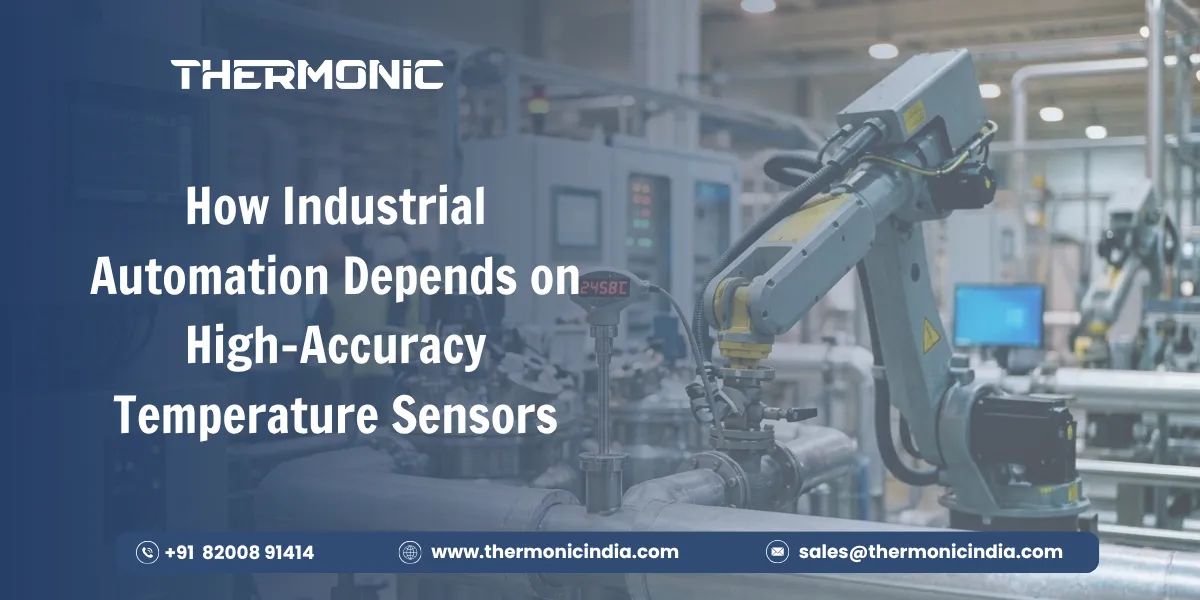
How Industrial Automation Depends on High-Accuracy Temperature Sensors
Industrial automation has changed the way modern factories monitor, control, and optimise their processes. From manufacturing and pharmaceuticals to power plants, chemicals, food processing, and steel, automated systems depend on accurate real-time information to maintain stable operations. Among all process variables, temperature is one of the most important because even a small variation can affect product quality, energy consumption, equipment life, and process safety.
This is where high accuracy temperature sensors become essential. These sensors act as the connection between the physical process and the automation system, providing temperature data that PLCs, DCS, SCADA systems, and controllers can use to make reliable decisions.
According to the International Energy Agency (IEA), industry accounted for nearly 40% of global final energy consumption in 2024, making process efficiency an important consideration for industrial facilities. Accurate temperature measurement can support better process control and help avoid unnecessary heating, cooling, and energy losses.
For this reason, selecting reliable sensors from experienced temperature sensors manufacturers is an important part of designing an efficient industrial automation system.
Key takeaway: Automation can only be as reliable as the data provided by its sensors.
What Are High-Accuracy Temperature Sensors?
High-accuracy temperature sensors are measurement devices designed to provide reliable temperature readings within a specified accuracy range. They are used where precise temperature monitoring is important for process control, quality, equipment protection, and safety.
Understanding Temperature Measurement Accuracy
Accuracy refers to how closely the measured temperature is to the actual temperature. However, accuracy is only one part of sensor performance. Industrial buyers should also understand:
- Accuracy: How close the measurement is to the actual temperature.
- Precision: How consistently the sensor produces similar readings.
- Repeatability: The ability to provide consistent results under the same conditions.
- Stability: The ability to maintain measurement performance over time.
The required accuracy depends on the application. A general-purpose monitoring application may not require the same level of accuracy as a pharmaceutical process, laboratory process, or critical industrial control system.
Common High-Accuracy Temperature Sensors
Several sensor technologies are used in industrial temperature measurement.
RTD sensors are widely used where accuracy, stability, and repeatability are important. Common options include:
- PT100
- PT1000
- Simplex RTD
- Duplex RTD
Thermocouple sensors are commonly selected for applications involving wider temperature ranges and demanding industrial environments. Common types include:
- K Type
- J Type
- T Type
- N Type
- R Type
- S Type
- B Type
Industrial temperature transmitters can also be integrated with temperature sensors to convert sensor signals into standardised outputs such as 4–20 mA, allowing the measurement to be transmitted to industrial control systems.
The Role of Temperature Sensors in Industrial Automation
Temperature sensors are an important part of the industrial automation control loop:
Process → Temperature Sensor → Transmitter/Signal Conditioning → PLC/DCS → Control Action → Process
The sensor measures the temperature of the process and sends the information to the control system. The PLC, DCS, or other controller then compares the measurement with the required setpoint and initiates an appropriate control action.
Temperature Sensors Provide Real-Time Process Data
Industrial temperature sensors help automation systems:
- Monitor process temperature continuously.
- Detect temperature changes.
- Send measurement signals to control systems.
- Maintain predefined temperature conditions.
- Support automatic process adjustments.
- Trigger alarms when abnormal conditions occur.
Automation Systems Use Temperature Data To:
Depending on the application, temperature information can be used to:
- Start or stop heating systems.
- Control cooling systems.
- Regulate industrial heaters.
- Adjust valves.
- Trigger high- or low-temperature alarms.
- Protect machinery from overheating.
- Maintain consistent process conditions.
Therefore, temperature sensors for industrial automation must be selected according to the process requirements rather than simply choosing a sensor based on temperature range.
Also Read : Common Temperature Sensor Problems in Factories and Their Solutions
Why High Accuracy Is Critical for Automated Processes
An automation system can only respond correctly when it receives reliable measurement data. An inaccurate temperature reading can cause the controller to take an unnecessary or incorrect action.
Better Process Control
Accurate temperature measurement helps controllers maintain the required setpoint with fewer unwanted fluctuations. This is particularly important in processes where temperature directly influences chemical reactions, material properties, cooking conditions, curing, drying, or heat treatment.
Better measurement can contribute to:
- Stable process conditions.
- Improved temperature control.
- Reduced fluctuations.
- Consistent production.
- More reliable automated operation.
Improved Product Quality
Temperature can directly influence product characteristics in many industries, including:
- Pharmaceuticals
- Food processing
- Chemicals
- Plastics
- Steel
- Glass
- Cement
- General manufacturing
For example, an incorrect temperature measurement during a heating or curing process may cause a product to be underprocessed or overprocessed. Reliable industrial temperature measurement helps maintain the required operating conditions.
Reduced Energy Consumption
Heating and cooling equipment can consume significant amounts of energy. Incorrect temperature readings may cause heaters or cooling systems to operate longer than necessary.
Accurate sensors can help automation systems:
- Avoid unnecessary heating.
- Prevent excessive cooling.
- Reduce overheating.
- Improve heater and furnace control.
- Minimise energy waste.
Equipment Protection
High temperatures can damage equipment, insulation, electrical components, motors, bearings, and process machinery. Temperature sensors can provide early warning when operating conditions move outside acceptable limits.
Reliable measurements can therefore support:
- Overtemperature protection.
- Reduced thermal stress.
- Preventive maintenance.
- Equipment monitoring.
- Reduced risk of unexpected downtime.

How Temperature Sensor Accuracy Affects PLC and DCS Systems
A temperature sensor does more than display a temperature value. Its measurement can directly influence automated decisions.
Sensor Signal → Controller Decision
Consider a simple example:
Actual temperature: 200°C
Sensor reading: 190°C
If the control system receives a reading of 190°C when the actual process temperature is already 200°C, the automation system may continue heating. Depending on the process, this could result in overheating, energy waste, product damage, or equipment stress.
Consequences of Incorrect Temperature Signals
Poor temperature measurement can contribute to:
- Overheating.
- Underheating.
- Product defects.
- Increased energy consumption.
- Equipment damage.
- Unplanned downtime.
- Incorrect alarms.
- Safety concerns.
This demonstrates why sensor accuracy should be considered during the design and maintenance of an industrial control system.
RTD vs Thermocouple for Industrial Automation
RTDs and thermocouples are both widely used in industrial automation, but their characteristics make them suitable for different applications.
| Feature | RTD | Thermocouple |
| Accuracy | Generally high | Depends on type and application |
| Stability | Excellent | Good |
| Temperature Range | Moderate | Very wide |
| Response Time | Moderate | Often fast |
| Common Example | PT100 | K Type |
| Typical Applications | Process control, HVAC, pharmaceuticals | Furnaces, kilns, high-temperature processes |
When to Choose an RTD
An RTD may be suitable when:
- Measurement accuracy is a priority.
- The operating temperature is within the RTD’s suitable range.
- Stable measurement is required.
- Repeatability is important.
- The application involves process control or pharmaceutical manufacturing.
PT100 temperature sensors are particularly common in industrial applications where reliable and stable temperature measurement is required.
When to Choose a Thermocouple
A thermocouple may be preferred when:
- High temperatures are involved.
- Fast response is required.
- The application has demanding environmental conditions.
- Furnaces, ovens, kilns, or high-temperature machinery are involved.
- A wide operating temperature range is required.
The correct sensor depends on the actual process, temperature range, installation conditions, accuracy requirements, and control system.
Factors That Determine Temperature Sensor Accuracy
Selecting an accurate sensor is important, but several other factors can affect measurement performance.
Sensor Element Quality
The quality of the RTD element or thermocouple junction can influence measurement reliability. Consistent manufacturing, suitable materials, and appropriate calibration can contribute to dependable performance.
Sensor Installation
Even a high-quality sensor can produce poor measurements if it is installed incorrectly.
Important considerations include:
- Correct insertion depth.
- Proper sensor positioning.
- Good thermal contact.
- Suitable mounting arrangement.
- Correct sensor location.
The sensing point should represent the actual process temperature as closely as possible.
Sheath Material
The sensor sheath protects the sensing element from the surrounding environment. Common industrial materials include:
- SS304
- SS316
- SS316L
- SS310
- Inconel
Material selection should consider operating temperature, corrosion, mechanical conditions, and the process medium.
Sensor Wiring
Wiring can also affect measurement reliability. Industrial applications may require:
- Suitable cable quality.
- Proper electrical connections.
- Shielding where required.
- Correct thermocouple compensation cable.
- 2-wire, 3-wire, or 4-wire RTD configurations.
The wiring arrangement should match the sensor and receiving instrument.
Calibration
Regular calibration helps verify that the sensor continues to provide reliable measurements. Calibration becomes particularly important in critical processes where small measurement errors can affect product quality, safety, or process performance.
Temperature Sensors in Different Industrial Automation Applications
High-accuracy temperature sensors are used across many industries.
Pharmaceuticals
Temperature measurement can be required for:
- Reactor monitoring.
- Sterilisation.
- Manufacturing processes.
- Controlled storage environments.
Food & Beverage
Temperature sensors support applications such as:
- Cooking.
- Pasteurisation.
- Food processing.
- Cold storage.
Power Plants
Temperature monitoring can be important for:
- Boilers.
- Steam systems.
- Turbine-related equipment.
- Exhaust systems.
Oil & Gas
Industrial temperature sensors may be used in:
- Process lines.
- Refineries.
- Storage systems.
- Heat exchangers.
Steel & Metal Processing
High-temperature measurement is important in:
- Furnaces.
- Heat treatment.
- Metal processing.
- High-temperature manufacturing.
Chemical Processing
Temperature measurement can be required in:
- Reactors.
- Tanks.
- Process pipelines.
- Heating and cooling systems.
What Happens When Temperature Sensors Are Inaccurate?
Temperature measurement problems can affect both production and automation performance.
Common Problems
Inaccurate temperature sensors may contribute to:
- Incorrect process temperature readings.
- Frequent controller switching.
- Unstable process conditions.
- False alarms.
- Delayed alarms.
- Product inconsistency.
- Higher energy consumption.
- Premature equipment failure.
Common Causes
Some common causes include:
- Sensor ageing.
- Poor installation.
- Incorrect sensor selection.
- Electrical interference.
- Damaged cables.
- Improper calibration.
- Incorrect sensor location.
- Wrong sensor type.
Identifying the root cause is important before replacing a sensor. In some cases, the sensor itself may be working correctly while the problem is related to installation, wiring, calibration, or signal transmission.
How to Select the Right Temperature Sensor for Automation
Choosing the right sensor requires more than checking the maximum temperature range. Industrial buyers should consider the complete operating environment.
Consider These Parameters
Before selecting an industrial temperature sensor, review:
- Temperature range
- Required accuracy
- Response time
- Process medium
- Pressure
- Chemical exposure
- Vibration
- Sensor sheath material
- Probe diameter
- Probe length
- Thread or mounting connection
- Output signal
- RTD configuration
- Environmental conditions
- Calibration requirements
Application-Specific Customisation
Industrial applications often require sensors to be customised according to the equipment and installation conditions.
Customisation may include:
- Probe length.
- Probe diameter.
- Thread type.
- Cable length.
- Head design.
- Sheath material.
- Sensor configuration.
- Transmitter integration.
Working with an experienced temperature sensor manufacturer can help industrial buyers select a configuration that matches their process requirements.
How High-Accuracy Temperature Sensors Improve Industrial Automation
High-accuracy temperature sensors can support industrial automation in several important ways:
- Higher process accuracy
- Better product consistency
- Lower energy consumption
- Reduced downtime
- Improved equipment protection
- Reliable automated control
- Better maintenance decisions
- Improved operational efficiency
- Enhanced process safety
When temperature measurement is reliable, automation systems can respond more effectively to process changes. This makes sensor selection an important part of overall industrial process control.
Also Read : Why PT100 RTD Sensors Are Widely Used in Industrial Temperature Control
The Future of Temperature Measurement in Smart Factories
As factories move towards Industry 4.0, temperature measurement is becoming increasingly connected with digital monitoring and data-driven decision-making.
Temperature Sensors and Industry 4.0
Modern industrial environments are increasingly focused on:
- Real-time monitoring.
- Connected sensors.
- Remote process monitoring.
- Automated alerts.
- Data logging.
- Predictive maintenance.
- IIoT-enabled systems.
The value of a temperature sensor is therefore not limited to displaying a temperature. Its measurement can become part of a wider digital process.
From Measurement to Intelligent Decision-Making
A modern automated system can follow a broader process:
Sensor → Data → Analytics → Decision → Automated Action
Reliable temperature data forms the foundation of this chain. If the initial measurement is inaccurate, subsequent analysis and automated decisions may also be affected.
Why Choosing the Right Temperature Sensor Manufacturer Matters
The performance of an industrial temperature measurement system depends not only on the sensor technology but also on its design, manufacturing, materials, configuration, and application suitability.
What Industrial Buyers Should Look For
When selecting a supplier, consider:
- Manufacturing expertise.
- Sensor customisation.
- Material options.
- Calibration capabilities.
- Quality control.
- Application support.
- Consistent manufacturing.
- Industry experience.
- Technical documentation.
A supplier with industrial temperature measurement experience can help identify the appropriate sensor type, construction, mounting arrangement, and output configuration for a specific application.
Thermonic India
Thermonic India manufactures and supplies industrial temperature measurement solutions for a range of industrial applications. Its product range includes:
- RTD sensors.
- PT100 and PT1000 sensors.
- Thermocouples.
- Temperature probes.
- Temperature transmitters.
- Thermowells.
- Customised temperature sensors.
For industrial buyers, selecting the right combination of sensing element, sheath material, dimensions, wiring, mounting, and transmitter can help achieve dependable temperature measurement in demanding environments.

Ready to Choose High-Accuracy Temperature Sensors for Better Automation?
Industrial automation depends on reliable real-time data, and temperature is a critical process variable in many manufacturing and process industries. High-accuracy temperature sensors help automation systems monitor conditions, maintain setpoints, protect equipment, and support consistent production.
The right choice depends on several factors, including sensor technology, temperature range, accuracy, response time, installation method, sheath material, wiring, and calibration requirements. Therefore, selecting a suitable sensor should be treated as an important part of the overall automation strategy.
If you are looking for high-accuracy temperature sensors for industrial automation, Thermonic India can help you identify suitable RTD, PT100, PT1000, thermocouple, and customised temperature measurement solutions.
Looking for reliable temperature sensors suppliers in India? Discuss your application requirements with our team and find a temperature measurement solution designed for your process.