Why PT100 RTD Sensors Are Widely Used in Industrial Temperature Control
Introduction
Accurate temperature measurement is essential for maintaining quality, safety, efficiency, and process stability across modern industrial operations. From chemical processing plants and oil refineries to pharmaceutical manufacturers, food and beverage facilities, and OEM production lines, even a small temperature measurement error can affect product quality, equipment performance, and overall process control. For this reason, industries rely on dependable temperature measurement technologies that can provide stable and repeatable readings.
PT100 RTD sensors are among the most widely used solutions for industrial temperature measurement and control. These sensors use a platinum resistance element to measure temperature with excellent accuracy, stability, and repeatability. Their flexible construction and compatibility with industrial control systems make them suitable for a wide range of applications.
For OEM manufacturers and process industries, selecting the right temperature sensor can help improve process consistency and reduce maintenance requirements. A reliable pt100 sensor manufacturer can also provide customized sensor designs based on temperature range, probe dimensions, process connection, cable type, and installation requirements.
In this article, we explore why PT100 RTD sensors are widely used in industrial temperature control, how they work, their major advantages, applications, and the factors businesses should consider when selecting the right sensor.
What Is a PT100 RTD Sensor?
Understanding RTD Temperature Sensors
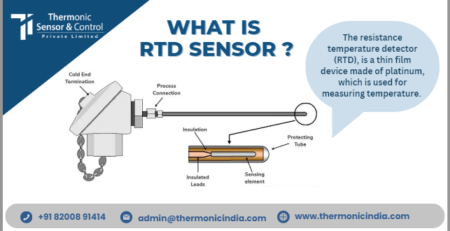
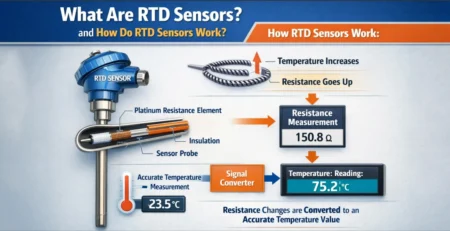
An RTD, or Resistance Temperature Detector, is a temperature sensor that determines temperature by measuring changes in the electrical resistance of its sensing element. . As temperature changes, the resistance of the element changes in a predictable way. The control system measures this resistance and converts it into a temperature reading.
A PT100 RTD sensor uses platinum as its sensing element. The term “PT100” refers to platinum and the sensor’s nominal resistance of 100 ohms at 0°C. Platinum is widely preferred for RTD applications because it provides excellent stability, predictable resistance characteristics, and reliable temperature measurement.
For industrial applications, pt 100 rtd sensor designs can be customized with different probe lengths, diameters, sheath materials, process connections, and cable configurations. This flexibility allows OEMs and process industries to select sensors according to their specific equipment and operating conditions.
How Does a PT100 RTD Sensor Work?
The operating principle of an rtd pt100 temperature sensor is based on the relationship between temperature and electrical resistance.
When the temperature surrounding the sensing element increases, the resistance of the platinum element also increases. As the temperature drops, the resistance of the sensing element also decreases.An instrument such as a temperature transmitter, controller, PLC, or monitoring system measures the resistance and determines the corresponding temperature.
PT100 sensors are commonly available in:
- 2-wire configurations
- 3-wire configurations
- 4-wire configurations

Why Are PT100 RTD Sensors Widely Used in Industrial Temperature Control?
1. High Temperature Measurement Accuracy
One of the primary reasons industries select PT100 RTD sensors is their excellent measurement accuracy. Accurate temperature information allows control systems to maintain processes within the required operating range.
For chemical processing plants, accurate temperature monitoring can help maintain reaction conditions. In pharmaceutical manufacturing, temperature control can be important for maintaining consistent production conditions. Similarly, food and beverage facilities can use reliable temperature sensors for controlled processing and storage applications.
For OEM manufacturers, integrating an accurate industrial PT100 RTD sensor into machinery can help provide reliable temperature feedback to the machine’s control system.
2. Excellent Repeatability and Stability
Industrial processes often require continuous temperature monitoring. A sensor must therefore provide consistent readings over repeated measurements.
PT100 RTD sensors offer excellent repeatability and long-term stability when correctly selected and installed. Consistent measurements can help reduce unexpected process variations and support reliable automated temperature control.
This makes them particularly useful for:
- Continuous process monitoring
- Industrial heating systems
- Temperature-controlled machinery
- Production equipment
- Process automation systems
- Equipment monitoring applications
3. Wide Range of Industrial Applications
The versatility of PT100 sensors is another reason for their widespread use. They can be designed for different temperature ranges, installation environments, and mechanical requirements.
Common applications include:
- OEM machinery
- Chemical processing equipment
- Oil and gas processing systems
- Refineries
- Pharmaceutical production equipment
- Food processing machinery
- Beverage production systems
- HVAC equipment
- Industrial ovens
- Boilers and heating systems
- Heat exchangers
- Process vessels
- Storage tanks
Because sensor specifications can be customized, a pt100 sensor manufacturer can develop solutions for specific equipment and process requirements.
4. Reliable Performance in Demanding Environments
Industrial temperature sensors may operate in environments involving vibration, moisture, chemicals, pressure, high temperatures, or continuous operation. Therefore, the construction of the sensor is just as important as the sensing element.
For chemical processing plants and refineries, material selection should take into account the process medium, temperature, pressure, and potential chemical exposure. The correct sensor design can improve reliability and service life.
5. Compatibility With Industrial Control Systems
Modern industrial facilities depend heavily on automation. Temperature sensors must communicate reliably with controllers, transmitters, PLCs, data acquisition systems, and monitoring equipment.
PT100 RTD sensors can be integrated into many industrial temperature control systems. Their resistance-based output makes them suitable for applications where temperature information is transmitted to an electronic control system.
For OEM manufacturers, this compatibility allows PT100 sensors to be incorporated into:
- Automated production machines
- Industrial control panels
- Heating systems
- Process control equipment
- Temperature monitoring systems
- Machine automation systems
6. Different Wiring Configurations
Another advantage of PT100 sensors is the availability of multiple wiring configurations.
2-wire PT100:
A simple configuration suitable for applications where extremely high measurement accuracy is not required or where lead-wire resistance has minimal impact.
3-wire PT100:
A widely used industrial configuration that helps compensate for the resistance of connecting wires. It offers a practical balance between accuracy, complexity, and cost.
4-wire PT100:
A configuration designed for high-accuracy temperature measurement because it can more effectively eliminate the influence of lead-wire resistance.
The appropriate configuration depends on the required measurement accuracy, cable length, instrumentation, and application.
Also Read : Why Your Temperature Sensor Is Giving Wrong Readings
PT100 RTD Sensor vs Thermocouple
Both PT100 RTD sensors and thermocouples are widely used for industrial temperature measurement, but they have different characteristics.
| Feature | PT100 RTD Sensor | Thermocouple |
| Accuracy | High | Generally lower |
| Stability | Excellent | Good |
| Repeatability | Excellent | Good |
| Response Time | Moderate | Typically faster |
| Signal | Resistance | Voltage |
| Common Applications | Precise temperature control | Wide-temperature and fast-response applications |
The correct choice should depend on the application’s temperature range, response-time requirements, environmental conditions, accuracy requirements, and instrumentation.
Key Factors to Consider When Choosing a PT100 RTD Sensor
Temperature Range
Always select a sensor designed for the expected operating temperature. Operating a sensor outside its appropriate range can affect accuracy, reliability, and service life.
Probe Material
The probe material should match the process environment. Stainless steel is commonly used for industrial applications, while specialized materials may be required for aggressive chemical or high-temperature environments.
Sensor Configuration
Choose between 2-wire, 3-wire, and 4-wire configurations according to the required measurement accuracy and control system.
Probe Length and Diameter
The probe should be correctly sized for the equipment. Incorrect dimensions can make installation difficult or result in poor temperature measurement.
Process Connection
Threaded, flanged, compression, and other connection options may be selected depending on the equipment and installation requirements.
Cable and Insulation
Cable material and insulation should withstand the operating temperature and surrounding environment. The cable should also provide appropriate mechanical and electrical protection.
Protection and Installation Requirements
Consider vibration, moisture, pressure, chemicals, mechanical exposure, and installation location before selecting the sensor construction.
Common Industrial Applications of PT100 RTD Sensors
Manufacturing and Process Industries
Manufacturing equipment often requires accurate temperature monitoring to maintain consistent production conditions. PT100 sensors can monitor machinery, process temperatures, heating systems, and production equipment.
OEM manufacturers can integrate customized sensors into machines based on specific mechanical and electrical requirements.
Food and Pharmaceutical Industries
Food and pharmaceutical facilities require controlled production environments. Temperature measurement can be important in processing, heating, cooling, storage, and other temperature-sensitive operations.
A properly specified PT100 sensor can provide stable temperature feedback for control and monitoring systems.
Chemical and Petrochemical Industries
Chemical processing plants and petrochemical facilities often operate complex processes where temperature must be carefully monitored.
PT100 sensors can be used in:
- Process vessels
- Storage tanks
- Pipelines
- Heating systems
- Reactors
- Heat exchangers
- Processing equipment
Oil and Refineries
Oil refineries use temperature measurement throughout various processing stages. Reliable sensors can support monitoring of equipment, process temperatures, heating systems, and other critical applications.
The sensor construction should be selected according to temperature, pressure, process conditions, and installation requirements.
Power and Energy
PT100 RTD sensors can also be used in boilers, heat exchangers, heating equipment, and other industrial systems where accurate temperature monitoring supports efficient operation.
Benefits of Using PT100 RTD Sensors for Temperature Control
Businesses choose PT100 RTD sensors because they offer several practical advantages:
- High temperature measurement accuracy
- Excellent repeatability
- Long-term stability
- Reliable industrial performance
- Flexible installation options
- Multiple wiring configurations
- Compatibility with automation systems
- Suitable for continuous temperature monitoring
- Customizable probe construction
- Availability for different industrial environments
These characteristics make PT100 sensors a practical option for industries where temperature control directly affects product quality, process efficiency, and equipment performance.
Common Problems With PT100 RTD Sensors
Incorrect Wiring
Incorrect wiring can produce inaccurate temperature readings. The wiring configuration should match the sensor specification and the connected instrumentation.
Sensor Damage
Mechanical impact, excessive vibration, corrosion, or unsuitable operating conditions can damage the sensor and affect measurement performance.
Poor Installation
Sensor placement can influence measurement accuracy. The probe should be installed where it can accurately detect the temperature of the process or equipment.
Electrical Interference
Industrial environments can contain motors, drives, power cables, and other electrical equipment that may affect instrumentation. Appropriate wiring and installation practices can help reduce interference.
Incorrect Sensor Selection
Selecting a sensor without considering temperature range, material compatibility, dimensions, process connection, and environmental conditions can lead to premature failure or inaccurate readings.
How to Improve PT100 RTD Sensor Performance
To achieve reliable performance from a PT100 sensor, industrial users should:
- Select the correct sensor specification.
- Choose an appropriate temperature range.
- Use the correct wiring configuration.
- Install the sensor correctly.
- Select suitable probe and sheath materials.
- Protect the sensor from excessive mechanical stress.
- Inspect cables and connections regularly.
- Check sensor readings during planned maintenance.
- Calibrate sensors when required.
- Use compatible temperature transmitters and controllers.
Working with an experienced rtd sensor manufacturer in Ahmedabad can also help OEMs and industrial users select or customize sensors according to their specific application requirements.
Also Read : How to Extend the Life of Industrial Thermocouples
Why Choose a Quality PT100 RTD Sensor?
The performance of an industrial temperature control system depends partly on the quality and suitability of its temperature sensor. A properly designed PT100 RTD sensor can provide consistent measurement performance and reliable operation.
When selecting a supplier, consider factors such as:
- Manufacturing experience
- Sensor customization capabilities
- Material options
- Temperature range
- Wiring configurations
- Process connection options
- Quality control procedures
- Technical support
- Application-specific recommendations
A reliable PT100 sensor manufacturer can help OEM manufacturers, chemical processing plants, oil refineries, pharmaceutical manufacturers, and food and beverage facilities choose the right sensor for their applications.
Need Reliable PT100 RTD Sensors? We Have the Right Solution for Your Industry
PT100 RTD sensors are widely used in industrial temperature control because they combine high accuracy, excellent repeatability, long-term stability, and flexible installation options. Their compatibility with temperature controllers, transmitters, PLCs, and automation systems makes them suitable for both simple monitoring applications and sophisticated industrial processes.
From OEM machinery and chemical processing plants to oil refineries, pharmaceutical production facilities, and food and beverage operations, accurate temperature measurement plays an important role in maintaining reliable processes.
Choosing the right pt100 rtd sensor requires careful consideration of temperature range, probe material, wiring configuration, dimensions, process connection, cable construction, and operating environment. By selecting the correct sensor specification and following proper installation and maintenance practices, businesses can achieve dependable temperature monitoring and control.
If you are looking for a reliable pt100 rtd sensor supplier for industrial temperature measurement applications, work with an experienced manufacturer that can provide suitable sensor designs, materials, configurations, and customization options for your specific requirements. A quality PT100 RTD solution can help OEMs and process industries achieve accurate temperature measurement and more consistent industrial performance.