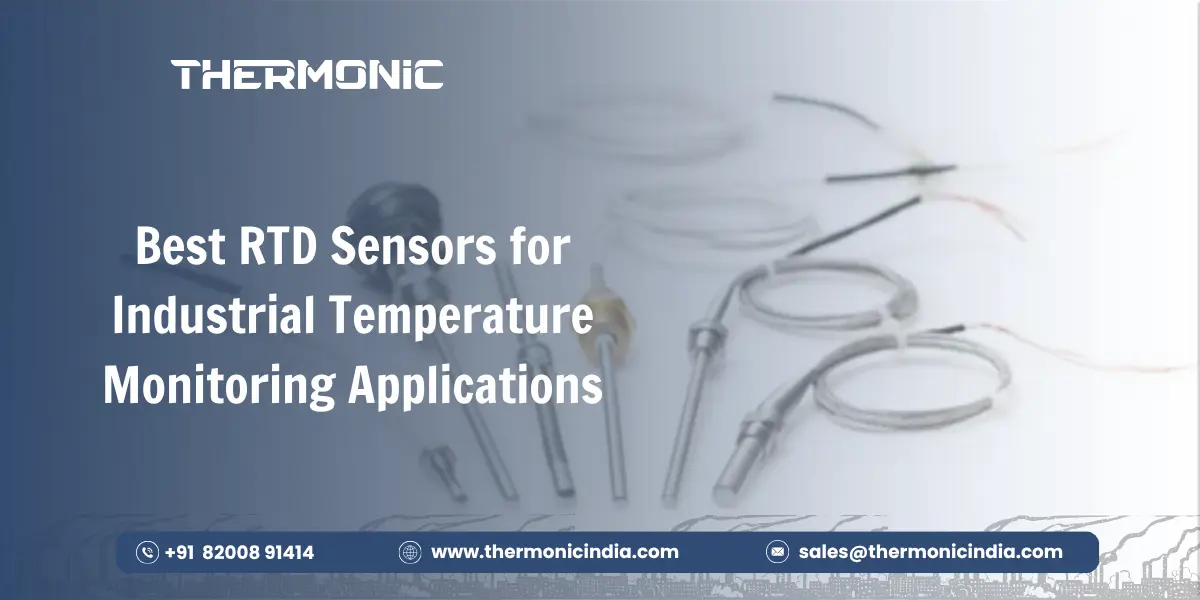
Best RTD Sensors for Industrial Temperature Monitoring Applications
Introduction
What happens when a temperature reading is off by just a few degrees in a critical industrial process? The result can be compromised product quality, equipment damage, increased operational costs, or even safety risks. In fact, according to an ABB survey, manufacturers experience unplanned downtime that costs an average of $125,000 per hour, highlighting the importance of reliable monitoring systems and accurate temperature measurement. This is why accurate temperature monitoring is a top priority across industries such as manufacturing, pharmaceuticals, food processing, power generation, and chemical processing. Implementing the best RTD sensors can help industries maintain precise process control, reduce costly downtime, improve product quality, and enhance overall operational efficiency.
Among the many temperature sensing technologies available today, Resistance Temperature Detectors (RTDs) are widely recognized for their exceptional accuracy, stability, and repeatability. Industries that require precise and reliable temperature measurements often choose RTD sensors to maintain process efficiency and ensure compliance with strict quality standards.
As a trusted RTD sensor manufacturer, Thermonic India provides high-quality RTD solutions designed to meet the demanding requirements of modern industrial applications.
In this guide, we will explore what RTD sensors are, their different types, key benefits, industrial applications, and how to select the best RTD sensor for your temperature monitoring needs.
What Is an RTD Sensor?
Understanding Resistance Temperature Detectors
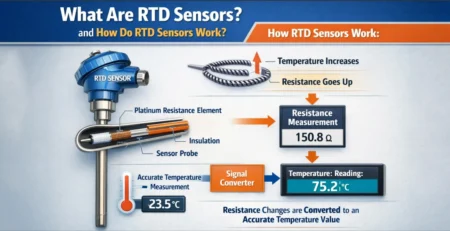
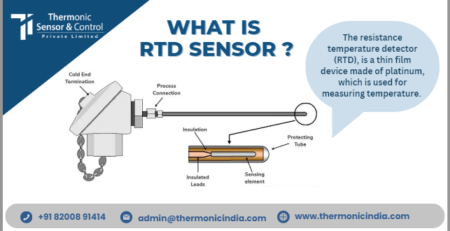
An RTD (Resistance Temperature Detector) is a temperature sensor that measures temperature by monitoring changes in electrical resistance. As temperature changes, the resistance of the sensing element changes in a predictable manner, allowing accurate temperature measurement.
RTDs are known for delivering highly accurate and repeatable readings, making them ideal for industrial temperature monitoring applications.
Common materials used in RTD elements include:
- Platinum
- Nickel
- Copper
Among these materials, platinum is the most widely used because of its excellent stability, accuracy, and resistance to corrosion.
Key Components of an RTD Sensor
A typical RTD sensor consists of several important components:
Sensing Element
The sensing element detects temperature changes through variations in electrical resistance.
Protective Sheath
The sheath protects the sensing element from moisture, chemicals, pressure, and mechanical damage.
Lead Wires and Terminals
Lead wires transmit resistance signals from the sensing element to the measuring instrument.
Connection Head or Transmitter
The connection head houses wiring terminals and can accommodate transmitters for signal conversion and remote monitoring.
Why RTD Sensors Are Preferred for Industrial Temperature Monitoring
High Accuracy and Stability
One of the primary reasons industries choose RTD sensors is their superior accuracy. RTDs provide precise temperature measurements with minimal drift over time, making them suitable for critical applications where even small temperature variations matter.
Wide Operating Temperature Range
RTD sensors can accurately measure temperatures across a broad range, typically from -200°C to 600°C, depending on the sensor design and construction.
This versatility makes them suitable for numerous industrial processes.
Excellent Repeatability
Repeatability refers to a sensor’s ability to provide the same measurement under identical conditions. RTD sensors excel in this area, ensuring consistent process control and reliable performance throughout their lifespan.
Resistance to Industrial Environments
Industrial environments often expose sensors to:
- High vibration
- Corrosive chemicals
- Moisture
- Dust
- Pressure fluctuations
Properly designed RTD sensors can withstand these harsh conditions while maintaining accurate temperature measurements.
Also Read : Thermocouple Wire Types and Their Importance in Temperature Measurement
Types of RTD Sensors Used in Industrial Applications
Pt100 RTD Sensors
Pt100 sensors are the most commonly used RTD sensors in industrial applications. They have a resistance value of 100 ohms at 0°C and offer excellent accuracy and stability.
As a leading Pt100 sensor manufacturer , Thermonic India provides reliable Pt100 solutions for diverse industrial requirements.
The RTD 100 temperature sensor is commonly used in:
- Process industries
- HVAC systems
- Pharmaceutical manufacturing
- Power plants
- Food processing facilities
Advantages of Pt100 Sensors
- High accuracy
- Excellent repeatability
- Wide temperature range
- Long operational life
Pt1000 RTD Sensors
Pt1000 sensors operate on the same principle as Pt100 sensors but have a resistance value of 1000 ohms at 0°C.
The Pt1000 RTD temperature sensor offers improved signal strength and reduced effects of lead wire resistance, making it particularly useful for long-distance signal transmission applications.
Common applications include:
- Building automation
- Industrial control systems
- Energy management systems
- Environmental monitoring
2-Wire RTD Sensors
2-wire RTD configurations are economical and easy to install.
Benefits include:
- Lower installation cost
- Simple wiring
Limitations include:
- Reduced accuracy due to lead wire resistance
- Less suitable for precision measurements
3-Wire RTD Sensors
The 3-wire configuration compensates for lead wire resistance, providing improved measurement accuracy.
Advantages include:
- Better accuracy than 2-wire systems
- Widely accepted industrial standard
- Cost-effective performance
4-Wire RTD Sensors
4-wire RTDs offer the highest level of accuracy by eliminating lead wire resistance errors.
These sensors are commonly used in:
- Calibration laboratories
- Research facilities
- Critical process applications
- Precision manufacturing
Best RTD Sensor Designs for Industrial Temperature Monitoring
Mineral Insulated RTD Sensors
Mineral insulated RTDs feature a compact design with excellent mechanical strength.
Benefits include:
- Fast response time
- High-temperature capability
- Superior vibration resistance
- Flexible installation options
Thermowell RTD Sensors
Thermowell-mounted RTDs protect the sensing element from process media while allowing easy sensor replacement without shutting down the process.
Key advantages:
- Increased sensor lifespan
- Enhanced safety
- Simplified maintenance
Surface Mount RTD Sensors
Surface mount RTDs are designed to monitor the temperature of machinery, pipelines, motors, and equipment surfaces.
Benefits include:
- Easy installation
- Non-invasive measurement
- Effective equipment monitoring
Head Type RTD Sensors
Head type RTDs are commonly used in industrial process environments where transmitters are required.
Advantages include:
- Improved signal conditioning
- Easy maintenance
- Better environmental protection
Threaded RTD Sensors
Threaded RTDs provide secure mounting in tanks, pipelines, and process equipment.
They are widely used in:
- Chemical plants
- Food processing systems
- Water treatment facilities
Flange Mounted RTD Sensors
Flange-mounted RTDs are designed for heavy-duty industrial applications involving high pressure and demanding operating conditions.
Applications include:
- Petrochemical facilities
- Power generation plants
- Large industrial reactors
Choosing the Best RTD Sensor for Your Application
Temperature Range Requirements
Always select an RTD sensor capable of operating within your process temperature range. Exceeding the sensor’s limits can affect accuracy and shorten its lifespan.
Accuracy Requirements
Different applications require different accuracy levels.
Critical applications such as pharmaceuticals and laboratories often require tighter tolerances than general industrial processes.
Environmental Conditions
Consider environmental factors such as:
- Moisture
- Chemicals
- Dust
- Pressure
- Vibration
Choosing the appropriate sheath material and sensor design can significantly improve performance and durability.
Installation Method
The installation method should align with your process requirements.
Common options include:
- Threaded RTDs
- Flanged RTDs
- Surface mount RTDs
- Thermowell RTDs
Response Time Requirements
Applications involving rapid temperature changes require sensors with fast response times.
Mineral insulated RTDs are often preferred in such situations.
Output Signal Compatibility
Many modern industrial systems require:
- Direct RTD resistance output
- 4-20 mA transmitter output
Ensure the selected sensor is compatible with your control and monitoring systems.
Industrial Applications of RTD Sensors
Manufacturing Plants
RTD sensors help maintain precise process temperatures, improving product quality and production efficiency.
Pharmaceutical Industry
Accurate temperature monitoring is essential for regulatory compliance, product consistency, and patient safety.
Food and Beverage Processing
RTD sensors support hygienic processing and ensure proper temperature control during production, storage, and transportation.
Power Generation
Power plants use RTD sensors to monitor:
- Turbines
- Boilers
- Generators
- Transformers
Chemical and Petrochemical Industries
RTDs play a critical role in maintaining safe and efficient chemical processes.
HVAC and Building Automation
Building management systems rely on RTD sensors for environmental control and energy optimization.
RTD Sensor Maintenance and Calibration Best Practices
Importance of Regular Calibration
Routine calibration helps ensure that RTD sensors continue to provide accurate and reliable measurements.
Inspection and Cleaning
Regular inspections can identify:
- Physical damage
- Corrosion
- Contamination
- Loose connections
Cleaning and maintenance help extend sensor life.
Common Signs of RTD Sensor Failure
Watch for:
- Temperature drift
- Inconsistent readings
- Slow response times
- Physical wear or damage
Calibration Intervals
Calibration frequency depends on:
- Industry standards
- Process criticality
- Environmental conditions
Regular calibration schedules help maintain optimal sensor performance.
Also Read : How to Buy the Right RTD Sensor for Your Industry
Common Mistakes to Avoid When Selecting RTD Sensors
Avoid these common mistakes:
- Selecting an inadequate temperature range
- Ignoring environmental conditions
- Choosing the wrong wiring configuration
- Overlooking installation requirements
- Neglecting routine calibration
Careful sensor selection can improve measurement accuracy, reduce downtime, and lower maintenance costs.
Find the Right RTD Sensor for Accurate Industrial Temperature Monitoring
Choosing the right RTD sensor is essential for achieving reliable temperature monitoring, process efficiency, product quality, and operational safety. Factors such as temperature range, accuracy, installation requirements, environmental conditions, and response time should all be considered during the selection process.
Whether you require a Pt100 sensor, Pt1000 sensor, thermowell RTD, mineral insulated RTD, or a customized temperature sensing solution, partnering with experienced RTD sensor suppliers can make all the difference.
At Thermonic India, we specialize in manufacturing high-quality RTD sensors engineered for demanding industrial environments. Our team can help you select the ideal solution for your specific application and provide customized temperature sensing products that deliver long-term performance and reliability.
Contact Thermonic India today to discuss your temperature monitoring requirements and find the perfect RTD sensor solution for your industry.