How to Buy the Right RTD Sensor for Your Industry
Summarize this blog post with:


Introduction
Temperature measurement plays a critical role in modern industries where precision, safety, and efficiency directly impact production quality and operational performance. One of the most trusted devices used for accurate temperature monitoring is the RTD sensor. RTD stands for Resistance Temperature Detector, a device that detects temperature through changes in electrical resistance.
Choosing the correct RTD sensor is extremely important because the wrong sensor can lead to inaccurate readings, equipment damage, process failures, production losses, and increased maintenance costs. According to industry reports, predictive maintenance and automated temperature monitoring systems can reduce unplanned downtime by up to 35% and maintenance costs by nearly 28% in industrial facilities. Industries such as pharmaceuticals, food processing, plastics, chemical manufacturing, HVAC, and power plants depend heavily on reliable temperature measurement systems to maintain smooth operations and product consistency.
Whether you need high accuracy, durability, fast response time, or resistance against harsh environments, selecting the right sensor can significantly improve industrial performance. This is why businesses prefer working with an experienced RTD sensor manufacturer in Ahmedabad that understands industry-specific temperature sensing requirements.
As a trusted name in industrial temperature solutions, Thermonic India provides high-quality industrial RTD temperature sensors designed for precision, durability, and long-term reliability across various industries.
What Is an RTD Sensor and How Does It Work?
Definition of RTD Sensors
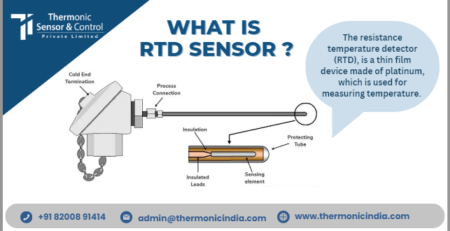
An RTD sensor, also known as a Resistance Temperature Detector, measures temperature by tracking changes in electrical resistance. The resistance of the sensing element increases with rising temperature, allowing highly accurate temperature measurement.
RTD temperature sensors are widely used in industries because they offer excellent accuracy, repeatability, and long-term stability compared to many other temperature sensing technologies.
Common Materials Used in RTD Sensors
Different metals are used in RTD sensors depending on the application requirements.
Platinum RTDs
- Most widely used material
- Excellent accuracy and stability
- Strong resistance to corrosion
- Suitable for a wide temperature range
Nickel RTDs
- Lower cost option
- Good sensitivity
- Used in limited industrial applications
Copper RTDs
- Good linearity
- Fast response characteristics
- Common in specific electrical applications
Why Platinum PT100 Sensors Are Most Popular
PT100 sensors are among the most commonly used industrial RTD temperature sensors because they provide:
- High measurement accuracy
- Excellent long-term stability
- Wide operating temperature range
- Reliable performance in demanding industrial environments
Their ability to deliver consistent and repeatable readings makes them ideal for critical industrial processes.
Why Choosing the Right RTD Sensor Is Important
Selecting the right RTD sensor directly affects industrial productivity and operational efficiency.
A properly selected sensor helps:
- Improve process accuracy
- Reduce unexpected equipment downtime
- Enhance workplace safety
- Increase energy efficiency
- Maintain consistent product quality
On the other hand, using an unsuitable RTD sensor can create major operational issues, including incorrect temperature readings, overheating, process instability, and higher maintenance costs.
Industrial environments often involve extreme temperatures, vibrations, moisture, chemicals, and pressure conditions. Therefore, industries must choose RTD temperature sensors that match their exact operating environment and performance requirements.
Also Read : How to Increase the Lifespan of Industrial Temperature Sensors
Key Factors to Consider Before Buying an RTD Sensor
Temperature Range
One of the most important factors to evaluate is the operating temperature range.
Different industrial applications require sensors capable of handling different temperatures:
- Low-temperature refrigeration systems
- Medium-range process heating
- High-temperature industrial furnaces
Choosing a sensor outside the required range may reduce accuracy and shorten sensor lifespan. Always ensure the RTD sensor matches your application’s operating conditions.
Accuracy Requirements
Accuracy is one of the biggest reasons industries choose RTD temperature sensors.
High-precision industries such as pharmaceuticals and laboratories require extremely accurate sensors, while general industrial processes may tolerate slightly lower precision.
Understanding tolerance classes is important:
- Class A RTDs offer higher accuracy
- Class B RTDs are suitable for standard industrial applications
The required accuracy level depends on your process sensitivity and quality standards.
Sensor Type
There are multiple RTD sensor types available for industrial applications.
PT100 RTD
- Most common industrial RTD
- 100-ohm resistance at 0°C
- Excellent stability and accuracy
PT1000 RTD
- Higher resistance output
- Better noise resistance
- Suitable for long cable distances
Thin Film RTD
- Compact design
- Fast response
- Cost-effective solution
Wire Wound RTD
- Higher precision
- Better stability
- Suitable for critical applications
Selecting the right type depends on the application needs, operating environment, and available budget.
Number of Wires
RTD sensors are available in different wiring configurations.
2-Wire RTD
- Simple and economical
- Suitable for short distances
- Lower accuracy
3-Wire RTD
- Most common industrial option
- Better accuracy compensation
- Cost-effective industrial solution
4-Wire RTD
- Highest accuracy
- Eliminates lead wire resistance errors
- Ideal for laboratories and precision systems
For industries requiring high measurement precision, 3-wire and 4-wire RTDs are generally preferred.
Response Time
Quick response time is important in applications where temperature fluctuations happen rapidly.
Industries such as plastics, packaging, and food processing often require quick temperature detection to maintain process control and avoid production losses.
Sensor design, sheath material, and probe size all affect response speed.
Environmental Conditions
Industrial environments are often harsh and highly demanding.
Before purchasing an RTD sensor, consider:
- Moisture exposure
- Chemical exposure
- Dust accumulation
- Vibration levels
- Outdoor weather conditions
Selecting a sensor designed for the environment improves durability and performance.
Sensor Sheath and Material
The protective sheath plays a major role in sensor longevity.
Common sheath materials include:
- Stainless steel
- Inconel
- Ceramic coatings
These materials provide:
- Corrosion resistance
- Mechanical protection
- Food-grade compatibility
Industries handling chemicals or moisture should prioritize corrosion-resistant designs.
Mounting and Installation Type
Different applications require different mounting styles.
Threaded RTD Sensors
- Secure installation
- Common in pipelines and tanks
Bayonet RTDs
- Adjustable positioning
- Used in plastic machinery
Surface-Mounted RTDs
- Ideal for surface temperature monitoring
Probe-Style RTDs
- Versatile industrial applications
- Easy installation
Selecting the proper installation type ensures better measurement reliability.
Different Industries and Their RTD Sensor Requirements
Food and Beverage Industry
Food industries require:
- Hygienic sensor designs
- Washdown-resistant construction
- Food-grade materials
Accurate temperature monitoring helps maintain food safety and quality standards.
Pharmaceutical Industry
Pharmaceutical applications demand:
- Extremely accurate temperature measurement
- Sterile process compatibility
- Reliable long-term stability
Even small temperature variations can affect product quality.
Plastic and Packaging Industry
Plastic processing requires:
- High-temperature resistance
- Fast sensor response
- Durable construction
Rapid temperature monitoring helps improve production consistency.
Chemical Industry
Chemical plants often expose sensors to:
- Corrosive chemicals
- Extreme temperatures
- Hazardous environments
Specialized industrial RTD temperature sensors with corrosion-resistant protection are essential.
HVAC and Refrigeration
HVAC systems require:
- Stable low-temperature sensing
- Energy-efficient monitoring
- Reliable long-term operation
RTD sensors help optimize energy consumption and system performance.
Power Plants and Heavy Industries
Heavy industrial applications need:
- Rugged sensor construction
- High vibration resistance
- Long-distance signal transmission capability
Durability is critical in these demanding environments.
Also Read : What Is Temperature Sensor Calibration and Why Is It Important?
RTD Sensor vs Thermocouple: Which One Should You Choose?
RTD Advantages
Our RTD sensors provide:
- Better accuracy
- Greater measurement stability
- Excellent repeatability
- Reliable long-term performance
These benefits make RTDs ideal for precision industrial processes.
Thermocouple Advantages
Thermocouples offer:
- Wider temperature range
- Faster response in some applications
- Lower overall cost
They are commonly used in very high-temperature applications.
Best Applications for Each Sensor
Choose RTD sensors when:
- Accuracy is critical
- Stable readings are required
- Moderate temperature ranges are involved
Choose thermocouples when:
- Extremely high temperatures are present
- Cost is a major concern
- Ultra-fast response is required
Common Mistakes to Avoid When Buying RTD Sensors
Many industries make purchasing mistakes that reduce sensor performance and lifespan.
Avoid these common issues:
- Ignoring operating temperature range
- Choosing the wrong wire configuration
- Overlooking environmental exposure
- Selecting low-quality materials
- Ignoring calibration requirements
- Buying only based on low price
A low-cost sensor may create higher maintenance and replacement costs over time.
How to Select a Reliable RTD Sensor Manufacturer
Check Manufacturing Experience
Choose a manufacturer with:
- Industrial expertise
- Advanced production capability
- Strong quality control systems
Experienced manufacturers understand industry challenges better.
Look for Customization Options
Industrial applications often require custom solutions such as:
- Special probe lengths
- Connector customization
- Custom cable materials
A reliable manufacturer should provide flexible customization support.
Verify Quality Certifications
Always check for:
- ISO certifications
- Calibration standards
- Industrial compliance testing
Quality-certified products ensure dependable performance.
Evaluate Technical Support
A professional RTD sensor manufacturer should provide:
- Pre-sales guidance
- Technical consultation
- After-sales support
- Application-specific recommendations
Good technical support helps industries select the right product faster.
Choose the Right RTD Sensor for Long-Term Performance
Selecting the right RTD sensor is essential for maintaining industrial safety, process efficiency, product quality, and equipment reliability. Every industry has unique temperature monitoring requirements, which makes proper sensor selection extremely important.
Factors such as temperature range, accuracy, environmental conditions, mounting style, and sensor construction should always be carefully evaluated before purchasing.
Working with experienced RTD sensor suppliers helps industries choose durable and high-performance sensors that provide long-term value and dependable operation.
If you are searching for reliable RTD temperature sensors and industrial temperature measurement solutions, Thermonic India offers customized products designed to meet modern industrial requirements with precision and reliability.