Top-Rated PT100 RTD Sensors for Accurate Temperature Measurement
Summarize this blog post with:


Reliable temperature monitoring plays a key role in maintaining product quality, improving process performance, and ensuring safe industrial operations. Among the available temperature sensing technologies, PT100 RTD sensors are widely preferred for their accuracy, stability, and consistent performance across demanding industrial applications. From pharmaceutical processing and chemical plants to plastic machinery and industrial equipment, PT100 sensors provide dependable temperature monitoring.
A temperature sensor PT100 RTD uses the predictable resistance characteristics of platinum to measure temperature accurately. Depending on the application, users can select different probe designs, wiring configurations, sheath materials, temperature ranges, and mounting arrangements.
For industries looking for dependable temperature measurement solutions, selecting the right RTD sensor PT100 configuration is important. Thermonic India manufactures and supplies industrial temperature sensors designed for a wide range of process and equipment requirements.
What Is a PT100 RTD Sensor?
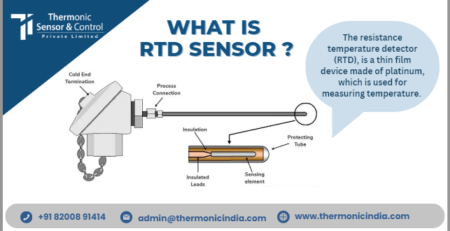
A PT100 RTD sensor is a resistance temperature detector that uses platinum as its sensing element. The term PT100 refers to the sensor’s nominal resistance of 100 ohms at 0°C.
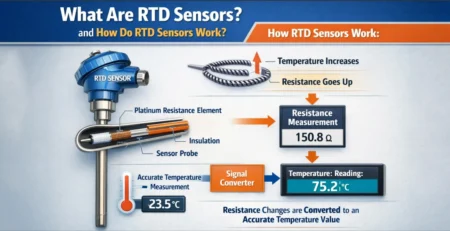
As temperature changes, the electrical resistance of platinum changes in a predictable manner. An appropriate temperature measuring instrument, transmitter, or controller measures this resistance and converts it into a temperature value.
The basic characteristics of an RTD PT100 sensor include:
- Platinum sensing element
- 100 Ω nominal resistance at 0°C
- Stable and repeatable temperature measurement
- Excellent long-term reliability
- Availability in different wiring configurations
- Suitable for a wide range of industrial applications
Because of these characteristics, a PT100 RTD temperature sensor is commonly selected where measurement stability and accuracy are important.
How Does an RTD PT100 Temperature Sensor Work?
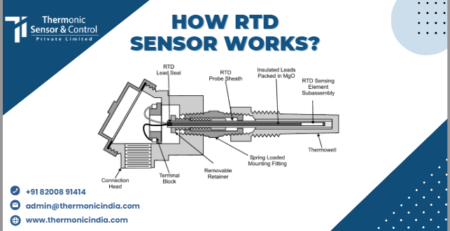
The operating principle of an RTD temperature sensor PT100 is based on the relationship between electrical resistance and temperature.
When the temperature surrounding the sensing element increases, the resistance of the platinum element also increases. When the temperature decreases, its resistance decreases.
The measurement process generally involves:
- The PT100 sensing element is exposed to the process temperature.
- The platinum element changes resistance according to temperature.
- The connected instrument measures the resistance.
- The instrument converts the resistance into a temperature reading.
- The reading can be displayed, recorded, or used for automatic process control.
The wiring configuration also affects measurement accuracy. Depending on the application, 2-wire, 3-wire, 4-wire, or specialised configurations may be selected.
Types of PT100 RTD Sensors
Different industrial processes require different sensor designs. Therefore, an RTD PT100 temperature sensor can be manufactured in several configurations.
PT100 Simplex RTD Sensor
A simplex PT100 contains a single sensing element and is suitable for standard temperature measurement applications.
Typical applications include:
- Process equipment
- Tanks and vessels
- Industrial machinery
- HVAC systems
- General temperature monitoring
PT100 Duplex RTD Sensor
A duplex PT100 contains two independent sensing elements within the same sensor assembly.
It can be useful when two measurement or control systems need temperature information from the same location. Duplex designs can also provide additional monitoring flexibility in critical applications.
3-Wire PT100 Sensor
The 3-wire configuration is widely used for industrial temperature measurement. It helps compensate for the resistance introduced by connecting wires.
A 3-wire PT100 sensor is commonly used with industrial temperature controllers, indicators, PLC systems, and transmitters.
4-Wire PT100 Sensor
A 4-wire configuration can provide higher measurement accuracy by reducing the effect of lead-wire resistance.
It is particularly useful in applications where precise temperature measurement is important, including laboratory, calibration, and precision process applications.

Key Benefits of a PT100 RTD Temperature Sensor
An RTD PT100 sensor offers several advantages for industrial temperature measurement.
High Measurement Stability
Platinum provides predictable resistance characteristics, allowing PT100 sensors to deliver stable measurements over extended periods.
Good Accuracy
When correctly selected, installed, and connected, a PT100 can provide accurate temperature measurement for demanding industrial processes.
Excellent Repeatability
A quality temperature sensor PT100 RTD can provide consistent readings during repeated measurement cycles.
Wide Application Range
PT100 sensors can be designed for different temperature ranges, process connections, probe dimensions, and environmental conditions.
Customisable Construction
Industrial PT100 sensors can be customised according to:
- Probe diameter
- Probe length
- Sheath material
- Wiring configuration
- Process connection
- Cable length
- Terminal or head arrangement
- Application temperature range
How to Choose the Right PT100 RTD Sensor
Selecting the right PT100 RTD sensor requires more than simply choosing the PT100 element. The sensor should match the actual process conditions.
1. Determine the Temperature Range
Identify the minimum and maximum temperature that the sensor will experience. Consider both normal operating temperatures and possible temperature peaks.
2. Select the Correct Wiring Configuration
Choose between 2-wire, 3-wire, 4-wire, or another configuration based on the required accuracy and instrumentation.
For many industrial applications, 3-wire PT100 sensors offer a practical balance between performance and cost.
3. Select the Appropriate Accuracy
The required accuracy class depends on the application and measurement requirements. IEC 60751-based accuracy classifications can help users select an appropriate sensor.
4. Consider the Sheath Material
The sensor’s sheath must withstand the process environment. Depending on the application, materials such as stainless steel can be selected for mechanical strength and corrosion resistance.
5. Check Installation Requirements
Consider:
- Probe length
- Probe diameter
- Thread size
- Mounting arrangement
- Cable length
- Connector type
- Thermowell compatibility
Correct installation helps the rtd temperature sensor pt100 respond properly to the actual process temperature.
Applications of PT100 RTD Sensors
A PT100 temperature sensor is suitable for numerous industrial applications.
Pharmaceutical Industry
PT100 sensors can be used for temperature monitoring in:
- Autoclaves
- Sterilisation equipment
- Processing systems
- Storage systems
- Pharmaceutical production equipment
Chemical Processing
Chemical plants require reliable temperature monitoring for tanks, reactors, pipelines, and other process equipment.
Plastic and Injection Moulding
PT100 sensors can be used for monitoring temperature in plastic processing machinery, barrels, dies, moulding equipment, and other applications where controlled temperature is important.
Food and Beverage
Temperature monitoring is important in food processing, heating, cooling, and storage applications. Suitable PT100 designs can support these requirements.
Industrial Machinery
PT100 sensors can also monitor equipment temperature, including bearings, machinery components, and process systems.
PT100 RTD Sensor vs Thermocouple
Both RTDs and thermocouples are widely used temperature sensors, but their characteristics differ.
A PT100 RTD sensor is often preferred when measurement stability, repeatability, and accuracy are important. Thermocouples, on the other hand, are frequently selected for very high-temperature applications and situations requiring rugged construction or fast response.
When choosing between an RTD and thermocouple, consider:
- Required temperature range
- Measurement accuracy
- Response time
- Process environment
- Installation requirements
- Instrument compatibility
- Cost
- Long-term stability
The best option depends on the specific process rather than simply choosing one sensor type for every application.
Why Choose Thermonic India for PT100 RTD Sensors?
Thermonic India manufactures and supplies industrial temperature measurement solutions for diverse applications. Our PT100 RTD sensors can be supplied in different configurations to suit specific process and equipment requirements.
Our capabilities include:
- PT100 Simplex and Duplex sensors
- Different wiring configurations
- Custom probe lengths and diameters
- Multiple sheath and construction options
- Application-specific sensor designs
- Industrial temperature measurement solutions
- Support for different mounting and connection requirements
Whether you require a standard rtd pt100 sensor or a customised temperature measurement solution, selecting the correct design is essential for reliable performance.
Common Mistakes When Selecting a PT100 Sensor
Avoiding common selection mistakes can improve measurement reliability.
Some frequent mistakes include:
- Selecting an unsuitable temperature range
- Choosing the wrong wiring configuration
- Ignoring accuracy requirements
- Using an unsuitable sheath material
- Selecting incorrect probe dimensions
- Poor sensor placement
- Ignoring process pressure or vibration
- Using an incompatible transmitter or controller
- Choosing a sensor based only on price
Understanding the actual process conditions before ordering can help ensure that the PT100 RTD temperature sensor performs reliably.
PT100 RTD Sensor Buying Checklist
Before purchasing an RTD sensor PT100, confirm the following specifications:
- Sensor type: Simplex or Duplex
- PT100 resistance value
- Accuracy class
- Wiring configuration
- Operating temperature range
- Probe diameter
- Probe length
- Sheath material
- Process connection
- Cable length
- Head or connector type
- Quantity required
- Application environment
Providing these details to the manufacturer can make sensor selection faster and more accurate.
Frequently Asked Questions
What is a PT100 RTD sensor?
A PT100 is a platinum resistance temperature sensor with a nominal resistance of 100 ohms at 0°C.
Is PT100 more accurate than a thermocouple?
PT100 RTDs are generally preferred for applications requiring high stability and accurate measurement within their suitable temperature range, while thermocouples are often preferred for higher-temperature applications.
What is the most common PT100 wiring configuration?
3-wire PT100 sensors are widely used in industrial applications because they provide lead-wire compensation while remaining practical for industrial instrumentation.
Can PT100 sensors be customised?
Yes. PT100 sensors can be customised according to temperature range, probe dimensions, wiring, sheath material, process connection, cable length, and application requirements.

Ready to Choose the Right PT100 RTD Sensor?
The right PT100 RTD sensor can improve temperature monitoring, process control, and measurement reliability across industrial applications. However, achieving consistent performance depends on selecting the correct sensing element, construction, wiring configuration, dimensions, and materials according to your process requirements.
As an experienced PT100 sensor manufacturer, Thermonic India provides reliable and application-specific temperature sensing solutions for different industrial requirements. Whether you need a standard sensor or a customised design, our team can help you select the right configuration.
Looking for a dependable PT100 RTD sensor supplier? Talk to Thermonic India about your temperature measurement requirements and get a solution suited to your application.