
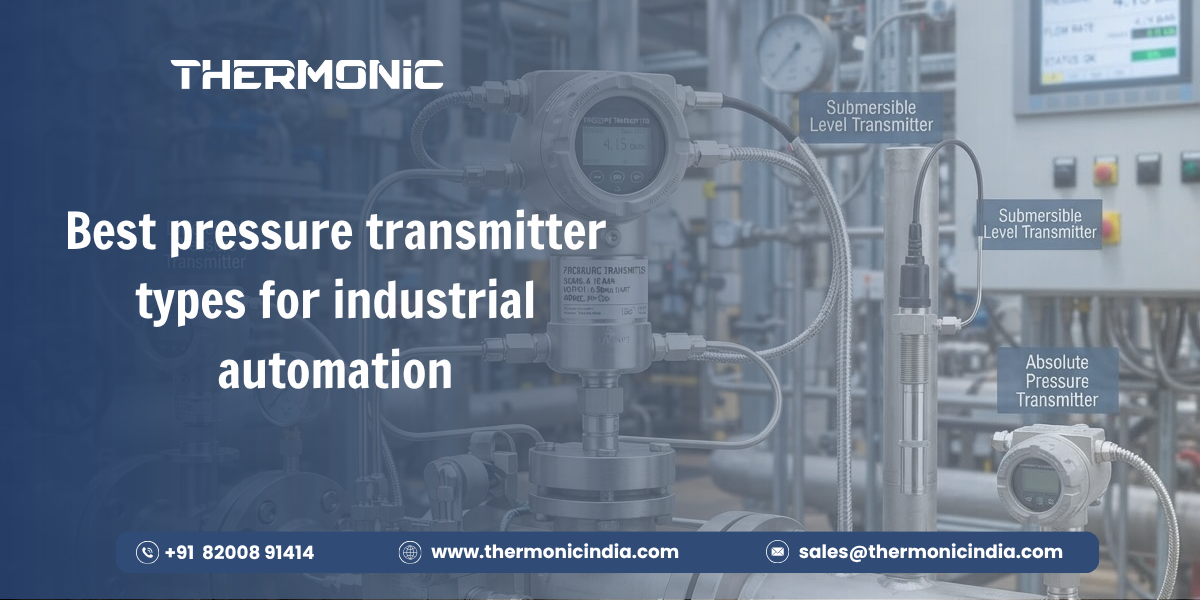
Best Pressure Transmitter Types for Industrial Automation: Working Principles, Types and Applications
Introduction: Why Pressure Transmitters Matter in Industrial Automation
Pressure measurement is essential for maintaining process stability, product quality and equipment safety in industrial automation. From monitoring pressure in pipelines to controlling pumps, compressors and process vessels, pressure transmitters help industries maintain the operating conditions required for efficient production.
The growing adoption of automation further highlights the importance of reliable measurement systems. According to the International Federation of Robotics, 542,000 industrial robots were installed worldwide in 2024, demonstrating the continued importance of automated manufacturing.
Pressure transmitters support automated processes by converting measured pressure into electrical signals that can be monitored by programmable logic controllers (PLCs), distributed control systems (DCS) and supervisory control and data acquisition (SCADA) systems. This allows operators to monitor pressure conditions, identify abnormal readings and regulate connected equipment.
However, selecting the correct instrument requires an understanding of the different types of pressure transmitter, their working principles and their applications. A transmitter suitable for a water pipeline may not be appropriate for a vacuum system or a process involving corrosive chemicals.
As a customized pressure transmitter supplier, Thermonic India supports industrial measurement requirements through application-oriented product selection. Understanding the available pressure transmitter types helps engineers and industrial buyers identify suitable solutions for their processes.
What Is a Pressure Transmitter?
A pressure transmitter is an industrial measurement instrument that measures the pressure of a gas, liquid or other compatible medium and converts the measurement into an electrical output signal. This signal allows a control system or monitoring device to display pressure readings and respond to changes in process conditions.
Pressure transmitters are commonly used in manufacturing plants, chemical processing facilities, water treatment systems, HVAC installations and automated production lines.
Difference Between a Pressure Sensor, Transducer and Transmitter
These terms are related, but they do not always mean the same thing.
- Pressure sensor: The sensing element that responds to applied pressure.
- Pressure transducer: A device that converts pressure into an electrical signal.
- Pressure transmitter: An instrument that processes the measurement and provides a suitable output for monitoring or control systems.
In practical applications, manufacturers may use these terms differently. Therefore, buyers should check the instrument’s specifications rather than relying only on its product name.
How Does a Pressure Transmitter Work?
The pressure transmitter working principle involves several stages:
- Pressure application: The process medium applies pressure to a diaphragm or another sensing element.
- Sensing: The sensing element responds to the applied pressure through deformation or another measurable physical change.
- Signal conversion: The sensing technology converts this change into an electrical signal.
- Signal conditioning: Internal electronics process the signal and convert it into a usable output.
- Signal transmission: The transmitter sends the measurement to a PLC, DCS, SCADA system or compatible display.
Many industrial transmitters use a 4–20 mA output because it is suitable for transmitting measurement signals over industrial wiring. Other models support voltage outputs or digital communication protocols such as HART.
The actual output and communication options depend on the selected transmitter.
Main Components of a Pressure Transmitter
The main components generally include:
- Sensing element or diaphragm: Responds to the applied pressure.
- Pressure port: Connects the instrument to the process.
- Electronic circuit: Processes the sensor signal.
- Output terminals: Transfer the measurement to external equipment.
- Housing: Protects the internal components from environmental conditions.
The materials, connections and enclosure design should suit the pressure, temperature and process medium.
Also Read : How to Choose the Right Pressure Transmitter for Your Application
How Many Types of Pressure Transmitter Are There?
There is no single fixed number because pressure transmitters can be classified according to their pressure reference, sensing technology, construction and application.
Based on the pressure measurement method, the main types of pressure transmitter include:
- Gauge pressure transmitter
- Absolute pressure transmitter
- Differential pressure transmitter
- Sealed gauge pressure transmitter
- Vacuum pressure transmitter
Pressure transmitter sensor types can also be classified according to their sensing technologies, such as piezoresistive, capacitive, strain gauge and resonant designs.
These classifications overlap. For example, a gauge pressure transmitter may use a piezoresistive sensing element. Therefore, understanding both the measurement type and sensing technology is important when choosing an instrument.

Different Types of Pressure Transmitter and Their Working Principles
Gauge Pressure Transmitter
A gauge pressure transmitter measures pressure relative to the surrounding atmospheric pressure.
For example, when a pipeline pressure is displayed as 5 bar(g), the reading represents pressure approximately 5 bar above the local atmospheric pressure.
Working principle: The transmitter measures the pressure difference between the process pressure and the atmospheric reference. Its sensing element converts this difference into an electrical output.
Common applications include:
- Water supply and distribution systems
- Industrial pumps and compressors
- Hydraulic and pneumatic equipment
- Process pipelines
- Manufacturing machinery
Gauge pressure transmitters are suitable when operators need to monitor pressure above or below the local atmospheric reference.
Absolute Pressure Transmitter
An absolute pressure transmitter measures pressure relative to a vacuum reference.
Unlike gauge pressure measurement, absolute pressure measurement does not use the surrounding atmosphere as its reference. This makes it useful when changes in atmospheric pressure must not affect the measurement reference.
Working principle: The transmitter compares the applied process pressure against a sealed reference chamber maintained at a sufficiently low pressure to act as a vacuum reference.
Common applications include:
- Vacuum processing systems
- Industrial vacuum pumps
- Vacuum packaging machinery
- Laboratory equipment
- Applications involving precise absolute pressure measurement
Absolute pressure transmitters are particularly useful when the actual pressure relative to a vacuum is important for process control.
Differential Pressure Transmitter
A differential pressure transmitter measures the difference between two applied pressures.
For example, it can compare the pressure before and after a filter to identify an increasing pressure drop caused by accumulated contamination.
Working principle: The transmitter receives two pressure inputs through high-pressure and low-pressure connections. Its sensing element responds to the pressure difference and generates a corresponding output.
Differential pressure transmitters are widely used for:
- Filter blockage monitoring
- Flow measurement across suitable primary flow elements
- Liquid level measurement in closed tanks
- Pressure drop monitoring across equipment
- Air pressure monitoring in HVAC systems
The transmitter’s range and installation arrangement must match the application. Flow and level measurement may also require suitable impulse connections, primary elements or compensation.
Sealed Gauge Pressure Transmitter
A sealed gauge pressure transmitter measures pressure relative to a sealed reference rather than directly referencing the surrounding atmosphere.
Working principle: The instrument uses a sealed reference pressure established during its design or manufacture. The measured pressure is compared against that reference.
Potential applications include industrial systems where a sealed reference design is required by the measurement arrangement.
Buyers should distinguish sealed gauge pressure from ordinary gauge pressure and absolute pressure. The appropriate reference depends on the instrument design and the intended measurement.
Vacuum Pressure Transmitter
A vacuum pressure transmitter measures pressure below atmospheric pressure. Depending on its design, it may report vacuum relative to atmosphere or measure absolute pressure over a range that includes vacuum conditions.
Working principle: The sensing element responds to the pressure conditions within the vacuum system and converts the measurement into an electrical output.
Typical applications include:
- Vacuum furnaces
- Vacuum pumps and packaging equipment
- Industrial drying systems
- Vacuum process chambers
- Material processing equipment
Before selecting a vacuum transmitter, check whether the application requires gauge vacuum measurement, absolute pressure measurement or a compound range that covers both vacuum and positive pressure.
Differential Pressure Transmitter Types and Applications
Differential pressure transmitters can also be classified according to their pressure range, process connections, isolation arrangements and intended use.
Wet-Wet Differential Pressure Transmitter
A wet-wet differential pressure transmitter is designed for applications where both pressure sides can be exposed to compatible liquids or other specified process media.
Applications include:
- Liquid process monitoring
- Pressure drop measurement across equipment
- Industrial filtration systems
- Selected chemical and process applications
Wetted materials and seals must be compatible with the process medium.
Wet-Dry Differential Pressure Measurement
Wet-dry configurations are used when one pressure connection is exposed to liquid and the other to gas, or when the installation involves different media on the two sides.
The instrument must be suitable for both media and the pressure conditions involved.
Applications may include:
- Selected tank and vessel measurement arrangements
- Liquid-to-gas pressure comparisons
- Specialised process monitoring installations
The exact configuration should be confirmed against the manufacturer’s specifications and installation requirements.
Low Differential Pressure Transmitter
Low differential pressure transmitters are designed to measure small pressure differences with suitable sensitivity.
Applications include:
- Cleanroom pressure monitoring
- HVAC duct pressure measurement
- Air filter monitoring
- Ventilation systems
- Room pressure control
These instruments help operators monitor airflow conditions and identify when filters or ventilation systems require attention.
High Differential Pressure Transmitter
High differential pressure transmitters are selected for applications involving larger pressure differences within the instrument’s rated limits.
Applications include:
- Industrial filtration systems
- Pressure drop monitoring across process equipment
- High-pressure industrial processes
- Selected flow measurement arrangements
Selection should consider both the normal differential pressure and the maximum static pressure that the instrument may experience.
Remote Seal Differential Pressure Transmitter
A remote seal differential pressure transmitter uses diaphragm seals and, where applicable, capillary connections to isolate the sensing instrument from the process medium.
This arrangement can help when direct process contact is unsuitable due to high temperature, corrosive media, viscous materials or hygienic requirements.
Applications include:
- Chemical processing
- Selected pharmaceutical processes
- High-temperature process equipment
- Viscous or difficult-to-handle fluids
- Closed-tank level measurement
The fill fluid, diaphragm material and capillary arrangement must be selected carefully because temperature changes and installation conditions can affect measurement performance.
Pressure Transmitter Sensor Types: Common Sensing Technologies
The sensing technology affects how a pressure transmitter detects pressure and converts it into an electrical signal.
Piezoresistive Pressure Transmitters
Piezoresistive sensors use a change in electrical resistance caused by mechanical strain.
When pressure deforms the sensing element, the resistance changes. The transmitter electronics process this change to determine the pressure reading.
These sensors are used in many general industrial pressure measurement applications.
Capacitive Pressure Transmitters
Capacitive pressure transmitters detect changes in capacitance caused by the movement of a diaphragm or sensing structure.
They can be suitable for applications requiring sensitive pressure or differential pressure measurement, depending on the design and specification.
Strain Gauge Pressure Transmitters
Strain gauge technology measures mechanical deformation through changes in electrical resistance.
These transmitters are used in industrial equipment, hydraulic systems and other applications where pressure-induced strain can be measured reliably.
Resonant Pressure Transmitters
Resonant pressure transmitters measure pressure through changes in the resonant frequency of a sensing element.
This technology is used in certain precision measurement instruments. Its suitability depends on the required accuracy, stability, pressure range and operating conditions.
Thin-Film and Ceramic Sensor Technologies
Thin-film sensors use sensing structures formed on a substrate, while ceramic sensor designs use ceramic materials as part of the pressure-sensitive structure.
Their suitability depends on the sensor construction, wetted materials, process compatibility and pressure range. Neither technology should be assumed to suit every corrosive, high-temperature or high-pressure application without checking its specifications.
Pressure Transmitter Types and Working Principles: Comparison Table
The following table summarises the main pressure transmitter types and their applications.
| Type | Pressure reference | Common applications | Key consideration |
| Gauge | Atmospheric pressure | Pumps, pipelines and hydraulic systems | Atmospheric reference |
| Absolute | Vacuum reference | Vacuum systems and precise pressure measurement | Absolute pressure range |
| Differential | Difference between two pressures | Filters, flow and tank level measurement | Both pressure inputs |
| Sealed gauge | Sealed reference pressure | Applications requiring a sealed reference | Reference design |
| Vacuum | Atmospheric or absolute reference, depending on model | Vacuum pumps and process chambers | Required vacuum range |
When comparing products, verify the rated pressure range, accuracy, output signal, process connection, materials and environmental protection. A transmitter’s measurement category alone does not establish its suitability for a particular application.
Best Pressure Transmitter Types for Different Industrial Applications
Chemical and Pharmaceutical Processing
Chemical and pharmaceutical plants require reliable pressure monitoring across pipelines, vessels and process equipment.
Gauge pressure transmitters can monitor line pressure, while differential pressure transmitters can measure pressure drops across filters or equipment. For corrosive media or demanding process conditions, suitable diaphragm seals and compatible wetted materials may be required.
Water and Wastewater Treatment
Pressure transmitters help monitor water pipelines, pump discharge pressure and filtration systems.
Gauge pressure transmitters are commonly used for pipeline monitoring. Differential pressure transmitters can help identify filter loading or monitor pressure differences across suitable equipment.
HVAC and Building Automation
HVAC systems use pressure measurement to monitor ventilation, airflow and filter conditions.
Low differential pressure transmitters are often suitable for measuring small pressure differences across air filters, ducts and controlled rooms. The selected instrument should match the expected pressure range and environmental conditions.
Oil, Gas and Process Industries
Industrial process facilities require pressure measurement across pipelines, vessels and process equipment.
Gauge and absolute pressure transmitters serve different pressure reference requirements, while differential pressure transmitters can support flow measurement and pressure drop monitoring. Hazardous-area approvals and process compatibility must be considered wherever applicable.
Manufacturing and Industrial Automation
Manufacturing facilities use pressure transmitters in hydraulic systems, pneumatic equipment, compressors and automated process lines.
The transmitter sends measurement data to a compatible control system, allowing operators to monitor conditions and configure control actions or alarms. The correct choice depends on the pressure range, response requirements and system interface.
Food and Beverage Processing
Food and beverage plants may require pressure measurement in process lines, tanks and filtration systems.
Hygienic connections, cleanability, compatible materials and resistance to the cleaning process are important selection factors. Differential pressure measurement may also help monitor filtration performance.
How to Choose the Right Pressure Transmitter for Industrial Automation
Selecting the correct instrument requires more than comparing prices or choosing a transmitter based on its pressure range alone.
Define the Pressure Measurement Requirement
First, establish whether the application requires gauge, absolute or differential pressure measurement.
Identify the normal operating conditions, minimum and maximum pressures, and whether the system operates under vacuum conditions.
Select the Correct Pressure Range
Choose a calibrated range that suits normal operating pressure while allowing for expected variations.
Check the maximum working pressure, overload rating and proof pressure. The normal operating point should fall within a suitable part of the calibrated range to achieve the required measurement performance.
Check Process Media Compatibility
Identify whether the medium is corrosive, viscous, contaminated or chemically aggressive.
Check the diaphragm, wetted materials, seals and process connections. A remote diaphragm seal may be appropriate where direct contact with the sensing instrument is unsuitable.
Choose the Appropriate Output Signal
Confirm that the transmitter can communicate with the control equipment.
Common options include:
- 4–20 mA current output
- Voltage output on compatible models
- HART communication where supported
- Other digital protocols specified for the application
Check the power supply, wiring arrangement and PLC or DCS input requirements before ordering.
Consider Environmental and Installation Conditions
Review process temperature, ambient temperature, vibration, moisture exposure, mounting requirements and cable entry.
Check the required IP rating and any hazardous-area approvals relevant to the installation.
Evaluate Accuracy and Long-Term Stability
Consider accuracy, repeatability, drift and calibration requirements. The instrument should meet the process measurement tolerance without unnecessary cost or specifications that the application does not require.
Also Read : Types of Pressure Transmitter Used in Industry
Common Pressure Transmitter Selection and Installation Mistakes
Avoid these common mistakes when selecting or installing pressure transmitters:
- Choosing gauge measurement when absolute pressure is required.
- Selecting an unsuitable calibrated pressure range.
- Ignoring process media compatibility.
- Using unsuitable diaphragm, seal or connection materials.
- Incorrectly connecting high-pressure and low-pressure ports.
- Overlooking electrical output and control system compatibility.
- Ignoring environmental protection requirements.
- Failing to follow commissioning and calibration procedures.
Correct installation and configuration are essential for reliable readings. Always follow the manufacturer’s instructions and relevant process safety procedures.
Pressure Transmitters in Automated Control Systems
Pressure transmitters provide measurement feedback for automated industrial processes.
A transmitter can send a pressure signal to a PLC or DCS, which processes the reading according to its control logic. The system may then adjust a pump, valve or compressor to maintain the required operating conditions.
For example, a pump system can use pressure feedback to regulate discharge pressure. A filtration system can use differential pressure readings to trigger an alarm when the pressure drop reaches a configured threshold.
Pressure transmitters can also support SCADA monitoring, trend analysis and maintenance planning. However, alarms and automatic shutdown functions must be properly designed and configured as part of the wider control and safety system.
Why Choose Thermonic India for Industrial Measurement Requirements?
Selecting the right industrial instrument requires an understanding of the process, operating conditions and control system requirements.
Thermonic India is a manufacturer and supplier of industrial temperature measurement and control products, with pressure transmitters included in its measurement product range. Industrial buyers should assess each pressure transmitter against their specific application before finalising a selection.
When discussing your requirement, provide the following details:
- Required pressure measurement type
- Normal and maximum operating pressure
- Process medium and temperature
- Process connection and mounting arrangement
- Required output signal
- Environmental and approval requirements
These details help establish the specifications needed for a suitable pressure measurement solution.
Frequently Asked Questions About Pressure Transmitter Types
Q1. How many types of pressure transmitter are there?
The main pressure measurement types include gauge, absolute, differential, sealed gauge and vacuum pressure transmitters. Additional classifications are based on sensing technology, construction and application, so the total number depends on how the instruments are categorised.
Q2. What are the main types of pressure transmitter used in industrial automation?
Gauge pressure transmitters are used for many pipeline and equipment applications. Absolute pressure transmitters are used when pressure must be measured relative to a vacuum reference. Differential pressure transmitters measure the difference between two pressures and are used for filter monitoring, flow measurement and tank level applications.
Q3. What is the difference between gauge and absolute pressure transmitters?
A gauge pressure transmitter measures pressure relative to atmospheric pressure. An absolute pressure transmitter measures pressure relative to a vacuum reference. The correct option depends on the process measurement requirement.
Q4. What is a differential pressure transmitter used for?
A differential pressure transmitter measures the difference between two pressure inputs. Common applications include filter monitoring, flow measurement across suitable flow elements, closed-tank level measurement and pressure drop monitoring across equipment.
Q5. What are the different types of differential pressure transmitter?
Differential pressure transmitters can be classified by measurement range, process connections, pressure isolation arrangement and application. Examples include low differential pressure instruments, higher-range models and remote seal configurations. Wet-wet and wet-dry describe media or connection arrangements rather than universal product categories.
Q6. What is the difference between a pressure sensor and a pressure transmitter?
A pressure sensor is the sensing element that responds to pressure. A pressure transmitter typically includes sensing and signal-processing components that provide an output suitable for external monitoring or control equipment. Terminology can vary between manufacturers.
Q7. How does a 4–20 mA pressure transmitter work?
A 4–20 mA pressure transmitter converts the measured pressure into a current signal within a configured range. Typically, 4 mA represents the lower range value and 20 mA represents the upper range value. A compatible receiving device converts the current into a pressure reading.
Q8. Which pressure transmitter is best for industrial automation?
There is no single best option for every application. Gauge transmitters suit many pipeline and equipment applications, absolute transmitters suit vacuum-referenced measurement, and differential transmitters suit applications that require pressure difference measurement. The choice depends on the process conditions and required specifications.
Q9. How do I select the correct pressure range for a transmitter?
Determine the normal operating pressure, expected fluctuations and maximum pressure. Select a calibrated range that covers the expected operating conditions while meeting the required accuracy. Also check overload and proof pressure ratings.
Q10. Can pressure transmitters be connected to a PLC?
Yes. Pressure transmitters can connect to compatible PLC inputs using supported signals such as 4–20 mA or voltage outputs. Some models also support digital communication. Check the transmitter’s output, power supply, wiring and PLC input specifications before installation.

Ready to Select the Right Pressure Transmitter for Your Application?
Choosing the right pressure transmitter helps support accurate measurement, reliable process control and effective equipment monitoring. Understanding the different types of pressure transmitter, their working principles and their applications makes it easier to identify a suitable instrument.
If you are looking for a pressure transmitter supplier for factories, Thermonic India can help you explore industrial measurement requirements. Share your operating pressure, process medium, connection type and output signal to discuss a suitable solution for your application.


Leave a Reply