What is Thermocouple ?
Summarize this blog post with:


If you are searching for what is a thermocouple, you are not alone. Engineers, maintenance professionals, and industrial operators frequently ask what is a thermocouple used for and why it remains one of the most trusted temperature sensors in modern industries. Thermocouples are commonly used in industrial and scientific applications for measuring temperature in environments where other types of temperature sensors might not be practical, such as high-temperature and high-pressure environments.
A thermocouple is a type of temperature sensor that consists of two dissimilar metal wires or elements, which are joined together at one end to form a junction. When this junction is exposed to a temperature gradient, it produces a voltage that is proportional to the temperature difference between the junction and the other end of the wires.
Thermocouples are commonly used in industrial and scientific applications for measuring temperature in environments where other types of temperature sensors might not be practical, such as high-temperature and high-pressure environments. They are also relatively inexpensive and can be made to operate in a wide range of temperatures.
There are many different types of thermocouples available, each with its own unique set of characteristics and temperature range. Some of the most commonly used types include Type K, Type J, Type T, and Type E.
What Is a Thermocouple and How Does It Work?
Many engineers ask, what is a thermocouple and how does it work?
To understand what is a thermocouple, it is important to know that a thermocouple is a temperature sensor made by joining two dissimilar metals together. The sensor produces a voltage when exposed to temperature differences, allowing accurate temperature measurement across a wide range of industrial processes.
A thermocouple works on a physical phenomenon known as the Seebeck Effect. When two different metals are joined together and exposed to different temperatures, they generate a measurable voltage proportional to the temperature difference.
This voltage is then interpreted by a temperature measuring instrument to determine the process temperature. As a leading thermocouple manufacturer in India, Thermonic India designs and manufactures thermocouples that deliver reliable and accurate temperature measurement across various industrial applications.
This simple yet effective operating principle makes thermocouples one of the most widely used temperature sensors in industries worldwide.
What Is a Thermocouple Used For?
One of the most common questions is what is a thermocouple used for. Thermocouples are used for monitoring and controlling temperature in boilers, furnaces, reactors, heat exchangers, plastic processing machines, power plants, food manufacturing equipment, and pharmaceutical systems. Their ability to operate in extreme environments makes them ideal for industrial temperature measurement.
What Is the Purpose of a Thermocouple?
Many users also ask what is the purpose of a thermocouple. The primary purpose of a thermocouple is to provide reliable and continuous temperature measurement in industrial processes. By accurately monitoring temperature, thermocouples help improve product quality, process efficiency, equipment safety, and regulatory compliance.
How Does a Thermocouple Work?
Understanding the Seebeck Effect
What Is the Seebeck Effect?
The Seebeck Effect is the basic principle that enables thermocouple operation. It states that when two dissimilar metals are connected and subjected to a temperature difference, an electrical voltage is produced.
Voltage Generation
As the temperature at the measuring junction changes, electrons move between the two metals, creating a small voltage signal.
Temperature Measurement
The generated voltage is measured and converted into a temperature value using standardized calibration tables.
What Is the Working Principle of a Thermocouple?
Many engineers want to understand what is the working principle of a thermocouple. The thermocouple working principle is based on the Seebeck Effect, where two dissimilar metals generate a small electrical voltage when subjected to different temperatures. This voltage is then converted into a temperature reading by a measuring instrument.
The thermocouple working principle involves two junctions:
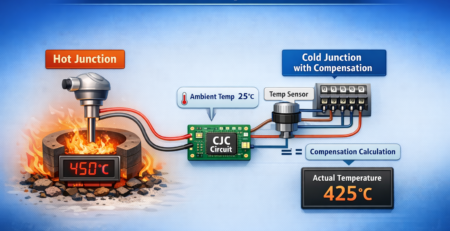
Hot Junction (Measuring Junction)
This junction is exposed to the process temperature being measured.
Cold Junction (Reference Junction)
This junction remains at a known reference temperature.
Signal Generation Process
The temperature difference between these two junctions generates a thermoelectric voltage.
Temperature Measurement Process
The measuring instrument converts this voltage into an accurate temperature reading using thermocouple calibration standards.
Construction of a Thermocouple
A thermocouple consists of several key components:
Thermoelement Wires
Two dissimilar metallic conductors responsible for generating the thermoelectric voltage.
Measuring Junction
The sensing point where temperature is measured.
Insulation Material
Prevents electrical interference between conductors.
Protective Sheath
Protects the sensor from corrosion, vibration, and mechanical damage.
Terminal Head or Connector
Provides secure electrical connection to instrumentation.
Types of Thermocouple Junctions
Grounded Junction
- Fast response time
- Excellent heat transfer
- Suitable for industrial processes
Ungrounded Junction
- Electrically isolated
- Reduced electrical noise
- Better for sensitive instrumentation
Exposed Junction
- Extremely fast response
- Suitable for clean environments
- Less mechanical protection
Types of Thermocouples
What Is a K Type Thermocouple?
Many customers ask what is a K type thermocouple. A K Type Thermocouple is the most commonly used thermocouple across the world due to its wide temperature range, durability, and cost-effectiveness. It is suitable for general-purpose industrial temperature measurement applications.
Material Composition
- Chromel (+)
- Alumel (-)
Temperature Range
-200°C to +1260°C
Applications
- Furnaces
- Kilns
- Heat treatment
- Food processing
- Power plants
Type J Thermocouple
Material Composition
- Iron (+)
- Constantan (-)
Temperature Range
-40°C to +750°C
Applications
- Industrial equipment
- Plastics industry
- Manufacturing processes
Type T Thermocouple
Material Composition
- Copper (+)
- Constantan (-)
Temperature Range
-200°C to +350°C
Applications
- Laboratory measurements
- Cryogenic applications
- Food industry
Type N Thermocouple
Material Composition
- Nicrosil (+)
- Nisil (-)
Temperature Range
-200°C to +1300°C
Applications
- Aerospace
- Petrochemical plants
- High-temperature processing
Type R, S, and B Thermocouples
These are precious metal thermocouples made from platinum alloys.
Temperature Range
Up to 1700°C
Applications
- Glass manufacturing
- Steel production
- High-temperature furnaces
- Research laboratories
Thermocouple Temperature Range Chart
| Type | Temperature Range | Typical Applications |
| K | -200°C to 1260°C | General industrial use |
| J | -40°C to 750°C | Manufacturing |
| T | -200°C to 350°C | Food & laboratory |
| N | -200°C to 1300°C | Petrochemical |
| R | 0°C to 1600°C | Glass industry |
| S | 0°C to 1600°C | Furnaces |
| B | 600°C to 1700°C | Steel processing |
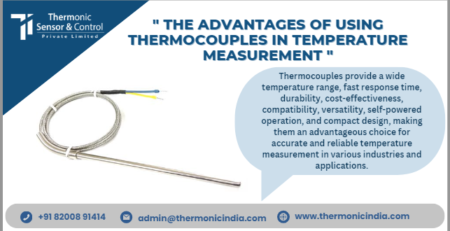
Advantages of Thermocouples
Thermocouples offer numerous benefits:
Wide Temperature Range
Suitable for extremely low and high temperatures.
Fast Response Time
Quick detection of temperature changes.
Durable Construction
Can withstand vibration and harsh conditions.
Cost-Effective
Lower initial investment compared to many alternatives.
Harsh Environment Capability
Ideal for corrosive and demanding applications.
Easy Installation
Simple integration into existing systems.
Limitations of Thermocouples
Despite their advantages, thermocouples have some limitations.
Lower Accuracy Than RTDs
RTDs generally provide higher measurement accuracy.
Signal Drift
Performance may change over extended periods.
Cold Junction Compensation Required
Additional compensation circuitry is necessary.
Electrical Noise Sensitivity
May experience measurement errors caused by electromagnetic interference.
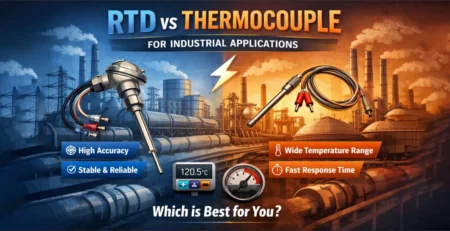
Thermocouple vs RTD
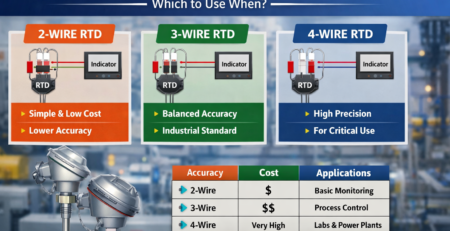
Accuracy Comparison
RTDs generally provide higher accuracy and repeatability.
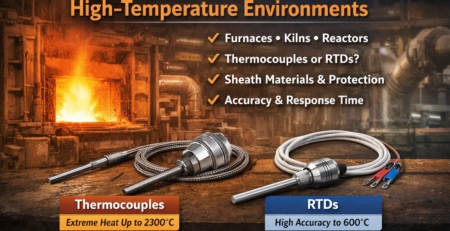
Temperature Range Comparison
Thermocouples operate at significantly higher temperatures.
Response Time Comparison
Thermocouples usually respond faster to temperature changes.
Cost Comparison
Thermocouples are generally more economical.
Which Sensor Should You Choose?
Choose:
Thermocouple when:
- High temperatures are involved
- Fast response is required
- Cost is a concern
RTD when:
- High accuracy is essential
- Stable measurements are required
- Moderate temperature ranges are involved
Industrial Applications of Thermocouples
Power Generation
Boilers
Monitoring steam temperature.
Turbines
Protecting critical rotating equipment.
Heat Exchangers
Improving thermal efficiency.
Steel and Metal Processing
Furnaces
Monitoring extreme temperatures.
Heat Treatment
Ensuring product quality.
Plastic Industry
Extruders
Maintaining process consistency.
Injection Molding Machines
Controlling material temperatures.
Chemical and Petrochemical Industry
Reactors
Maintaining reaction temperatures.
Storage Tanks
Monitoring product integrity.
Pipelines
Preventing overheating.
Food and Pharmaceutical Industry
Sterilization Processes
Ensuring product safety.
Temperature Monitoring Systems
Maintaining regulatory compliance.
How to Select the Right Thermocouple
Consider the Temperature Range
Ensure the thermocouple can withstand operating temperatures.
Evaluate the Process Environment
Consider vibration, pressure, and moisture.
Check Chemical Compatibility
Select materials resistant to process chemicals.
Determine Required Accuracy
Match sensor performance with process requirements.
Choose the Correct Thermocouple Type
Different types suit different applications.
Select Appropriate Sheath Material
Choose stainless steel, Inconel, ceramic, or other suitable materials.
Common Causes of Thermocouple Failure
Several factors can reduce thermocouple life:
- Oxidation
- Corrosion
- Mechanical damage
- Thermal shock
- Moisture ingress
- Improper installation
Proper sensor selection can significantly improve service life.
Thermocouple Maintenance Best Practices
To maximize performance:
Regular Inspection
Check for wear and physical damage.
Calibration Checks
Verify measurement accuracy periodically.
Proper Installation
Follow manufacturer recommendations.
Replacement Guidelines
Replace aging sensors before failure occurs.
Looking for a Reliable Thermocouple Solution for Your Industry?
By understanding what is a thermocouple, what is a thermocouple used for, and what is the working principle of a thermocouple, industries can make better decisions when selecting temperature sensors. Whether you need a standard sensor or a custom-engineered solution, choosing the right thermocouple can improve process efficiency, product quality, and operational safety.
Whether you require standard sensors or custom-engineered solutions, Thermonic India delivers dependable temperature sensing products designed for demanding industrial environments.
Contact Thermonic India today for expert consultation, customized thermocouple solutions, and reliable temperature measurement products tailored to your industry needs.