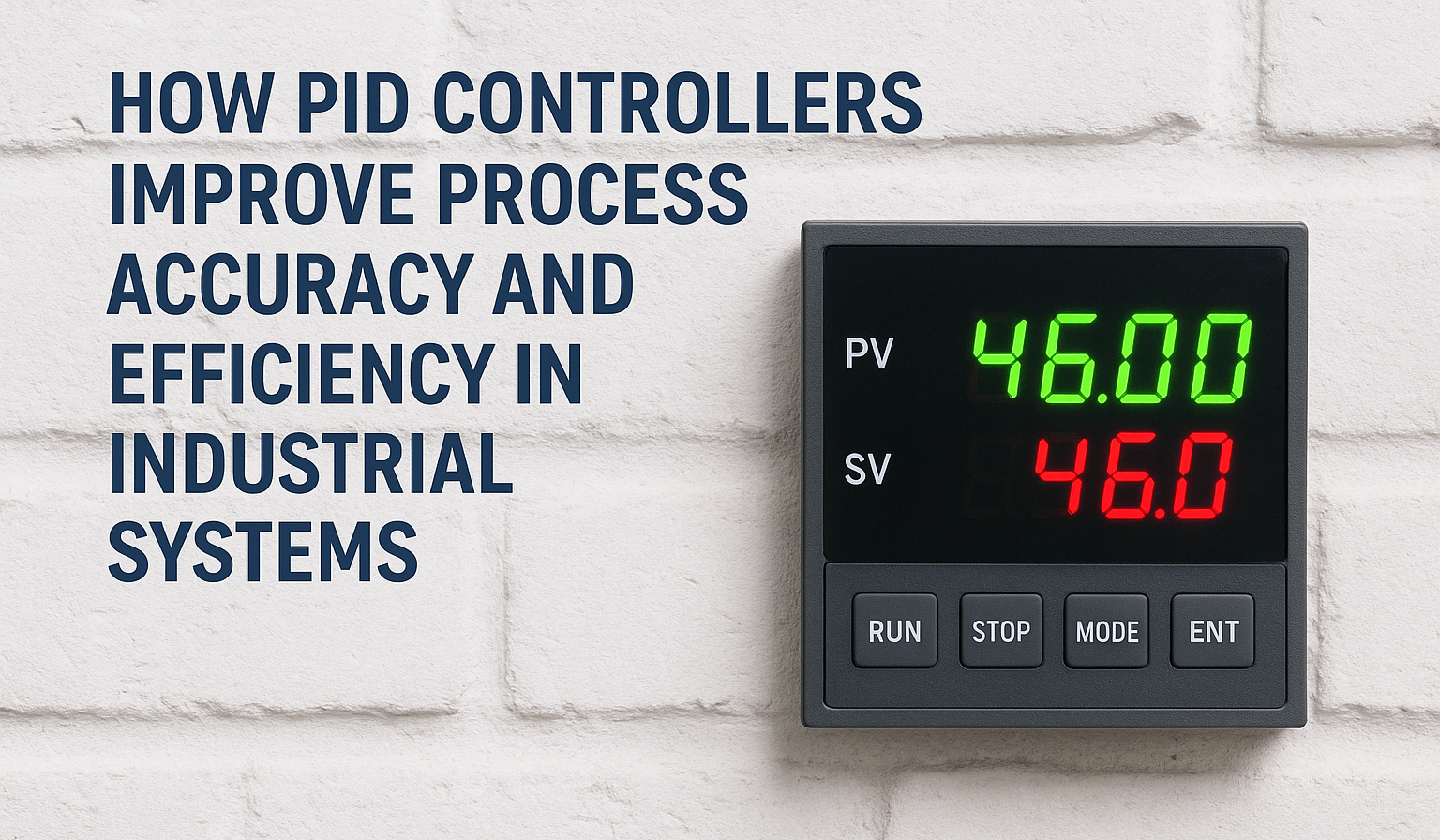
How PID Controllers Improve Accuracy and Efficiency in Industry
Summarize this blog post with:


In the landscape of modern industrial automation, precision is the currency of competitiveness. Proportional–Integral–Derivative (PID) controllers are the backbone of process control across sectors — from chemical processing and food production to HVAC and power generation. At Thermonic Sensor and Control Pvt. Ltd., we design control solutions that don’t just regulate variables — they optimize outcomes, mitigate risk, and drive operational excellence.
Operational leaders often ask: Why invest in PID control when there are advanced algorithms and AI-based systems? The answer is simple and strategic — PID controllers deliver predictable, robust, and cost-effective control, especially in environments where stability, fast response, and proven reliability are non-negotiable.
Key business benefits:
- Reduced process variability → higher product yield and consistency.
- Faster settling times → minimized scrap and cycle-time improvements.
- Lower manual intervention → reduced OPEX and fewer human errors.
A PID controller continuously evaluates the difference between a process variable (e.g., temperature, pressure, flow) and its desired setpoint, then applies corrective action using three terms:
- Proportional (P): immediate correction proportional to current error.
- Integral (I): eliminates steady-state error by integrating past errors.
- Derivative (D): anticipates future error by observing the rate of change.