7 Mistakes Industries Make While Selecting Temperature Sensors
Introduction
Selecting the right temperature sensor is essential for maintaining accuracy, safety, product quality, and process efficiency. Whether you operate a chemical plant, pharmaceutical facility, food processing unit, power plant, or manufacturing line, the temperature sensor you choose directly affects how accurately your process is monitored and controlled.
However, many industries make temperature sensor selection decisions based on habit, price, or basic specifications. A sensor may appear suitable on paper but fail when exposed to high vibration, corrosive media, electrical noise, rapid temperature changes, or demanding operating conditions.
Working with experienced temperature sensors manufacturers can help industries avoid these issues by matching the sensor design to the actual application.
In this article, we will discuss 7 common mistakes industries make while selecting temperature sensors and explain how to avoid them for better performance, reliability, and long-term value.
Mistake 1: Choosing Sensor Type Based on Habit, Not Application
One of the most common mistakes is selecting a sensor simply because it has always been used in a particular machine or process.
For example, an engineer may automatically choose a Type K thermocouple because it has been used successfully in previous installations. However, the same sensor may not be the best choice for every application.
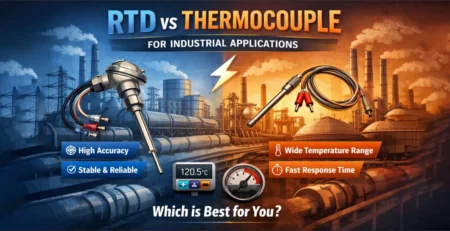
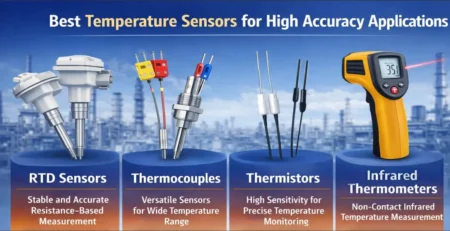
Thermocouples, RTDs, and thermistors have different operating characteristics. Selecting between them should depend on the actual requirements of the process.
What goes wrong?
Industries may:
- Use thermocouples where an RTD could provide better accuracy and stability.
- Use RTDs outside their practical temperature range.
- Select thermistors for applications requiring a wider temperature range.
- Prioritize familiarity instead of application requirements.
How to avoid it
Start by evaluating:
- Required temperature range
- Accuracy requirements
- Response time
- Process environment
- Vibration and mechanical conditions
- Electrical noise
- Cost and maintenance requirements
As a simple starting point:
- Above 600°C or extremely harsh environments: Thermocouples are often a suitable choice.
- Moderate temperatures with higher accuracy requirements: RTDs such as PT100 and PT1000 are commonly preferred.
- Narrow temperature ranges requiring high sensitivity and economical sensing: Thermistors can be suitable.
The correct sensor type should always follow the application, not habit.
Mistake 2: Ignoring Temperature Range and Over- or Under-Specifying
Temperature range is one of the first specifications engineers consider, but it is often evaluated incorrectly.
Some buyers focus only on the maximum temperature rating. Others assume that a sensor with a much higher temperature capability is automatically better.
Neither approach is ideal.
What goes wrong?
Operating a sensor close to its limits can contribute to premature failure, measurement drift, or reduced service life. On the other hand, selecting an unnecessarily high-temperature sensor can increase the purchase cost without providing a meaningful benefit.
For example, a process that normally operates between 100°C and 180°C may not require a sensor designed for extremely high temperatures.
How to avoid it
Define the complete temperature profile, including:
- Normal operating temperature
- Minimum startup temperature
- Maximum operating temperature
- Temperature spikes
- Duration of temperature peaks
- Frequency of thermal cycling
Then select a sensor whose recommended operating range comfortably covers the real process conditions.
A reliable temperature sensor factory should also be able to recommend suitable construction and materials based on the complete temperature profile rather than simply offering a standard sensor.
Mistake 3: Overlooking Accuracy, Tolerance Class, and System-Level Error
Another common mistake is focusing only on the accuracy stated for the sensor itself.
In an actual installation, measurement accuracy can also be affected by the transmitter, wiring, measuring instrument, installation method, and environmental conditions.
For example, expecting very high system-level accuracy from a Class B PT100 connected through unsuitable wiring and a low-accuracy transmitter can result in disappointing performance.
What goes wrong?
Industries may experience:
- Process control instability
- Incorrect temperature readings
- Unnecessary process adjustments
- Product quality problems
- Difficulty achieving required measurement uncertainty
How to avoid it
Define the complete measurement requirement, including:
- RTD tolerance class, such as PT100 Class A or Class B
- Thermocouple accuracy requirements
- Transmitter accuracy
- Instrument resolution
- Wiring configuration
- Installation-related errors
- Required overall system uncertainty
Remember that the actual measurement performance depends on the complete sensing system, not just the sensor element.
This is where professional temperature sensor solutions can provide significant value because sensor construction, wiring, transmission, and installation can be considered together.
Also Read : Temperature Sensor Solutions for Plastic Processing Industries
Mistake 4: Neglecting Environmental and Chemical Compatibility
A temperature sensor can have excellent electrical specifications and still fail quickly if its materials are incompatible with the application environment.
Simply choosing a stainless-steel sensor does not guarantee long-term performance in every process.
Chemical exposure, humidity, pressure, vibration, thermal cycling, and washdown conditions can all influence sensor life.
What goes wrong?
Industries may encounter:
- Corrosion of the sensor sheath
- Moisture penetration
- Mechanical damage
- Sensor cracking
- Premature element failure
- Unstable temperature readings
Aggressive environments containing acids, chlorides, salts, chemicals, or high-temperature gases require careful material selection.
How to avoid it
Evaluate both the process and surrounding environment.
Consider:
- Process media
- Chemical concentration
- Pressure
- Humidity
- Washdown requirements
- Outdoor exposure
- Vibration
- Shock
- Thermal cycling
Depending on the application, materials such as SS316L, Inconel, Hastelloy, ceramic, or other specialized alloys may be more appropriate than standard stainless steel.
Protection tubes and thermowells can also provide additional mechanical and chemical protection.
An experienced industrial temperature sensor factory should be able to customize sheath material, diameter, length, mounting, and protection according to the application.

Mistake 5: Getting Wiring, Connection, and Signal Transmission Wrong
Even a high-quality temperature sensor can provide inaccurate readings if the wiring and signal transmission are incorrectly designed.
This is especially important for RTDs and thermocouples installed far away from the control panel.
What goes wrong?
Common problems include:
- Lead resistance errors in 2-wire RTD configurations
- Incorrect thermocouple extension cables
- Electrical noise
- Unstable readings
- Signal loss over long distances
- Incorrect cold-junction compensation
How to avoid it
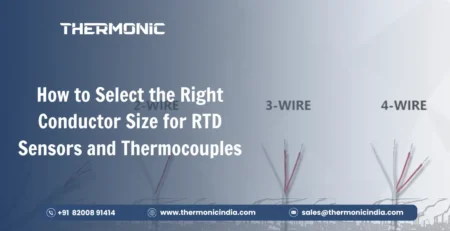
For RTDs, consider 3-wire or 4-wire configurations when higher accuracy is required. These configurations can reduce the effect of lead resistance.
For thermocouples, always use the appropriate extension or compensating wire for the thermocouple type. A Type K thermocouple, for example, requires suitable Type K extension wiring.
For long-distance installations or electrically noisy industrial environments, consider using 4–20 mA temperature transmitters or digital sensing solutions.
Signal cables should also be routed away from VFDs, motors, contactors, and high-current power cables wherever practical.
Mistake 6: Forgetting Response Time and Thermal Mass
Temperature sensor selection often focuses on temperature range and accuracy while ignoring response time.
This can create problems in processes where temperature changes rapidly.
A sensor with a thick sheath or large thermal mass may take longer to respond to process changes. While the sensor may technically be accurate, the delayed measurement can affect process control.
What goes wrong?
Slow response can result in:
- Temperature overshoot
- Undershoot
- Delayed control action
- Poor process stability
- Apparent measurement errors
In many cases, what appears to be inaccurate sensing is actually a response-time problem.
How to avoid it
Evaluate:
- Required response time
- Sheath diameter
- Tip design
- Immersion length
- Process flow
- Mounting arrangement
- Thermal mass
For fast-changing applications, smaller-diameter probes, exposed or semi-exposed junctions, or appropriately designed fast-response sensors may provide better performance.
Your temperature sensing solutions provider should understand both the static and dynamic requirements of your process.
Mistake 7: Skipping Calibration, Documentation, and Long-Term Drift Planning
Temperature sensors are sometimes treated as “install and forget” components. However, sensors can experience gradual drift due to aging, thermal cycling, contamination, mechanical stress, and harsh operating conditions.
Without periodic verification, these changes may go unnoticed.
What goes wrong?
Unnoticed sensor drift can lead to:
- Product quality problems
- Process inefficiency
- Safety risks
- Incorrect control decisions
- Failed audits
- Loss of measurement traceability
How to avoid it
Create a maintenance strategy that defines:
- Calibration intervals
- Acceptable drift limits
- Replacement criteria
- Calibration documentation
- Sensor identification and tracking
- Verification procedures
Critical applications should use appropriate calibration certificates and traceability documentation. Periodic verification against a known reference can also help identify gradual measurement changes.
Reliable temperature sensors suppliers should be able to provide appropriate documentation and support for critical industrial applications.
Also Read : How Industrial Automation Depends on High-Accuracy Temperature Sensors
How to Select Temperature Sensors the Right Way: Quick Checklist
Before purchasing or specifying a temperature sensor, review these key points:
1. Define Process Requirements
Determine:
- Normal temperature range
- Minimum and maximum temperatures
- Peak temperatures
- Accuracy requirements
- Required response time
2. Assess the Environment
Evaluate:
- Process media
- Corrosion
- Pressure
- Vibration
- Shock
- Humidity
- Washdown conditions
3. Choose the Correct Sensor Type
Compare thermocouples, RTDs, and thermistors according to:
- Temperature range
- Accuracy
- Response time
- Stability
- Application environment
- Budget
4. Specify the Construction
Select the appropriate:
- Sheath material
- Probe diameter
- Probe length
- Mounting style
- Thread or connection
- Protection tube or thermowell
5. Plan Wiring and Signal Transmission
Determine whether you need:
- 2-wire, 3-wire, or 4-wire RTD
- Correct thermocouple extension wire
- Local transmitter
- 4–20 mA output
- Shielded signal cables
6. Set a Maintenance Strategy
Establish:
- Calibration intervals
- Documentation requirements
- Drift limits
- Replacement schedules
- Performance monitoring procedures
Taking these steps before ordering can significantly reduce sensor failures, inaccurate readings, unnecessary replacements, and unexpected maintenance costs.

Ready to Avoid These Temperature Sensor Mistakes? Let’s Find the Right Solution
Choosing the right temperature sensor is not simply about selecting a probe with the correct temperature range. The sensor must match the process, environment, accuracy requirements, response time, wiring system, and long-term maintenance strategy.
The seven mistakes discussed in this article, from choosing a sensor based on habit to ignoring calibration and environmental compatibility, can affect accuracy, reliability, safety, and operating costs.
Industries should regularly audit their existing temperature sensors and verify whether the selected sensors still meet actual process requirements.
If you need help selecting the right sensor for your application, work with an experienced temperature sensors company that can provide application-specific recommendations, customized designs, and complete sensing support.
For industries looking for reliable temperature sensors suppliers in India, Thermonic provides application-focused temperature measurement and temperature sensing solutions for industrial processes and equipment.
Need help selecting the right temperature sensor? Contact our team for a sensor audit or consultation and find a solution designed around your actual process requirements.