Choosing the Right Probe for Extreme Heat
Summarize this blog post with:


Selecting the right probe for these environments requires careful high-temperature probe selection, balancing factors like maximum range, material compatibility, response speed, and accuracy. In such applications thermocouples and RTDs are the most common sensors. Thermocouples can withstand very high temperatures (some types up to ~2300–2500 °C) but trade off a bit of accuracy. RTDs (usually platinum PT100s) offer high precision (often ±0.1 °C) but are generally limited to a few hundred °C. In practice this means thermocouples dominate in furnaces and kilns (extreme range, fast response) while RTDs serve well where precision in moderate heat is needed. Always match the probe’s temperature rating and construction to the specific furnace or reactor chemistry and conditions.
Understanding Probe Types: Thermocouples vs. RTDs
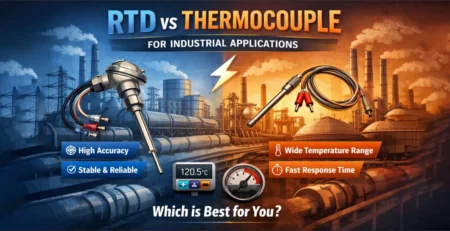
Engineers often start by comparing thermocouples and RTDs when selecting industrial temperature sensors. Key differences include:
Thermocouples:
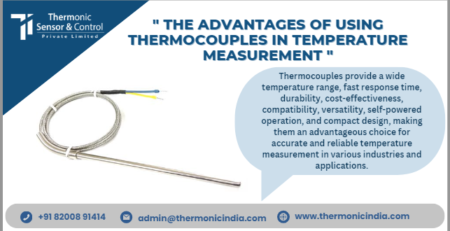
Wide temperature measurement range (common thermocouple sensor types cover about –200 °C to +1250 °C, and high-temperature thermocouples up to ~2300 °C). Extremely rugged temperature probes with fast response time (a grounded or exposed-junction thermocouple reacts quickly to temperature changes). They are self-powered temperature sensors (generate millivoltage output) and cost-effective. Accuracy is moderate—typically around ±1 °C or 0.75% for base-metal thermocouples.
RTDs (Platinum Resistance Sensors):
Very high temperature measurement accuracy and sensor stability (many PT100 RTD probes are ±0.1 °C or better) with excellent long-term performance. However, standard industrial RTD sensors are only rated up to ~600–650 °C (with high-temperature RTDs up to ~1000 °C). RTDs require an excitation current and generally have slower thermal response due to a larger sensing element. They also cost more than thermocouples for the same temperature range.
Other temperature sensing technologies (like thermistors or infrared pyrometers) exist but are less common in high-temperature industrial furnaces and kilns. In most extreme heat industrial applications, thermocouples and RTDs provide the required temperature range, durability, and reliability.
Sheath Materials and Protective Features
A probe’s sheath material must withstand the environment. Common options include:
- Stainless Steel (e.g. 304/316/310): Widely used for corrosive or general services. Austenitic grades (316L, 304L) work up to about 900 °C; 310SS can handle ~1150 °C. Good all-around corrosion resistance at high heat.
- High-Nickel Alloys (Inconel, Incoloy): Ideal for very high temperatures and corrosive gases. For example, Inconel 600 is rated to ~1175 °C, with excellent strength and oxidation resistance. Inconel 601 pushes that to ~1260 °C intermittently.
- Ceramic or Quartz: For extreme cases above metal limits, ceramic tubes (alumina, silicon carbide) or quartz sleeves are used. For instance, ceramic-sheathed K-type thermocouples can survive ~1300–1370 °C in kilns and furnaces. Quartz is used for even higher (and often transparent) probes.
- Protective Features: Many probes include multi-layer “dual sheaths” or purge fittings. Purging with inert gas can prevent oxidation at the tip. Cooling jackets or air-cooling can extend probe life in furnaces. Choose a design (grounded vs. ungrounded tip, mineral-insulated cable, etc.) based on how quickly you need readings versus durability. Grounded sheaths give fastest response (thermocouple welded to sheath), but ungrounded/insulated tips isolate electrical noise.
Many sensors also come with robust terminal heads and calibration options. For example, The Thermonic Sensor and Control Pvt. Ltd. offers high-quality thermocouples and RTDs with various sheath alloys and protection options suited for furnaces and reactors.
Key Factors for High-Temperature Probe Selection
When choosing a probe, consider these application-specific factors:
- Temperature Range: Ensure the probe exceeds the maximum process temperature. (Thermocouples span from ~–270 °C to 2300 °C; RTDs cover roughly –200 °C to 660 °C) Matching range means selecting the correct type (e.g. a Type K or N thermocouple for 1000 °C+).
- Response Time: A thin, grounded thermocouple reacts very fast (on the order of milliseconds). RTDs (and thicker sheaths) have slower thermal mass and might take seconds. Fast control loops demand quick response.
- Accuracy & Stability: RTDs generally have better absolute accuracy (±0.1 °C) and repeatability. Thermocouples drift more over time and need more frequent calibration. If precision is critical (e.g. in heat-treatment ovens), favor RTDs or noble-metal TCs (Type S/R/B).
- Environment: Corrosive or abrasive atmospheres call for inert sheaths (e.g. Inconel or ceramic). High vibration/shock favors rugged thermocouples. If there is EM interference, an ungrounded or insulated probe is better. Consider also how the probe is mounted – flange adapters, compression fittings or threaded connections must seal the process.
- Other Practicalities: Probe length, diameter, and installation (immersion depth, angle) affect performance. Longer probes have slower response. Thinner probes heat up faster but may not last. Many industrial probes use 1/8″–1/4″ OD stems for fast dynamics.
Practical Checklist:
- Match the sensor type (TC or RTD) to accuracy vs. range needs.
- Pick a sheath material rated above your max temperature and compatible with process chemicals.
- Check tips and insulation (grounded vs ungrounded) for noise and speed.
- Include any needed protective features (purge, cooling tube, thermowell).
- Ensure the probe supplier (e.g. Thermonic Sensor and Control Pvt. Ltd.) provides quality builds and documentation for calibration.
Thermonic Sensor Solutions: For example, The Thermonic Sensor and Control Pvt. Ltd. manufactures thermocouples and RTDs built for furnaces, kilns, reactors and other severe environments. Their probes feature durable sheath alloys (stainless, Inconel, ceramic) and fast-response designs, ensuring reliable readings in extreme heat. Choosing a proven vendor helps ensure your high-temperature probe selection meets both performance and longevity goals.