Troubleshooting Common Issues with K-Type Thermocouple Reading
Introduction
K-type thermocouples are widely used for industrial temperature measurement because they offer a broad operating range and practical construction. A NIST-published review notes that the global temperature-sensor market was valued at $6.3 billion in 2017 and was projected to exceed $9 billion by 2026, highlighting the importance of temperature measurement across modern applications. For industries looking for reliable K type thermocouple manufacturers in India, understanding common reading problems is essential for maintaining accurate process control.
A K-type thermocouple can sometimes show inaccurate, fluctuating, unusually high or low, or no temperature readings. These problems may result from incorrect wiring, poor installation, electrical interference, sensor damage, or controller configuration. This guide explains common K-type thermocouple reading issues and practical troubleshooting steps.
What Is a K-Type Thermocouple?
A K-type thermocouple is a temperature sensor made from two different nickel-based alloys. When the two metals are joined at the sensing junction and exposed to a temperature difference, they generate a small electrical voltage that can be measured and converted into a temperature reading.
K-type thermocouples are commonly used because they provide a wide temperature measurement range and are suitable for many industrial applications. NIST lists the reference-function range for Type K thermocouples as approximately -270°C to 1372°C, although the practical operating limit depends on construction, wire size, sheath material, environment, and application.
Common applications include:
- Plastic processing machinery
- Furnaces and ovens
- Chemical processing equipment
- Industrial heating systems
- Manufacturing machinery
- HVAC equipment
- Process temperature monitoring
- Power and energy applications
How Does a K-Type Thermocouple Work?
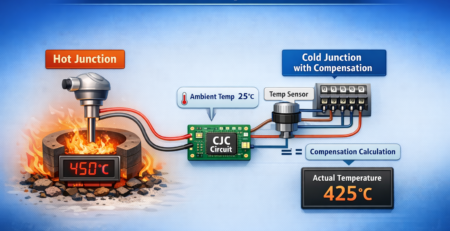
A K-type thermocouple produces a small thermoelectric voltage based on the temperature difference between its measuring junction and reference junction. The connected temperature controller or measuring instrument interprets this voltage and displays the corresponding temperature.
Because the generated signal is small, correct wiring, suitable cables, proper installation, and appropriate electrical practices are important. Even a good-quality sensor can provide an unreliable reading if it is incorrectly connected or installed.
This is why K-type thermocouple troubleshooting should consider the complete measurement system rather than only the sensor.

What Causes K-Type Thermocouple Reading Problems?
Several factors can cause a K-type thermocouple to produce an incorrect or unstable reading.
The most common causes include:
- Incorrect polarity
- Loose electrical connections
- Damaged thermocouple wires
- Incorrect controller configuration
- Wrong thermocouple type selected
- Poor sensor positioning
- Electrical interference
- Moisture or contamination
- Excessive mechanical stress
- Sensor ageing or degradation
- Incorrect extension cable
- Open circuit in the thermocouple
Before replacing the sensor, it is useful to check the complete installation systematically.
Common K-Type Thermocouple Problems and How to Fix Them
1. K-Type Thermocouple Shows an Incorrect Temperature
An incorrect temperature reading is one of the most common K-type thermocouple problems.
The displayed temperature may be consistently higher or lower than the actual process temperature. This does not always mean that the thermocouple itself has failed.
Possible causes include:
- Incorrect positive and negative connections
- Wrong thermocouple type selected in the controller
- Incorrect sensor position
- Damaged sensing junction
- Incorrect extension wire
- Poor electrical connections
- Measurement system calibration issues
How to Troubleshoot It
Start by checking whether the controller is configured for a K-type thermocouple. Next, inspect the polarity and terminal connections.
Also check whether the sensing junction is positioned correctly within the process. If the sensor is not measuring the actual process temperature, the displayed value may not represent the temperature you expect.
Where appropriate, compare the reading with a suitable reference measurement to determine whether the problem is with the sensor, installation, or measurement system.
2. K-Type Thermocouple Reading Keeps Fluctuating
A fluctuating temperature reading can make process control difficult. If the actual process temperature is relatively stable but the displayed value changes continuously, inspect the electrical and mechanical installation.
Common causes include:
- Loose terminals
- Damaged cable insulation
- Intermittent connections
- Electrical interference
- Poor grounding or shielding
- Mechanical vibration
- Damaged thermocouple junction
How to Troubleshoot Fluctuating Readings
First, inspect all terminals and connectors. Make sure the connections are secure and free from visible damage.
Then inspect the thermocouple cable for cuts, crushing, heat damage, or worn insulation.
Electrical interference can also affect thermocouple measurements because the generated signal is very small. Check whether thermocouple wiring is routed close to high-power electrical equipment, motors, drives, or other potential sources of interference.
Also Read : What Is a Bayonet Thermocouple and How Does It Work?
3. K-Type Thermocouple Gives No Reading
If the temperature controller shows no temperature value or indicates a sensor fault, an open circuit should be considered.
Possible causes include:
- Broken thermocouple wire
- Damaged cable
- Loose terminal
- Faulty connector
- Damaged sensing junction
- Open circuit inside the sensor
- Fault in the controller input
How to Check for an Open Circuit
Inspect the complete wiring path from the thermocouple to the measuring instrument. Check the terminals and connectors first.
A suitable electrical test can help determine whether the thermocouple circuit is continuous. However, continuity alone does not confirm that the sensor is producing an accurate temperature measurement.
If the circuit is open and the wiring and connections are confirmed to be intact, the thermocouple may need replacement.
4. K-Type Thermocouple Reading Is Too High or Too Low
A reading that is consistently too high or too low can result from installation or configuration problems.
Check:
- Thermocouple type
- Polarity
- Controller configuration
- Sensor position
- Sensor insertion depth
- Process conditions
- Cable and extension wire
- Sensor condition
The sensor should be positioned so that its measuring junction represents the temperature you actually need to measure. Poor positioning can cause the sensor to measure a different temperature from the surrounding process.
5. K-Type Thermocouple Reading Is Slow to Respond
A K-type thermocouple may appear slow when the sensor construction or installation does not match the application.
Response can be influenced by:
- Probe diameter
- Sheath construction
- Sensor mounting
- Contact with the measurement point
- Process conditions
- Sensor location
A thinner sensor may respond differently from a heavier protective construction. Therefore, thermocouple selection should consider both temperature range and response requirements.
How to Test a K-Type Thermocouple
When troubleshooting a suspected sensor problem, follow a systematic inspection process.
Step 1: Perform a Visual Inspection
Look for:
- Damaged sheath
- Burn marks
- Cracked insulation
- Broken wires
- Corrosion
- Loose terminals
- Damaged connectors
Physical damage can indicate that the sensor has been exposed to conditions beyond its suitable application.
Step 2: Check the Wiring
Verify that:
- The sensor is actually a K-type thermocouple
- Positive and negative connections are correct
- Terminals are secure
- The extension cable is suitable
- Connectors are properly installed
Do not assume that a replacement sensor will automatically work correctly without checking its specifications and connections.
Step 3: Check Continuity
An appropriate electrical test can help identify an open circuit.
If the circuit is open, inspect the wiring and connections first. If those are intact, the thermocouple element itself may be damaged.
Step 4: Compare the Temperature Reading
Where practical, compare the thermocouple reading with a suitable reference measurement.
This can help determine whether the problem is related to:
- Sensor accuracy
- Controller configuration
- Installation
- Wiring
- Actual process temperature variation
K-Type Thermocouple Wiring and Polarity: What to Check
Correct polarity is important when installing a K-type thermocouple.
Check the positive and negative conductors against the applicable thermocouple identification standard and the sensor manufacturer’s documentation.
Also verify:
- Controller terminals
- Connector orientation
- Extension cable type
- Junction connections
- Wiring continuity
What Happens If a K-Type Thermocouple Is Wired Incorrectly?
Incorrect wiring can result in an incorrect temperature indication. Therefore, if a reading suddenly changes after installation or sensor replacement, check the wiring and polarity before assuming that the new thermocouple is defective.
How Environmental Factors Affect K-Type Thermocouple Readings
The environment around the sensor can influence measurement performance.
Electrical Interference
Industrial environments may contain motors, drives, switching equipment, and other electrical sources that can interfere with low-level thermocouple signals.
Keep sensor wiring appropriately routed and follow the installation practices recommended for the measuring system.
Vibration and Mechanical Stress
Continuous vibration can loosen connections or damage cables and sensor assemblies.
Inspect thermocouples installed on vibrating machinery periodically, particularly when readings become intermittent.
High-Temperature Exposure
Thermocouple performance can change when the sensor is exposed to unsuitable temperatures or harsh environments for extended periods.
NIST notes that thermocouples operating at higher temperatures can undergo chemical and physical changes that may lead to loss of calibration.
Moisture and Contamination
Moisture, chemicals, and process contamination can affect insulation, connections, and sensor construction depending on the application.
For this reason, sheath material and sensor construction should be selected according to the process environment.
When Should You Replace a K-Type Thermocouple?
A K-type thermocouple may require replacement when:
- The circuit remains open after wiring checks
- The sensor has visible physical damage
- Readings remain inaccurate after installation checks
- The output becomes consistently unstable
- The sensor has experienced unsuitable operating conditions
- Comparison with a suitable reference indicates unacceptable performance
- The sensor no longer meets the requirements of the application
Do not replace a thermocouple immediately just because a reading is incorrect. First check wiring, controller configuration, installation, and the surrounding measurement system.
K-Type Thermocouple Troubleshooting Checklist
Use this checklist when investigating a temperature reading problem:
- Check that the sensor is a K-type thermocouple
- Verify positive and negative connections
- Inspect the thermocouple for physical damage
- Check all terminals and connectors
- Check for an open circuit
- Verify controller configuration
- Inspect sensor positioning
- Check the extension cable
- Look for electrical interference
- Compare the reading with a suitable reference
- Check the process temperature and installation conditions
- Replace the sensor if testing confirms failure
A systematic approach can help prevent unnecessary sensor replacement and reduce temperature measurement problems.
How to Choose the Right K-Type Thermocouple
If repeated troubleshooting identifies sensor selection as the problem, review the original specification.
Important factors include:
- Required temperature range
- Sheath material
- Probe diameter
- Probe length
- Junction type
- Mounting arrangement
- Cable insulation
- Connector type
- Process environment
- Response requirements
The right thermocouple depends on the application. A sensor designed for one process may not provide the same performance in another environment.
For industrial applications, working with experienced K type thermocouple manufacturers in India can help you specify the appropriate sensor construction for your operating conditions.
Also Read : How to Select the Right Thermocouple for a High-Temperature Furnace?
Frequently Asked Questions About K-Type Thermocouple Readings
Why is my K-type thermocouple giving the wrong reading?
Incorrect readings can result from wiring errors, incorrect controller configuration, poor sensor positioning, damaged components, unsuitable extension cables, or changes in sensor performance. Check the complete measurement system before replacing the sensor.
Why does my K-type thermocouple reading fluctuate?
Fluctuating readings can be caused by loose connections, damaged cables, electrical interference, vibration, grounding issues, or an unstable process. Inspect the wiring and installation before assuming the sensor has failed.
How do I test whether a K-type thermocouple is working?
Start with a visual inspection and wiring check. An appropriate continuity test can identify an open circuit, while comparison with a suitable reference can help assess measurement performance.
How do I check K-type thermocouple polarity?
Check the positive and negative conductors against the thermocouple manufacturer’s documentation and the applicable identification standard. Also verify that the controller and connector terminals are correctly matched.
What causes a thermocouple to give no reading?
A broken wire, open circuit, loose connection, damaged connector, faulty sensing element, or measurement instrument issue can cause a K-type thermocouple to give no reading.
Can a damaged thermocouple cause inaccurate temperature readings?
Yes. Physical damage, degradation, contamination, or unsuitable operating conditions can affect thermocouple performance and may result in inaccurate or unstable readings.

Facing K-Type Thermocouple Issues? We’re Here to Help
Troubleshooting common K-type thermocouple reading issues starts with checking the complete measurement system. Wiring, polarity, controller configuration, sensor position, electrical interference, physical damage, and environmental conditions can all affect temperature readings.
Before replacing a sensor, identify the actual cause of the problem through systematic inspection and testing. When a replacement is required, selecting the correct construction and specifications for the application is equally important.
If you are looking for an experienced K type thermocouple manufacturer, Thermonic India can help with industrial temperature sensing requirements, including application-specific thermocouple solutions for different process conditions.