Temperature monitoring is a critical aspect of modern healthcare, ensuring the safety and well-being of patients and the effectiveness of medical procedures.
Among the various temperature sensing technologies available, thermocouples have emerged as a preferred choice for temperature monitoring in medical devices due to their accuracy, reliability, and versatility.
Thermocouples are temperature sensors that work based on the Seebeck effect, generating a voltage proportional to the temperature difference between two dissimilar metals in the sensor.
This voltage is then converted into temperature readings, providing real-time and precise data for medical applications.
One of the primary reasons thermocouples are extensively used in medical devices is their wide temperature range.
From monitoring the body temperature of patients to measuring the temperature of surgical tools and equipment, thermocouples can operate across a broad spectrum of temperatures with high sensitivity and response speed.
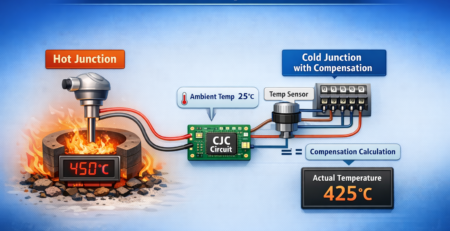
In Cold Junction Compensation (CJC) becomes a strategic enabler rather than just a technical feature.
In modern industrial environments, accurate... read more
In the landscape of modern industrial automation, precision is the currency of competitiveness. Proportional–Integral–Derivative (PID) controllers are the backbone... read more
In today’s competitive manufacturing landscape, precise temperature monitoring is essential to maintain product quality, process stability, and operational efficiency.... read more
In industries where performance and precision define success, reliable temperature measurement isn’t just important — it’s mission-critical. From the... read more
Introduction
In today’s highly competitive textile industry, temperature control is no longer optional—it’s mission-critical. From fiber processing and dyeing to... read more
In today’s competitive manufacturing landscape, process stability is no longer just an operational concern—it’s a strategic priority. Frequent fluctuations,... read more













Leave a Reply